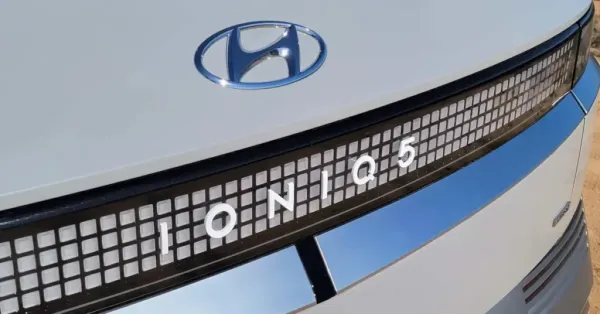
Hyundai and Kia have filed a patent for an unusual system that places small wind turbines inside a vehicle’s front bumper.
The concept uses air flowing through the front of a moving vehicle to turn turbines and generate electricity. Adjustable shutters would control the amount and direction of air passing through the system.
The generated power could support electrical systems or return a limited amount of energy to the vehicle’s battery.
It sounds like an electric car that could recharge itself while driving, but the physics is less spectacular. The turbines cannot create free energy. Any electricity produced from air pushed through the bumper will also create aerodynamic resistance.
The patent shows air entering through openings in the front bumper and being directed towards turbine assemblies.
The airflow turns turbine blades connected to generators. The resulting electrical energy can then be supplied to the vehicle.
Electronically controlled shutters can open, close or change position according to driving conditions. This could allow the car to balance electricity generation against cooling requirements and aerodynamic drag.
The system may be more useful when the vehicle is already facing strong natural wind, travelling downhill or slowing down, rather than during steady cruising when additional drag would increase energy consumption.
The patent documentation reportedly allows the turbines to be used in different types of vehicles, including electric, hybrid and combustion-powered models.
However, Hyundai and Kia have not announced plans to install the system on a production car.
Electric and hybrid vehicles already recover energy through regenerative braking. When the driver slows down, the motor operates as a generator and converts part of the vehicle’s motion back into electricity.
A bumper turbine would recover energy from airflow instead.
The difficulty is that a moving car must use energy to push through the air. Extracting more energy from that airflow generally increases resistance. The vehicle’s motor may then have to consume additional electricity or fuel to maintain speed.
For this reason, a turbine powered entirely by air created through the vehicle’s own forward motion cannot produce more energy than it costs. Mechanical losses, electrical losses and extra drag make a net gain during normal cruising unlikely unless the system captures airflow that would otherwise be wasted or takes advantage of external wind.
The shutters could reduce this penalty by closing when electricity generation is inefficient.
Automakers routinely patent ideas that never reach showrooms.
A patent protects the design and prevents rivals from copying it. It does not confirm that Hyundai or Kia has completed testing, achieved a useful energy gain or approved the system for commercial production.
The technology would also add turbines, generators, ducts, shutters, wiring and control systems to an area of the vehicle exposed to water, dust, stones and minor collisions.
That creates questions about weight, noise, durability, repair cost and pedestrian-impact safety. Any electricity generated would need to justify those disadvantages.
The concept could still have specialised applications. Small turbines might supply power to sensors, low-voltage systems or auxiliary equipment without being presented as a major range-extending device.
Hyundai and Kia’s idea is inventive, but it should not be described as a self-charging breakthrough. It is an energy-recovery concept whose usefulness will depend on whether the electricity produced exceeds the penalties created by added drag, weight, cost and complexity.
Until the companies demonstrate a working prototype and publish test results, the bumper-mounted wind turbines remain an interesting patent rather than an upcoming production feature.
-
Mirabai wins hat-trick of gold at CWG, Rishikanta secures silver

-
Vaibhav's game awareness has skyrocketed in last six months: Laxman

-
Eddie Howe breaks silence on Bruno Guimaraes' transfer links with Arsenal as Newcastle boss faces 'another challenging summer'

-
PM Modi Congratulates Mirabai Chanu After India's First Gold Medal At Commonwealth Games 2026 In Weightlifting
-
Tej Pratap Yadav Jailed For Supporting Bihar Bandh Over NEET Paper Leak; Tejashwi Alleges Political Vendetta