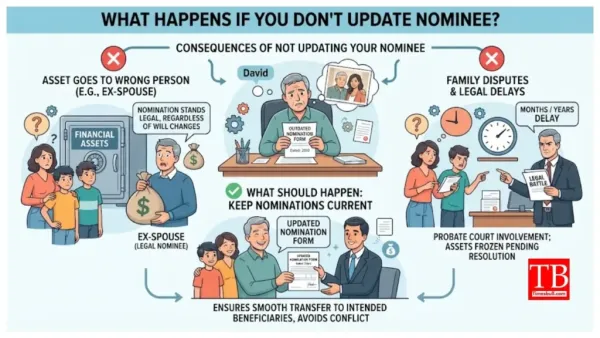
Nominee Update: Nowadays, everyone invests to secure their family’s future. If you have investments in bank accounts, fixed deposits, RD schemes, PPF, NPS, or insurance policies, simply making the investment is not enough; it is equally important to ensure that the correct, updated nominee details are recorded. Many people designate a nominee at the time of investment but forget to update the details following life events such as marriage, divorce, the birth of a child, or the death of a family member.
Experts emphasize the importance of keeping nominee information updated periodically. If the nominee has passed away, their details have changed, or they are no longer your intended beneficiary, retaining the old nomination can cause complications for your family in the future. Such situations can lead to delays in accessing the investment funds after your demise and create difficulties in the legal process.
What is a nominee?
A nominee is an individual designated by an investor for assets such as bank accounts, insurance policies, mutual funds, stock market holdings, PPF, and other investments. This ensures that, upon the investor’s death, the institution can first hand over the funds or investment proceeds to that specific person. It is important to note that, in many cases, the nominee is not the ultimate legal owner but rather the person authorized to receive the funds; ultimate ownership rights may be determined by a will.
Why is it important to update the nominee?
The primary objective of updating nominee details is to ensure that your accumulated capital, investments, and financial assets reach your family after your death without unnecessary disputes or delays. Outdated or incorrect nominee information can prolong the settlement process. Financial institutions often request additional documentation in such cases, causing financial and mental distress to the family.
What happens if the nominee passes away? If the person you appointed as a nominee passes away, that nomination effectively ceases to exist. In such a scenario, if you do not register a new nominee and subsequently pass away yourself, the investment proceeds cannot be handed over directly to any specific individual. Legal heirs would then be required to complete additional legal formalities and provide proof of their rights to claim the assets. Therefore, if your nominee has passed away, it is crucial to promptly register a new nominee.
Is it necessary to change the nominee even if a will exists?
Many people believe that once a will has been drafted, there is no need to update the nominee. This assumption is not entirely correct. Even if a will exists, banks, insurance companies, mutual fund houses, and other financial institutions typically release the funds to the nominee recorded in their official files first. Subsequently, if the will designates a different person as the beneficiary, the final distribution of assets is carried out in accordance with the will. Thus, if your will has been revised or your family circumstances have changed, it is essential to update the nominee details accordingly.
Does changing the nominee in one place automatically update it across all investments?
It is a common misconception that changing the nominee for a bank account automatically updates it for all other investments. In reality, nomination details are specific to each financial product; if you hold investments with different institutions, you must update the nominee details with each of them individually.
When can the nominee be changed?
Experts recommend changing the nominee in specific situations—such as getting married, getting divorced, the birth of a child, the death of the existing nominee, a change in the family’s succession status, a desire to designate a different beneficiary, or errors in the existing nominee’s details.
What happens if there is no nominee?
If no nominee is registered for an investment and the investor passes away, the process of claiming the funds can be quite difficult. In such a scenario, legal heirs may be required to submit various documents—such as a Succession Certificate, Legal Heir Certificate, No Objection Certificate (NOC), proof of identity and address, and the death certificate. Delays in obtaining these or other necessary legal documents can prolong the claim settlement process.
What documents are required if there is no nominee?
It is worth noting that if a nominee is already registered, the process becomes much simpler. However, the concerned institution may still request certain documents, such as the nominee’s proof of identity (eg, Aadhaar or another valid ID), the investor’s death certificate, a claim form, and bank account details; Documents to legal heirs may also be requested if necessary.
What are the benefits of having a valid nominee?
Having correct nominee details offers several advantages. The claims process is completed more quickly, sparing the family the hassle of making repeated visits to offices. The likelihood of legal disputes is reduced, and the investment amount is received on time. There is less need for additional documentation, and the verification process becomes easier for financial institutions, ensuring the family receives timely financial support.
Conclusion
It is worth noting that while investing is important, designating the right nominee is equally crucial. Nominee details should be updated promptly in situations such as the nominee’s death, changes in family circumstances, or the creation of a new will. Taking this simple step can save your family from unnecessary legal hassles, cumbersome documentation processes, and delays in claim settlement in the future.
-
Mirabai strikes gold again; Rishikanta, Muthupandi win a silver each as weightlifters shine

-
FIFA President Gianni Infantino travelled almost three times the Earth's circumference during the World Cup

-
Sink Cleaning Tips: Got a sticky and dirty kitchen sink? Get a new glow with these homemade products under Rs.5

-
Beauty Mistakes: These 10 daily habits can take away the glow of your face, change them in time.

-
The biggest change is coming to Facebook! TikTok feature will be available