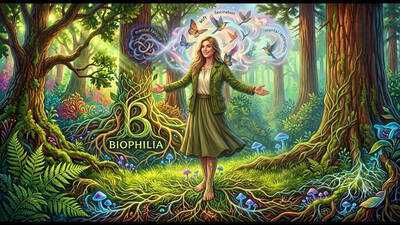
There is a reason a child can spend twenty minutes watching an ant carry a crumb across the pavement while the adult standing beside them barely notices the tree overhead. Children have not yet forgotten something that many of us have.
It has a complicated scientific name—
biophilia —but the idea itself is beautifully simple. Coined by biologist Edward O. Wilson, biophilia describes our innate tendency to seek connections with nature and other living things. In other words, humans are wired to love the natural world. We don't merely enjoy it; we need it to thrive.
The irony is that while children seem born knowing this, adults spend much of their lives unlearning it.
A five-year-old doesn't see nature as a destination that requires planning. They don't think of parks as a wellness intervention or forests as a digital detox. To them, a puddle is an adventure. A butterfly is a miracle. A stick is a sword, a wand, or a fishing rod depending on the hour. They kneel to inspect mushrooms, rescue worms after rain, and proudly carry home oddly shaped stones as if they've discovered treasure. Wonder comes naturally.
Somewhere between homework, deadlines, traffic, mortgages and endless notifications, many of us lose that instinct. We stop noticing the changing colours of the sky because we're looking down at our phones. We rush past flowering trees without knowing their names. Plants become decorative accessories rather than living companions. Birds become background noise. Rain becomes an inconvenience. In the process, we disconnect from something our brains still crave.
Scientists now have decades of research explaining what children instinctively understand. Spending time around trees, gardens and green spaces lowers cortisol, the body's primary stress hormone. Even a short walk through a park has been shown to reduce mental fatigue and improve attention. Hospital patients with windows overlooking greenery often recover faster than those staring at brick walls. Researchers are also discovering that microbes found naturally in healthy soil interact with our immune system and may even influence mood by encouraging the release of serotonin, often called the brain's "feel-good" chemical.
Nature isn't simply pleasant scenery. It is medicine hidden in plain sight. This matters because our lives have changed dramatically, but our biology hasn't. Most people today spend close to 90 per cent of their time indoors – in offices, homes, shopping malls, gyms and cars. Our eyes move constantly between screens. Artificial light replaces daylight. Air conditioning replaces breezes. Birdsong competes unsuccessfully with notification alerts.
We have built remarkably efficient cities, but in many ways we have also built ourselves into concrete cages. The World Health Organization (WHO) has repeatedly identified stress, anxiety and depression as growing public health concerns across the globe. While nature is certainly not a cure-all, it remains one of the simplest, cheapest and most overlooked ways to support emotional wellbeing.
Perhaps the greatest lesson children can teach us is not just to spend time outdoors but to experience it differently.
Children touch everything.
They run their fingers across tree bark because it feels rough. They collect fallen leaves because each one is different. They splash through puddles without worrying about muddy shoes. They smell flowers before asking what they're called. They watch clouds until dragons and castles appear in the sky.
Adults, by contrast, often experience nature intellectually rather than physically. We photograph sunsets instead of watching them. We identify flowers using an app instead of simply admiring them. We walk through parks while answering emails. We treat nature as another item to consume rather than a relationship to nurture.
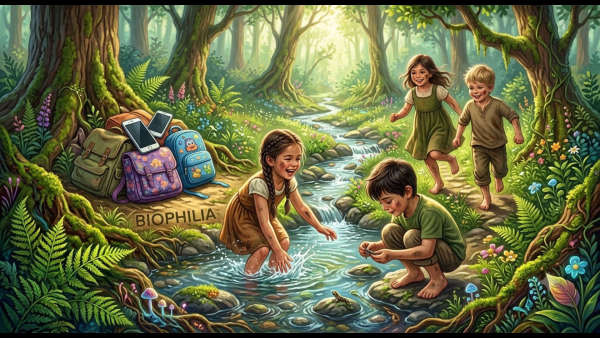
Biophilia asks us to reverse that habit. It asks us to remember that we are not separate from nature. We are part of it. Thinking like a five-year-old doesn't require quitting your job and moving to a cabin in the mountains. It begins with paying attention again.
Touch the bark of the tree you pass every morning. Walk barefoot on grass whenever you can and notice how different it feels from concrete. Watch the clouds for five uninterrupted minutes. Grow herbs on your kitchen windowsill and notice the scent released when you brush against basil or mint. Leave your headphones behind during one evening walk and listen instead to birds, wind and distant rain.
None of these actions changes the world overnight. But they change your relationship with it.
Perhaps that is why biophilia feels so urgent today. We often think our biggest challenge is reconnecting with nature, when in reality it may be reconnecting with ourselves. Nature does not ask us to become experts. It asks us to become curious again.
The child within us already knows how to do this. We simply need to remember.
-
Tourism ministry, IndiGo join hands to promote India as global tourism destination

-
India''s wait for maiden CWG shot put medal continues as Toor, Samardeep miss podium

-
Strong anti-paper leak bill passed, won't spare mafia playing with future of children: PM

-
16 Indian nationals have lost their lives since conflict began in Middle East this year: Govt

-
NSUI workers climb atop water tank in Jaipur, denounce police action at Jantar Mantar