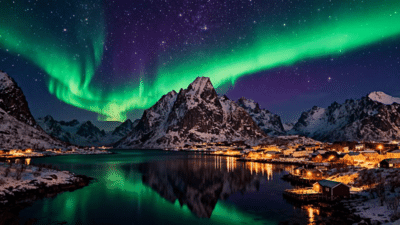
New Delhi: At first glance, it feels like someone got the labels wrong. Greenland, one of the coldest and iciest places on Earth, is wrapped beneath a colossal blanket of ice. Iceland, meanwhile, surprises visitors with rolling green valleys, moss-covered lava fields, waterfalls and thriving grasslands during summer.
The contrast has puzzled generations, fuelled countless memes and inspired one of geography’s most enduring myths – that the two countries deliberately swapped names to trick settlers.
The truth, however, is far more interesting.
Why Greenland is mostly ice, and Iceland is surprisingly greenAround 80 per cent of Greenland is covered by the Greenland Ice Sheet, the second-largest body of ice on Earth after Antarctica. In several places, the ice is more than 3 kilometres (around 2 miles) thick, making it one of the planet’s largest freshwater reserves.
Iceland paints a very different picture.
Although glaciers still cover roughly 11 per cent of Iceland’s land area, the island enjoys relatively mild coastal conditions because of the North Atlantic Current, an extension of the Gulf Stream. Summers transform much of the country into lush green landscapes, giving Iceland its iconic emerald appearance despite its volcanic reputation.
So why is Greenland called GreenlandThe answer begins more than a thousand years ago.
According to the Icelandic sagas, Erik the Red, a Norse explorer who had been exiled from Iceland, reached Greenland around AD 982. After discovering habitable fjords and relatively green coastal areas in the southwest, he chose a name that would make the harsh new land sound more inviting.
The Saga of Erik the Red famously states that he called it “Greenland” because people would be more attracted to settle there if the land had a favourable name. Historians widely interpret this as an early example of strategic branding rather than deception.
It wasn’t entirely misleading either.
During the Medieval Warm Period (roughly AD 800–1300), southern Greenland experienced warmer conditions than today, allowing Viking settlers to raise livestock and establish farming communities along its ice-free coasts. Those settlements later disappeared as the climate cooled during the Little Ice Age.
Why Iceland got its icy nameUnlike Greenland, Iceland’s name was not chosen to scare people away.
Historical accounts attribute the name to the Viking explorer Hrafna-Flóki Vilgerðarson, commonly known as Flóki. After enduring a difficult winter, he climbed a mountain and saw a fjord filled with drifting sea ice. The sight inspired him to name the island Ísland, or Iceland.
By the time Greenland was discovered and named, Iceland had already been known as Iceland for decades.
This is why historians reject the popular myth that the names were intentionally swapped. Greenland’s name was promotional, but Iceland wasn’t renamed in response.
Ironically, Greenland is becoming greener todayIn a twist that history couldn’t have predicted, Greenland is slowly living up to its name.
Scientists have observed expanding vegetation across parts of Greenland over recent decades as rising temperatures melt sections of its ice sheet. Satellite observations show increasing areas of shrubs, wetlands and tundra replacing previously ice-covered terrain.
While that might sound positive, researchers warn it is actually another visible sign of accelerating climate change. The melting ice contributes to global sea-level rise and alters Arctic ecosystems, making Greenland’s growing greenery less a symbol of renewal than of environmental concern.
What appears to be a geographical mistake is actually a remarkable story of exploration, history and human psychology. Iceland earned its name from drifting sea ice spotted by early Norse explorers. Greenland received its name because a Viking leader understood that people are more likely to move somewhere that sounds inviting.
More than a millennium later, that marketing strategy is still working.
-
Has your gas booking DAC code been deleted? Here's how to recover it
-
Ram Charan Recovers from Successful Hand Surgery After Injury on Set

-
The Traitors Season 2 Set to Premiere on August 13 with Exciting New Contestants

-
Murali Sreeshankar and Sajan Prakash Shine at Glasgow Commonwealth Games

-
Gurindervir Singh's Disappointing Exit and India's High Jump Hopes at Commonwealth Games 2026