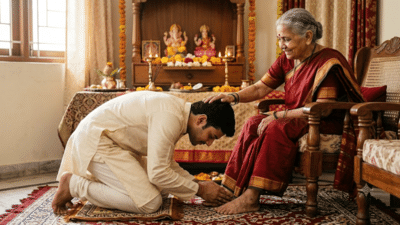
New Delhi: Every Indian has seen it countless times. A child bends before grandparents before an exam. Newlyweds seek blessings by touching the feet of elders. Families reunite after months apart, and the first instinct is often the same – a gentle bow, fingertips brushing the feet of parents or grandparents, followed by hands placed on one’s forehead.
To millions, it is simply “taking blessings.” To others, especially younger generations, it raises an obvious question: Why feet?
The answer stretches back thousands of years into India’s philosophical traditions, family structures and religious texts. Far from being just a social custom, touching the feet of elders, known as Charan Sparsh or Pranam, has historically represented humility, gratitude, the transmission of wisdom and the acknowledgement of lived experience. While some modern explanations claim scientific or energy-based reasons, historians note that the strongest evidence points towards cultural, ethical and spiritual symbolism rather than medically proven physiological effects.
Ancient tradition rooted in Vedic cultureThe practice of bowing before elders predates modern India by centuries and is deeply embedded in Hindu traditions. Ancient Sanskrit literature repeatedly emphasises reverence towards parents, teachers and spiritual guides. Rather than treating respect as merely verbal, Indian civilisation evolved physical gestures that reflected humility.
The Sanskrit words Pranam (to bow with reverence) and Charan Sparsh (touching the feet) became symbolic acts of acknowledging someone considered worthy of respect because of age, wisdom, learning or spiritual stature.
In the traditional guru-shishya (teacher-disciple) system, students often bowed before their gurus before receiving knowledge. Respect was therefore associated not merely with age, but with learning, experience and moral authority.
Why feet? Understanding the symbolismAt first glance, touching someone’s feet may seem unusual. Yet within Indian philosophy, the act is highly symbolic.
Standing at another person’s feet represents setting aside one’s ego. Instead of asserting equality in status, the younger individual voluntarily expresses humility before someone whose life experience is recognised.
The gesture also acknowledges an important cultural belief – that every generation builds upon the sacrifices and wisdom of the one before it.
In many Indian languages, elders are described as having “walked the path” before the younger generation. Touching their feet symbolically honours the journey they have already completed and the lessons they have accumulated along the way.
Role of blessings (Ashirwad)
Perhaps the most familiar part of the ritual comes immediately afterwards.
Once the younger person bows, the elder typically places a hand on their head and offers blessings or ashirwad. Within Hindu tradition, these blessings are believed to carry spiritual significance and represent goodwill, protection and hopes for the younger person’s success.
From a cultural perspective, the exchange also strengthens family bonds. Rather than being a one-sided act of submission, it becomes an interaction in which respect is reciprocated through affection, encouragement and emotional reassurance.
Tradition that extends beyond HinduismAlthough the practice has strong roots in Hindu culture, versions of the gesture are also found among several Indian communities across religious and regional lines.
In many Sikh, Jain and some Buddhist families, respectful bows or gestures towards elders continue to be observed, though practices vary according to religious teachings and family traditions. In several parts of South Asia, similar customs survive as expressions of familial respect rather than strictly religious obligations.
This illustrates how the ritual gradually became part of India’s broader cultural fabric, transcending theology in many households.
What is science behind touching the feet Negative and positive energyAccording to reports, there are negative and positive currents in the human body. The body’s left side reportedly carries negative current while the right side carries positive energy. By touching the feet of another person, the two bodies are connected and it creates a complete circuit of positive and negative energy.
The receptor and giver of energyThe nerves from the brain are present throughout the body. Some of them end at the toes of the feet and the fingertips of our hands. As per reports, when we touch our fingertips to the feet of an elderly person, it connects the energies of the two bodies. Fingers and palms receive energy and feet of the elderly person gives energy.
Blood circulationWhen we bow down and touch the feet of elders, it increases blood circulation to upper body parts which improves skin and hair health. Also, the Charan Sparsh acts as an exercise for our feet, waist and upper body as we bend and touch the feet of elders.
Whether practised every day or only on special occasions, Charan Sparsh continues to remind generations that respect in Indian culture is not merely spoken – it is often expressed through action.
-
Has your gas booking DAC code been deleted? Here's how to recover it

-
Ram Charan Recovers from Successful Hand Surgery After Injury on Set
-
The Traitors Season 2 Set to Premiere on August 13 with Exciting New Contestants

-
Murali Sreeshankar and Sajan Prakash Shine at Glasgow Commonwealth Games
-
Gurindervir Singh's Disappointing Exit and India's High Jump Hopes at Commonwealth Games 2026