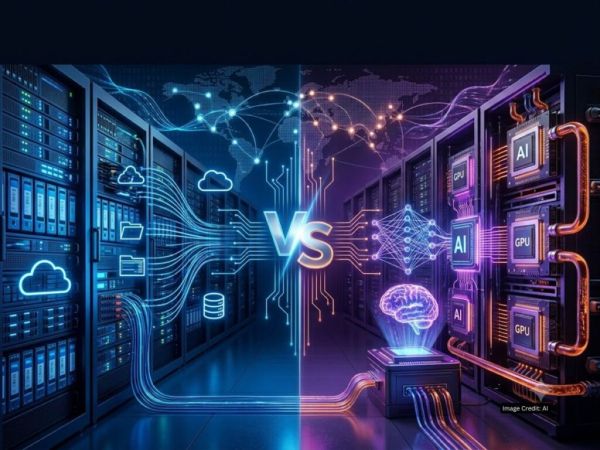
Every time you back up a photo to Google Photos, stream a show on Netflix, or ask a chatbot to draft an email, you’re leaning on a piece of infrastructure most people never think about which is a data centre. But not all data centres do the same job anymore. As artificial intelligence has exploded into everyday use, a distinct category of facility has emerged alongside the traditional cloud storage centre, and the two are now being built, powered and priced in very different ways.
What Is A Cloud Storage Data Centre?
A cloud storage data centre is, at its simplest, a warehouse full of servers that stores and delivers data over the internet. When you upload a document, save a photo, or use an app that needs to “remember” something, that information doesn’t sit inside your phone and it travels to one of these facilities, gets written onto racks of hard drives and solid-state storage, and is handed back to you the moment you ask for it.
Three things anchor a facility like this: how much it can store, how much general computing it can do, and how well-connected it is to the outside world. The processors inside aren’t chasing anything mathematically demanding as they’re just keeping websites up, apps running, inboxes syncing, and databases ticking over. The bigger design philosophy is redundancy: nobody wants a single failed drive to wipe out a customer’s files, so copies of your data usually sit on more than one server, often in more than one city entirely. This is the business Amazon Web Services, Microsoft Azure and Google Cloud have built empires on renting out storage and computing power to companies that would rather not deal with racks of their own servers.
What Makes an AI Data Centre Different?
An AI data centre is built for a completely different kind of workload. Instead of relying primarily on storage drives, these facilities are packed with dense clusters of Graphics Processing Units (GPUs) and, increasingly, Tensor Processing Units (TPUs), chips designed specifically to perform the kind of massive, parallel mathematical calculations that machine learning models need in order to learn and respond.
Three things separate an AI data centre from a conventional one. First, the chips themselves: GPUs and TPUs are engineered for parallel processing, not the sequential tasks a standard server CPU handles well. Second, the networking: AI workloads need extremely low latency and high bandwidth between thousands of accelerators working in tandem, which is why AI facilities lean on specialised interconnects rather than standard enterprise networking gear. Third, and perhaps most visibly, the power and cooling demands are far higher as training and running large AI models generates enormous heat, pushing many operators toward liquid cooling systems that traditional storage-focused centres rarely need.
Put simply: a cloud data centre is built to hold and serve information efficiently. An AI data centre is built to think or at least to run the calculations that simulate thinking at enormous scale and speed.
How Do They Actually Work?
Functionally, both types of facility follow the same broad principle: they take a request from a user, process it, and send a response back, all within a fraction of a second. In a cloud storage centre, that request might be “fetch this file” as a relatively light task handled by storage drives and general processors. In an AI data centre, the same instant response might involve a request being routed to a cluster of GPUs that run a model with billions of parameters, perform the calculations needed to generate an answer, and send that answer back as a process that consumes vastly more energy and computing power per request.
Increasingly, the line between the two is blurring. Major cloud providers now build AI-optimised zones within their existing data centre regions, while dedicated AI facilities are beginning to offer cloud-like, on-demand access to their compute capacity. Many organisations today run a hybrid model storing everyday data in conventional cloud centres while routing AI-specific workloads to specialised facilities elsewhere.
Why Are Data Centres Becoming So Important?
The short answer is that the world is generating and depending on more data than ever, and AI has multiplied that dependence overnight. Every AI chatbot query, image generation request or automated business tool sits on top of physical infrastructure that has to be built, powered and cooled and that build-out is happening at a scale rarely seen in the technology industry.
Global hyperscalers are now spending hundreds of billions of dollars a year expanding data centre capacity, with new AI-specific campuses coming up in major hubs across the United States, Europe and Asia. This isn’t just an infrastructure story as it has real economic and environmental consequences, from the strain AI facilities place on local power grids to growing debates around water use for cooling systems. At the same time, businesses and governments are increasingly concerned about where their data physically lives, pushing many countries toward stricter data-sovereignty rules that determine which type of centre-cloud or AI, domestic or global-is allowed to handle which kind of information.
The post What Is a Cloud Storage Data Centre? How It Differs From an AI Data Centre: Explained appeared first on NewsX.
-
Hyderabadi Sutriyan and 6 other Indian pastas perfect for monsoon

-
Either he ordered it or is incompetent: Rahul calls for Shah’s resignation

-
Amit Shah skips Parliament, hails youth over anti-paper leak bill

-
What went wrong between Raghav Juyal and Lakshya?

-
Rejected By IIT-Kanpur, Student Hacks Website; Institute Offers Fresh Chance