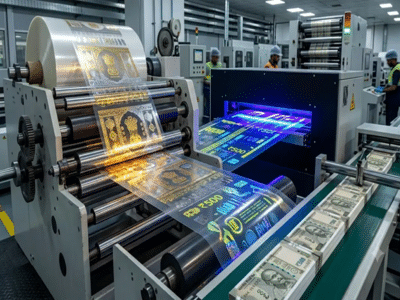
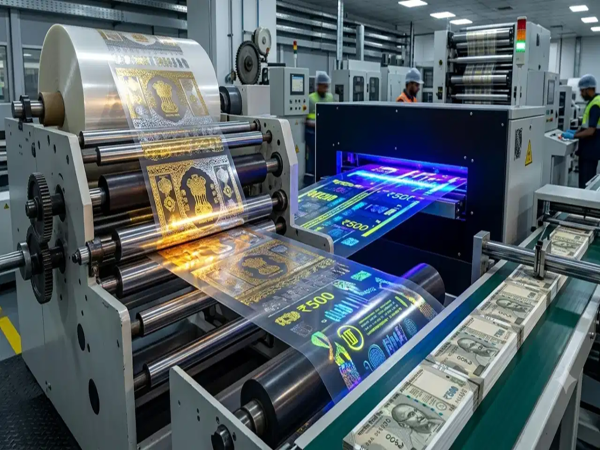
The Government of India and the Reserve Bank of India have approved a trial for plastic notes in denominations of ₹10 and ₹20. This has sparked curiosity about how these plastic—or polymer—notes are actually manufactured. What technology goes into them, and how do they differ from paper notes? Let’s understand the entire process of making plastic notes in simple terms.
**The Journey of Plastic Notes Began in Australia**
Plastic notes were invented by David Solomon. Work on this project began in 1988 at the request of the Reserve Bank of Australia and took nearly 20 years to complete. Australia issued its first polymer note—a 10-Australian-dollar note—in 1988. By 1996, it had become the first country to transition its entire currency to polymer notes. Later, in 2016, the Bank of England also adopted this technology with the introduction of the £5 polymer note featuring Sir Winston Churchill.
**BOPP Technology and Security Features Make Them Unique**
Plastic notes are based on a transparent plastic material known as BOPP (Biaxially Oriented Polypropylene). Since this material lacks fibers or pores, it does not absorb water, dirt, or sweat. A section of the note is left transparent, making it nearly impossible to replicate using scanners or printers. Additionally, technologies such as diffraction gratings and optically variable devices are employed; these cause the note's colors and patterns to appear to change when viewed from different angles.
**From BOPP Sheets to UV Treatment: How the Note Is Made**
According to reports, the process begins with the preparation of the transparent polymer sheet (BOPP). The note's design and images are printed on both sides of the sheet. Subsequently, the sheet is sent to a foiling machine, where foil tapes containing security features are applied. After printing is complete, the banknote undergoes UV treatment and is coated with a protective layer to ensure the ink remains intact for a long time. Finally, the large sheets are cut using a guillotine cutter to produce individual banknotes. The finished notes also undergo various tests to ensure they function correctly in ATMs and cash-counting machines.
Why Polymer Notes Are Considered Superior to Paper Notes
Standard banknotes are made from long cotton comber and linter fibers, utilizing the 'windowed thread' technology developed by the British company Portals to incorporate a security thread. In contrast, polymer notes are considered much more durable, with a lifespan approximately 2.5 times longer than that of paper notes. They are completely waterproof—remaining undamaged by water—resistant to tearing, and suitable for long-term use. This is why many countries around the world have adopted them.
Disclaimer: This content has been sourced and edited from TV9. While we have made modifications for clarity and presentation, the original content belongs to its respective authors and website. We do not claim ownership of the content.
-
Is Prashant Kishor’s stake weakened in Bankipur? Voting figures raised questions. Prashant Kishor Bankipur By Election 2026 Voting Percentage Jan Suraaj Bihar News

-
Nalgonda: Medical shop raided, 113 MTP kits seized for illegal sale

-
Will removing dandruff keep the scalp healthy? Make herbal shampoo at home with red bitter ginger. Bitter Ginger Shampoo Benefits And How To Make At Home

-
Green Bangles with Kangan: From bridal to office look, these bangles will look perfect with green bangles. Latest Kangan Designs With Green Bangles For Sawan

-
Palakkad: Mystery Deepens as Hundreds of Fish Die Suddenly in Vaniyamkulam Pond!