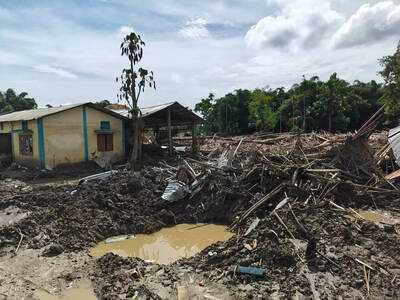
In Nepali Khuti, destruction stretches as far as the eye can see. (Photo)
Nepali Khuti, July 30: Upon entering Nepali Khuti, visitors are immediately struck by a foul odor that permeates the air, intensifying with each step.
Local residents attribute this unpleasant smell to the decomposing bodies of livestock, including cattle, goats, and poultry, which litter the streets and fields after the Dikhow River inundated the village on July 19.
"The smell is unbearable, coming from the carcasses of our animals that are decaying everywhere; our cattle, chickens, goats..." a local woman remarks, covering her nose with her anchal while gesturing towards what used to be her neighborhood.
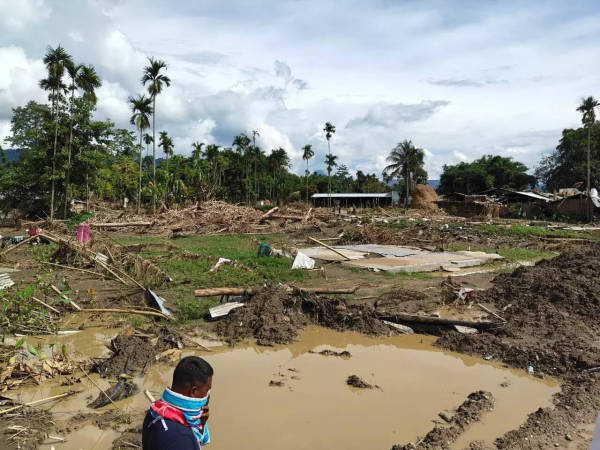
Beyond the odor, the village presents a scene of utter devastation. Homes made of concrete and mud have crumbled into piles of debris.
(Photo)
Furniture is buried beneath thick layers of silt, while motorcycles, bicycles, and cars are overturned in yards and fields, tossed there by the floodwaters. Children's toys, swept away, now lie half-buried in mud, silent reminders of lives abruptly disrupted.
Outside homes that have lost their walls, schoolchildren are spreading waterlogged textbooks in the sun, hoping to salvage at least a few pages.
Clothes, bedding, cupboards, and cooking gas cylinders are scattered across muddy fields, left behind wherever the floodwaters finally receded.

(Photo)
As of Thursday, aside from a solitary concrete structure and the remnants of a few collapsed buildings, almost everything has been destroyed. "Eku nabasile; sob gol ge (Nothing is left; everything is gone)," laments one survivor, gazing at the ruins of his former home.
Abandoned to the Flood
For many residents, the disaster unfolded in unforgettable hours. Survivors recount that the rising waters of the Dikhow had indicated danger long before the village was submerged.
Gopal Sharma recalls that the river began to swell on the morning of July 19. "By around 9–9:30 am, floodwaters started entering the village. The water level rose rapidly in no time," he explains.
(Photo)
Realizing the imminent danger, Sharma and his family climbed onto their roof. However, around 11:30 am, a powerful surge swept them away. "The wave was terrifying," he recalls.
"The floodwaters reached over 12 feet and destroyed our house. I was carried away by the current. Everyone thought I had perished, but I managed to cling to a tree until the next day. My family spent the entire night stranded like that. Nothing was left. Everything was gone," he recounts.
The torrent carried massive logs and debris downstream. Along with the roof of their house, Sharma and his family somehow found refuge on the roof of another home.
Residents claim that help was absent when they needed it most. They remember repeatedly contacting the district administration, pleading for rescue as floodwaters engulfed their village.
View this post on InstagramA post shared by The Assam Tribune (@theassamtribune_official)
"Initially, our calls were answered once or twice. We were told that a rescue boat would be dispatched. But no one arrived until evening. Eventually, they stopped responding to our calls altogether," one survivor claims.
With no official rescue in sight, families remained stranded, primarily on rooftops, until they were eventually rescued by a local boatman.
Picking Up the Pieces
For some, the losses are irreparable. Navajyoti Duwara shares that he lost his younger sister and grandmother in the flood. He asserts that despite numerous requests for help, no rescue personnel showed up.
"My family survived for three days on rainwater and floodwater before any assistance reached them," he states.
Some local residents also claim that over 200 individuals from Nepali Khuti are still unaccounted for following the flood. However, this figure has not been officially confirmed by the authorities.

(Photo)
Since Wednesday, residents have gradually begun returning to the village. One by one, they walk back to the homes they spent years constructing, only to find them reduced to rubble and mud.
Some sift through debris in search of important documents. Others collect utensils, broken furniture, or anything salvageable. Many simply stand in silence, gazing at empty plots where their homes once stood. “Amar kitab bohi bur aase, kintu polox’or tolot (Our books are there, but under heavy layers of silt),” a teenager expresses, hoping to recover a few items.
For the survivors of Nepali Khuti, while the floodwaters may have receded, their struggle is just beginning.
-
IPO-Bound PhonePe Bets On Transaction Data Monetisation With PulsePro

-
Saransh Jain's Journey to Team India: A Testament to Perseverance

-
Ajinkya Rahane Retires: A Tribute to His Legacy in Indian Cricket

-
From Struggles to Stardom: An Actor's Inspiring Journey in the Entertainment Industry

-
Meet the Star-Studded Contestants of 'Traitors' Season 2: Who Will Outwit Whom?