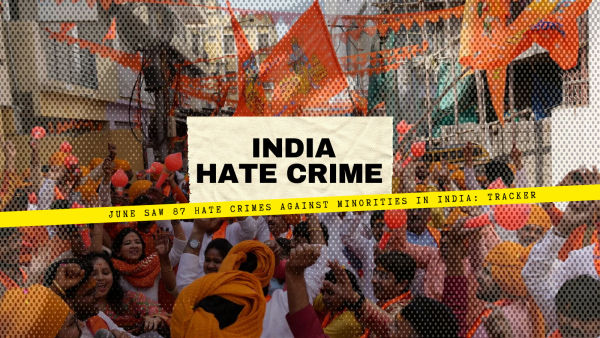
Hyderabad: India logged 87 incidents of hate crime against religious and caste minorities in June, a jump of nearly 15 per cent over the previous month, according to data compiled by Siasat.com.
The attacks ranged from public beatings and mob lynchings to open threats and torture. And it was not only violence. Through the month, several public figures also used harsh, divisive language against minorities.
The count reflects only those cases the platform was able to document and should not be read as a definitive number. A great deal of everyday discrimination and intimidation never makes it into a news report, which means the real scale of what Muslims, Dalits and Christians faced through June is almost certainly larger than the number suggests.

Muslims: From a boat party to boy beaten to death
One case in June showed how differently Muslims are often treated. Five Hindu men held a party on a boat on the Ganga in Varanasi, drinking beer and eating chicken on the river. When 14 Muslim youths had done something similar in March, they were punished. But these five men were let out on bail within 24 hours of their arrest.
The difference angered many people. Activists and rights groups said letting some off easy while punishing others only pushes Muslims further to the margins.
Hateful speech also hit a new high. After clashes between Hindus and Muslims in Dehradun, set off by the murder of a local Bharatiya Janata Party (BJP) leader, some Hindutva leaders went as far as threatening to “rip the children from wombs of Muslim women.”
Leaders in government spoke more carefully, but their message was still pointed. Kiren Rijiju, the Union Minister for Minority Affairs, rejected the idea that Muslims are unsafe in India. “By saying Muslims are not safe in India, you are maligning the character of our nation,” he said. He argued that minorities have full constitutional rights and pointed to the region.
“Hindus, Christians and Sikhs from Pakistan, Afghanistan and Bangladesh… why is India their first choice to seek refuge?” he asked, giving the BJP credit for building an inclusive country.
On the ground, the news was far grimmer. In West Bengal, a month after what the BJP called a historic win in the state only ruled by the Trinamool Congress (TMC), party workers allegedly killed a 71-year-old man, Shah Alam, because he supported and worked for the rival TMC. Minorities in the state were also absorbing structural changes to their daily lives, the most consequential being a sizeable cut to the budget for the minority and madrasa board, the body that funds welfare for minorities and Islamic schools.
With violence rising, the mood in the state grew even more tense.
Bihar saw an even more brutal case. A 12-year-old Muslim boy, Taufiq Khan, was found murdered, with his face smashed with bricks in Sitamarhi district on June 19. His family was left shattered when they found his body in a field, cut with knives and with his head crushed. He is believed to have been killed by at least 10 people.
Bulldozers, by now a fixture of BJP-ruled India, stayed busy too. In Uttar Pradesh, mosques, shrines and other religious buildings were knocked down through the month, with officials alleging that they had been built illegally or on government land. In June alone, Siasat.com counted eight such cases – demolitions, eviction notices, threats to demolish and forced removals – mostly in UP and Rajasthan.
Uttar Pradesh Chief Minister Yogi Adityanath added to the heated words. In his speeches, he warned against “love jihad,” the false, right-wing claim that Muslim men trick Hindu women into marriage to convert them. He said it was part of a bigger plan to change the country’s religious make-up. He also spoke against “land jihad” and said it had to be stopped. India, he said, was no shelter for those with no loyalty to it.
“India’s land cannot be a dharamshala for invaders or for those who have no faith, loyalty or respect for its values and traditions. It absolutely cannot be,” the Adityanath, arguably one of the BJP’s most popular figure, said.
Another right-wing leader from Telangana’s Hyderabad, T Raja Singh, tried to explain away his anti-Muslim remarks. He said he had been talking about Muslims in Pakistan and Saudi Arabia, not in India. “I have targeted the Muslims of Pakistan, I have targeted the Muslims of Saudi Arabia, then why are the people here feeling the pain? Are these people colluding with the terrorists there?” he said.
His not-so-convincing clarification came after he made offensive comments about Muslim women, in which he boasted that “a lot of people who love me and wish to give me their sisters and make me their brother-in-law.” He was booked under Section 196 of the Bharatiya Nyaya Sanhita (BNS), the law that punishes speech meant to spread hatred between communities.
A conversion row also drew national attention. A man named Ayush Malik said he had chosen to become a Muslim on his own and denied being forced to. But his father, Devraj Malik, filed a complaint under Uttar Pradesh’s anti-conversion law. Ayush’s wife and father-in-law were then arrested. The case took another turn when Ayush reconverted to Hinduism, saying he had seen how much pain he had caused his family.
There were many smaller cases too. Hindutva men like Daksh Chaudhary beat up a man over “love jihad.” Bengali-speaking Muslims were branded Bangladeshis and “infiltrators.” Together, they show how common such targeting has become.
Dalits: caste, custody and marriage
At Siasat.com, we recorded about 12 attacks on Dalits in June. Five of them ended in death.
In Andhra Pradesh, a Dalit woman died in police custody, with people demanding an independent inquiry, raising fresh questions about how the police treat those they hold. In Rajasthan, authorities sent in bulldozers and knocked down homes, leaving families with nowhere to go. Residents tried to resist as houses that had stood for years were destroyed under heavy police guard. Videos of the tearful protests went viral.
Caste also decided who people could love and how they were treated.
A couple from Madhya Pradesh ran away to Gujarat to be together. But relatives who opposed the match hunted them down and killed the young woman, in a classic case of hate-fuelled honour killing. In Telangana, a man was booked for repeatedly sexually abusing his Dalit domestic worker, who came forward to describe what she had gone through in his home.
In Uttar Pradesh, a man stabbed his own daughter inside a police station because she had married a Dalit man. The attack happened right in front of officers, raising serious worries about safety even inside a police station.
Much of the violence was meant to humiliate.
In UP, a Dalit man was beaten to death at a gathering after he refused to massage the feet of others there. A Dalit teenager was tortured, with attackers using pliers on him and driving nails into his feet, before he was killed. In Haryana, a Dalit man accused of theft was hung upside down in a well and badly beaten. And in UP again, a 14-year-old Dalit girl was tied to a tree, beaten and abused by a group of villagers.
Christians: fewer cases but same pattern
Attacks on Christians dropped sharply. Siasat.com recorded two cases in June.
In Narayanpur, Chhattisgarh, a tribal family was thrown out of their village for a short time over claims that they had changed their religion. They were allowed back only after they agreed to return to their old faith. The villagers said they had nothing personal against the family. The village council had decided to expel them, they said, because the family had stopped taking part in the village’s traditional tribal worship.
In West Bengal, members of the Vishva Hindu Parishad (VHP) attacked a Christian prayer meeting in Raniganj, in Paschim Bardhaman district. They claimed Hindu women were being forced to convert to Christianity, even as no police came to stop them. The attack left Christians in the state more worried about their safety.
And there was one more case
One case in June stood out because it angered even many Hindus. A mob in Uttar Pradesh forced a Hindu youth to chant “Jai Shri Ram.” “You will chant Jai Shri Ram till you are alive. If you don’t chant it, your hands and legs won’t be spared,” one man is heard saying in a video. The young man was also forced to abuse Muslims in filthy language.
That the target this time was a Hindu was what drew the wider community’s anger.
-
ISRO Apprentice Recruitment 2026: Notification Out For Graduate, Diploma & ITI Posts; Apply Before August 29

-
President Murmu Hosts Bastar Tribal Delegation, Expresses Desire To Attend Bastar Dussehra
-
BJP National Spokesperson Shehzad Poonawalla Quits Party, Updates X Bio
-
John Stones Joins Inter Milan: A New Chapter in His Football Journey

-
Lift Malfunction at Noida Event Causes Panic and Injuries