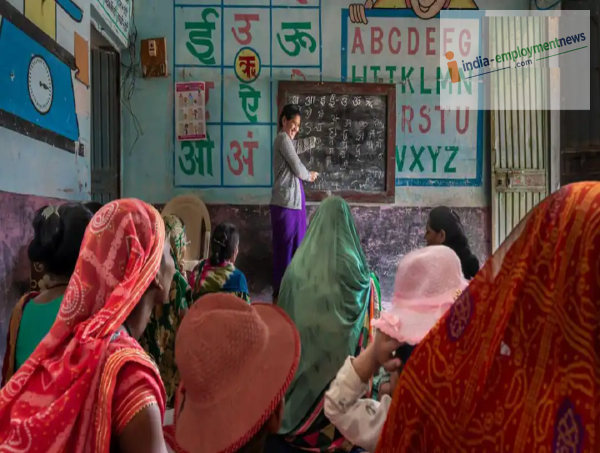
According to the latest data from the Ministry of Education presented in Parliament, there were 100,843 schools across the country in 2025-26—including government-aided and private institutions—that operated with only one teacher.
Despite continuous improvements in the education sector and the expansion of new schools, a large number of schools still rely on a single teacher to conduct all classes. Data presented in Parliament by the Ministry of Education reveals that in 2025-26, a total of 100,843 schools nationwide had only one teacher on staff; this figure encompasses government-aided and private schools. The data indicates that Andhra Pradesh has the highest number of such schools, while a shortage of teachers remains a serious issue in several other states as well.
What the Ministry of Education’s Data Reveals
According to the Ministry of Education, the teacher-student ratio falls within the standards prescribed by the National Education Policy. The ratio stands at 9:19 at the primary level, 17:1 at the upper primary level, 15:1 at the secondary level, and 23:1 at the higher secondary level. However, the Ministry acknowledged that despite meeting national averages, significant imbalances in teacher availability persist across various states and regions.
Andhra Pradesh Has the Highest Number of Such Schools
Data from UDISE+ 2025-26 shows that Andhra Pradesh has the highest number of single-teacher schools, totaling 16,357. This accounts for approximately 16 percent of all such schools in the country. Jharkhand follows with the next highest count, having 9,827 single-teacher schools, while Maharashtra ranks third with 9,269 such schools. Meanwhile, there are 8,042 such single-teacher schools in Karnataka, 7,874 in Uttar Pradesh, 6,159 in Assam, 4,793 in Madhya Pradesh, 3,957 in Tamil Nadu, 2,655 in Uttarakhand, 2,461 in Chhattisgarh, and 2,318 in Telangana, where a single teacher has to shoulder the responsibility for all classes.
Better situation in some states
On the other hand, the number of such schools is quite low in certain states and Union Territories. Only 16 such schools have been recorded in Kerala, 35 in Goa, 31 in Sikkim, 28 in Ladakh, 7 in Delhi, and just one in the Andaman and Nicobar Islands.
Why is the problem growing?
The Ministry of Education informed the Rajya Sabha that the situation regarding single-teacher schools is not solely due to a shortage of teachers. Several other factors contribute to this, including retirements, resignations, fluctuations in student enrollment, the creation of new posts, promotions, transfers, and local administrative requirements. The Ministry also clarified that the responsibility for the recruitment, deployment, and transfer of teachers lies with the respective state governments and Union Territories; therefore, the Central Government does not maintain a separate record of state-wise vacancies.
Directives issued to states
The Central Government has advised states and Union Territories to address the teacher shortage by employing transparent recruitment processes, merit-based appointments, technology-enabled teaching methods, and financial assistance. Additionally, special emphasis has been placed on ensuring the availability of teachers in remote tribal areas and ‘aspirational districts’.
-
Cyclospora symptoms explained as UKHSA issues alert to travellers
-
Cyclospora symptoms explained as UKHSA issues alert to travellers
-
Karonda Benefits: Karonda is a rainy season superfood, offering 7 major benefits from immunity to digestion.

-
Facebook takes major action against fake profiles and AI accounts, this is how you can get a free Verified Badge

-
Senators Negotiate With SEC and Big Ten Over College Sports Bill