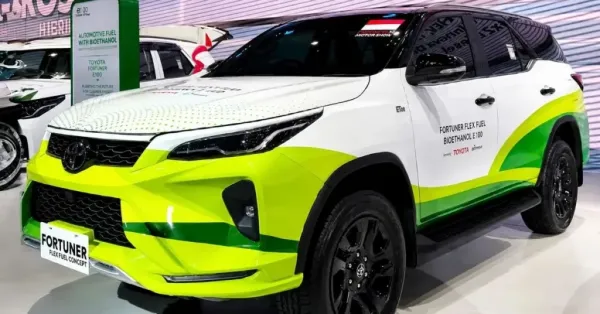
We have often heard Union Ministers talk about automakers like Toyota working on flex-fuel vehicles. Maruti Suzuki has already launched its first flex-fuel vehicle in India. Now, Toyota has showcased a 100 percent bioethanol-compatible Toyota Fortuner SUV at the 2026 Indonesia Motor Show.
Toyota had showcased a similar Fortuner-based concept a couple of years ago. Apart from the E100 Fortuner, the company also displayed a B50 biodiesel version of the Fortuner at the expo. Both concepts are currently technology demonstrators and are neither in development nor in production.
The Fortuner E100 flex-fuel concept showcased at the expo is based on the current-generation model. The SUV looks largely unchanged on the outside. However, Toyota has made significant changes under the bonnet to make the vehicle E100-compatible.
As part of the conversion, Toyota has reworked components such as the fuel lines, hoses, cylinder head, and several other engine- parts. These modifications allow the SUV to run on fuels containing anywhere between 5 percent and 100 percent ethanol. The engine itself remains unchanged. It continues to use the same 2.7-litre naturally aspirated petrol engine that produces 161 bhp and 243 Nm of torque, with power sent to the rear wheels.
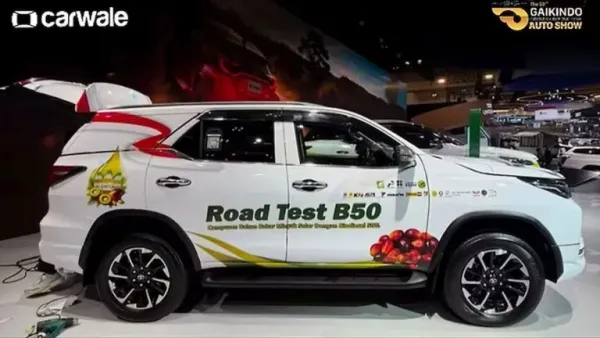
The B50 biodiesel version of the Fortuner uses a 2.8-litre turbocharged diesel engine and is available in both rear-wheel-drive and four-wheel-drive configurations. While Toyota has not revealed the exact mechanical changes, the company has modified several components to ensure compatibility with B50 biodiesel. The engine produces 201 bhp and 500 Nm of peak torque and is paired with a 48V mild-hybrid system.
For those unfamiliar with the terminology, biodiesel is different from isobutanol. Biodiesel is a fatty acid methyl ester produced from vegetable oils, animal fats, or recycled cooking oil. Isobutanol, on the other hand, is a four-carbon alcohol that is typically produced by fermenting biomass or processed ethanol.
As mentioned earlier, both SUVs showcased at the motor show are concept vehicles. Toyota is still evaluating these technologies, which is likely why the company has not announced any production plans. However, given the increasing focus on alternative fuels, it would not be surprising if Toyota eventually considers introducing one of these technologies in the Indian market.
Ethanol-blended fuel and its impact on older vehicles have become major topics of discussion across automotive forums. The government has acknowledged that higher ethanol blends can result in lower fuel efficiency and may affect certain rubber and plastic components over prolonged use, although the extent of the impact depends on the vehicle’s compatibility and design.
Toyota recently launched the new-generation Hilux in the Indian market at a starting price of Rs 32 lakh (ex-showroom). While the company has showcased the flex-fuel Fortuner in Indonesia, there is no confirmation on whether it is coming to the Indian market anytime soon. The market is currently not ready for E100 flex fuel vehicles as they are expensive when compared to regular versions and the higher blends of ethanol is not widely available across India.
-
Carabao Cup draw creates fixture headache for Chelsea and Fulham in West London

-
GIMS Staff Nurse Recruitment 2026: Registration for Staff Nurse posts has started; check full details here, including eligibility and fees.

-
Railway ICF Apprentice 2026: Recruitment announced for 1,010 apprentice posts at Railway ICF; here is the stipend amount..

-
Income Tax Department begins recruitment for Canteen Attendants in MP-CG; matriculates can apply..

-
SBI Clerk 2026 Vacancy: Applications open for 9,124 SBI Junior Associate posts; check state-wise vacancy details..