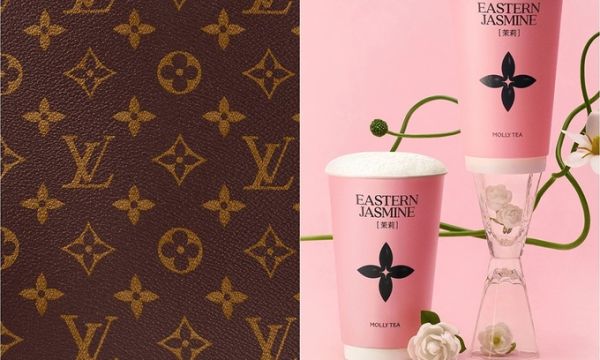
A court in Suzhou in Jiangsu province in late June ruled that Shenzhen-based Molly Tea had infringed on seven of LV’s registered four-petal floral trademarks and ordered the chain to pay 10.3 million yuan (US$1.5 million) in damages and legal expenses. Molly Tea’s founder had told local media that the company would appeal the decision.
Although the ruling was consistent with Chinese trademark and intellectual property laws, it has left people in the country unhappy and sparked a heated debate.
The controversy initially focused on whether Molly Tea’s logo was actually similar to LV’s trademarks and why the French luxury house had taken legal action against a company operating in an entirely different industry.
It then evolved into questions over where courts should draw the line between safeguarding intellectual property and monopolizing elements of shared cultural heritage.
Many compared the four-petal floral trademarks to the baoxiang floral designs on Tang dynasty pipa instruments, decorative window patterns in Suzhou’s classical gardens and even ventilation grilles and floor tiles found in older public toilets.
Critics argued that LV’s monogram dates back only about 130 years while the four-petal flower motif had existed in China for more than a millennium, according to Think China.
The case also reignited public anger over what many Chinese netizens view as a long history of cultural appropriation by global luxury brands.
Wins lawsuits, faces PR issue
Despite losing in court, Molly Tea has seemingly won over the public. The chain’s official account on social media Weibo gained 250,000 followers in the 30 days after news of the case broke, according to data from the platform.
News of the ruling amassed 400 million views on the same platform while the hashtag “Molly Tea lost the lawsuit but won the public’s heart” drew more than 30 million views.
The chain gained even more support earlier this month after it donated one million yuan to Hengzhou in the Guangxi Zhuang Autonomous Region, which had been hit by a typhoon. It was the first in the milk tea industry to launch a relief initiative for the disaster-stricken area.
“I am so touched. They are in the rain, yet still take the initiative to hold an umbrella for others,” one netizen commented, as quoted by the South China Morning Post.
A number of consumers also posted on social media that they were buying Molly Tea drinks as a way of supporting the brand.
Some industry players have said the lawsuit could ultimately work in the company’s favor.
“More people know Molly Tea today because Louis Vuitton sued it,” a tea-industry executive told Caixin, adding that the chain might see limited impacts on sales even if it had to abandon the disputed logo.
|
Louis Vuitton’s monogram on one of its bags (left) and Molly Tea’s logo on its drinks. Photos from the companies’ websites |
Meanwhile, LV has been actively enforcing its trademark rights in China. It had 151 opposition cases filed with China’s intellectual property regulator against numerous four-leaf or four-petal designs as of July 16, Caixin reported, citing data from Dai Jiapeng, a partner at BZW Law Firm in Beijing.
Its lawsuits have gained more public attention in recent weeks, including one against a small daily necessities store in Ningbo over alleged intellectual property infringement and another against the China National Intellectual Property Administration over a trademark administrative dispute.
Over the last five years, the luxury brand has filed nearly 1,700 trademark lawsuits in China, including 56 cases in the first half of this year alone.
While some netizens have defended LV, including in the Molly Tea suit, others have accused it of monopolizing ancient Chinese motifs and bullying smaller businesses, according to the Global Times.
A hashtag called “no queues at multiple LV stores” began trending on Sina Weibo earlier this month amid the controversy.
Some local media outlets reported that LV boutiques in several cities, including Shanghai, have seen a noticeable drop in foot traffic in the weeks after the ruling.
A number of Louis Vuitton’s popular handbags have also seen prices decline in the resale market.
The Carryall Small, which retails for 23,000 yuan, was listed for around 19,000 yuan in brand-new condition on resale platform Dewu in mid-July. The same bag in 9.5/10 condition was priced at about 12,000 yuan on ZZER, another luxury marketplace. A Neverfull Small in good condition was selling for just over 4,200 yuan on Dewu, less than a third of its 14,400 yuan retail price.
Spring Chang, founding partner of IP law firm Chang Tsi and Partners, said recent controversies reveal gaps in legal application and communication, though they are unlikely to affect China’s trademark laws.
Large brands filing lawsuits against small companies is not new, but the speed and scale at which such disputes spread through today’s media landscape have changed, she said.
“If public opinion swings entirely to the view that any enforcement by a big company is bullying, that will weaken the basis for legitimate enforcement and confidence in the system over time,” she told The Straits Times.
She noted that small and mid-sized Chinese firms are also increasingly suing large firms, including foreign ones.
“Put together, this looks less like the strong bullying the weak and more like a general rise in how seriously people take and use intellectual property rights,” she said.
-
Manchester Airport colleagues discover they are long-lost brother and sister

-
Manchester Airport colleagues discover they are long-lost brother and sister

-
Sajal Aly’s edgy photoshoot sparks debate
-
Inside Ravi Kishan’s Rs 20 Crore Mumbai Home With A Terrace Garden, Gym And Pooja Room
-
Saudi-led group completes $55bn purchase of gaming giant EA