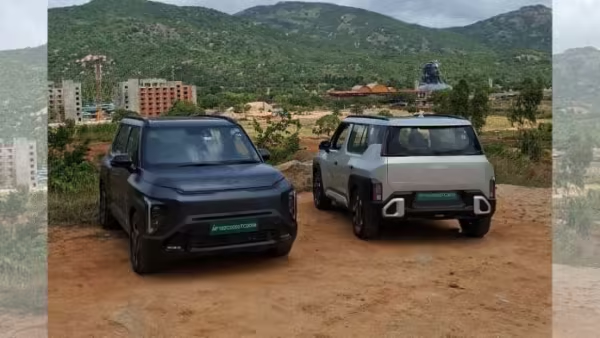
There are a few reasons for this. Two primary ones simply being that it was a bit expensive when compared to its competition and did not offer the cheaper naturally-aspirated petrol engine option, unlike its sibling, the Sonet. The Sonet continues to have 10 to 12 times the monthly sales of the Syros. And in all this, the quirky design did not help as well.
A born electric?
Maybe the Kia Syros was always meant to be an electric vehicle. Clearly, the success of the MG Windsor and the Mahindra XEV 9e and BE 6 have proven that electric vehicle buyers are willing to experiment with designs. And this past week in Bengaluru, I found myself driving the Syros EV. And to cut a long story very short, this is a vehicle that I could happily recommend to my wife, given that she is considering an electric vehicle as an urban runabout.
Of course, the standard caveats for any electric vehicle purchase in India still apply, the biggest one being the ability to charge at home or office. I have a home charging setup and it does feel really good to be able to ‘tank up’ a vehicle at home, and I am well aware of the issues that some electric vehicle owners face in apartment complexes across the country.
However, as for charging on long-distance drives on highways, the overall charging infrastructure in India has improved dramatically over the past year. I recently drove down to Jaipur from Delhi on the Delhi-Vadodara Expressway and noticed that there were not only several electric vehicles along the way, but also quite a few charging stations. Likewise, most major hotels in Jaipur also had electric vehicle charging facilities.
Interestingly though, while the Syros electric has the same underpinnings as the electric versions of the Kia Carens Clavis and Hyundai Creta — same battery pack and motor options — by virtue of being a bit smaller, it has a certified range of 526 km. It’s more than enough for a drive from Delhi to Jaipur, Chandigarh or Dehradun. And while real-world range would possibly be around 450 km, it’s still more than enough for most drives.
In December last year, I had taken the Kia Carens Clavis electric between Delhi and Chandigarh, and despite some high-speed driving, it wasn’t too much of a headache to charge the vehicle. Kia has made it easier by introducing a new smartphone application called K-Charge that now incorporates over 23,000 charging stations (and growing) as well as an in-built payment system.
All very good, but how is the vehicle to drive? Quite good, actually. The internal-combustion engine version did have a slightly harsh ride quality, but the heavy battery pack between the axles softens it a bit. This is still not a vehicle you would want to throw into corners, but that is not its raison d’etre. It is a comfortable and easy vehicle to drive, both on rural roads, including some twisty sections, and highways.
Where Kia stands out
The 170-PS motor that comes with the larger 51.4 kilowatt-hour battery pack does deliver a punch, so overtaking on the highways is easy. And because the top X-Line variant also has Level 2 Advanced Driver Assistance Systems (ADAS), you can comfortably set the vehicle on adaptive cruise control with lane-keep assist and let it do some of the heavy lifting on the better expressways. In the city, the Syros also gets a fully-automatic single-pedal driving option, which is super convenient. Although, this being India, you should always have your own in-built radar (your senses) scanning the roads for idiots.
Where I think Kia India really shines, however, is the exceptional build quality of their vehicles and some of the features they offer. It seems weird to wax eloquently on the quality of plastics and fabrics on a car, but Kia really stands out here. The overall quality of the plastics, the 30-inch triple-display, and the steering wheel are stupendous. The rear seats are excellent too, as Kia offers a slide-and-recline function along with seat ventilation at the rear on higher variants. All this while not compromising on luggage space, thanks to the quirky, boxy shape of the Syros. And you also get a small ‘frunk’ under the hood and a tonne of storage space inside, including below the central console as the Syros, like the Carens Clavis and Creta electrics, also gets a steering-mounted shifter.
The prices start at Rs 13.49 lakh and go up to Rs 19.99 lakh for the top X-Line variant that I drove. These are comfortably within the road tax and registration benefits that some states like Haryana offer electric vehicles. This might seem a bit expensive compared to the competition, but there is a catch. A very good one.
Kia India is offering a three-year buyback guarantee of 80 per cent for the buyers until 1 October 2026. After that, buyers still get an impressive 70 per cent assured buyback. And while this will come with strict terms and conditions, it’s still impressive, since it deals with a major issue faced by EV buyers, which is the highly depreciating value of their asset. Buyback values are also offered for longer tenures as well.