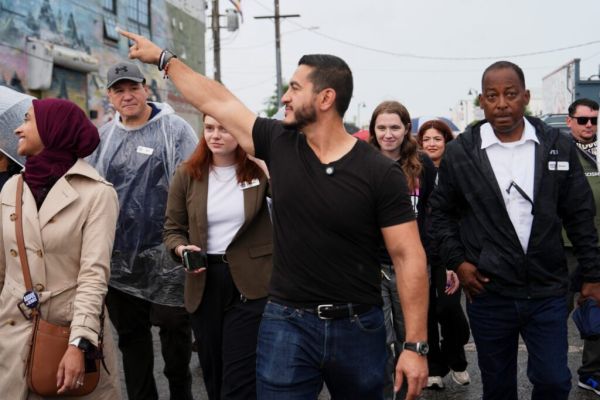
El-Sayed and Stevens Make Final Push in Pivotal Michigan Senate Primary/ TezzBuzz/ WASHINGTON/ J. Mansour/ Abdul El-Sayed and Rep. Haley Stevens are making their final appeals before Tuesday’s closely watched Michigan Democratic Senate primary. El-Sayed is campaigning as a progressive challenger to the party establishment, while Stevens emphasizes experience, electability and support from senior Democrats. The winner must reunite the party’s divided coalition to face Republican Mike Rogers in a race crucial to control of the Senate.
Quick Look
- Michigan’s Democratic Senate primary is Tuesday.
- El-Sayed and Stevens focused heavily on Black voters in metro Detroit.
- Both candidates visited churches, union halls and campaign rallies.
- El-Sayed is endorsed by Sen. Bernie Sanders.
- Stevens is backed by Senate Democratic Leader Chuck Schumer.
- El-Sayed campaigned Sunday at three Detroit churches.
- Reps. Summer Lee and Ayanna Pressley appeared with him.
- Stevens emphasized her longstanding relationships with local churches.
- Her campaign highlighted her work on the Obama administration’s auto rescue.
- El-Sayed plans to spend the final campaign day in Detroit.
- Stevens will campaign in western Michigan.
- El-Sayed’s campaign says it has 12,000 volunteers statewide.
- Stevens is endorsed by Gov. Gretchen Whitmer and Sen. Gary Peters.
- Republican Mike Rogers awaits the Democratic nominee.
- The open seat is important to Democrats’ hopes of controlling the Senate.
Deep Look
Candidates make final appeals before primary
DETROIT — Abdul El-Sayed and U.S. Rep. Haley Stevens entered the final hours of Michigan’s Democratic Senate primary making appeals to many of the same voters after campaigning for more than a year on sharply different visions for their party.
El-Sayed attended a packed Detroit church Sunday morning with his wife and prominent Black political leaders.
Less than 10 miles away, Stevens sought support at another Black church, where a well-known local pastor promoted her candidacy.
The candidates later moved to union halls and campaign rallies as they worked to assemble enough support from Michigan’s diverse Democratic coalition to win Tuesday.
“Last word phenomenon” takes over campaign
Stevens, a four-term member of Congress who has survived several competitive Democratic primaries, described the frantic closing phase as “the last word phenomenon.”
Campaigns often spend their final days attempting to reinforce support rather than introduce new messages.
Candidates return to important communities, mobilize volunteers and remind supporters to cast their ballots.
For El-Sayed and Stevens, the final schedule revealed which voters each campaign believes will decide the race.
Primary tests Democratic Party’s direction
The Michigan contest has emerged as one of the clearest tests of the Democratic Party’s ideological future.
El-Sayed is running as a progressive who has challenged party leaders and large political donors.
He is supported by independent Vermont Sen. Bernie Sanders and other prominent figures on the Democratic left.
Stevens has made experience and general election electability central to her campaign.
She is supported by Senate Democratic Leader Chuck Schumer and many senior Michigan Democrats.
Winner faces difficult general election
The primary winner will face Republican Mike Rogers in November.
Rogers is the presumptive Republican nominee for the seat being vacated by retiring Democratic Sen. Gary Peters.
President Donald Trump carried Michigan in 2024, giving Republicans confidence that they can win the open seat.
Democrats must retain Michigan to improve their chances of winning control of the Senate next year.
The nominee will also need to reunite supporters after a costly and ideologically divisive primary.
Detroit’s Black electorate could determine result
Democratic primaries in Michigan often depend on turnout in Detroit.
The city’s large Black electorate is an essential part of the party’s statewide coalition.
Both candidates spent Sunday seeking support from Black voters in Detroit and surrounding communities.
Churches remain influential civic institutions, offering candidates access to congregations with strong community ties and a history of political participation.
The simultaneous focus on those voters demonstrated their importance to both campaigns’ final calculations.
El-Sayed campaigns at three churches
El-Sayed visited three churches Sunday.
His message focused on equal rights, education, health care, employment and economic opportunity.
The remarks connected his progressive policy platform with concerns affecting working-class and minority communities.
Progressive leaders campaign with El-Sayed
Both lawmakers are nationally recognized members of the Democratic Party’s progressive wing.
Yusef Jackson, president of the Rainbow PUSH Coalition and son of the late Rev. Jesse Jackson, also appeared with him.
Their presence strengthened El-Sayed’s argument that his campaign represents a broader national movement rather than an individual candidacy.
It also helped introduce him to voters connected to civil rights and progressive organizations.
Pastor says political moment demands change
Pastor David A. Johnson II said he does not normally welcome political candidates into the church.
He made an exception for El-Sayed because of what he described as an unusual political moment.
Religious institutions risk alienating members when they become closely associated with political campaigns, making endorsements or candidate appearances sensitive.
Johnson’s decision reflected the urgency some El-Sayed supporters attach to changing the party’s leadership and policy direction.
Undecided voter chooses El-Sayed
Robin Robertson, a 59-year-old Detroit resident, said she spent much of the campaign uncertain about her decision.
El-Sayed’s church visit helped settle her choice.
Robertson said Stevens “had a good run.”
Her decision illustrates why candidates continue making personal appearances even after months of advertising and public debates.
Stevens presented herself as a consistent presence in Detroit-area churches rather than a candidate appearing only during election season.
At a church in Pontiac, she remained after the service to speak individually with congregants.
She greeted many people as established acquaintances.
Her campaign argues that those relationships demonstrate both authenticity and an ability to represent communities across the state.
Stevens highlights Obama-era auto work
Stevens and her allies have used advertising to emphasize her connection to former President Barack Obama.
She served as chief of staff for the Obama administration’s auto rescue effort from 2009 to 2011.
That experience carries particular significance in Michigan, where the automobile industry supports large numbers of workers and remains central to the state’s economy.
Her campaign presents the role as evidence that she can manage major economic challenges and deliver results through government.
The advertisements also seek to connect Stevens with Obama’s continued popularity among Black Democratic voters.
Strong Detroit performance essential for Stevens
Stevens’ campaign acknowledges that she needs a strong result among Detroit voters to win.
Her base includes older Democrats, establishment-aligned voters and people who prioritize experience in federal office.
The challenge is converting support from elected officials and institutions into sufficient turnout.
Reggie Williams, a longtime constituent who attended an Oakland County event, said Stevens had earned his support through years of community involvement.
Candidates split on final campaign day
After competing for similar constituencies Sunday, El-Sayed and Stevens planned sharply different schedules for Monday.
El-Sayed intended to remain in Detroit.
He planned to attend canvassing events and focus on converting enthusiasm in Michigan’s largest city into votes.
Stevens planned to travel through western Michigan.
Her schedule included areas around Democratic strongholds such as Grand Rapids and Kalamazoo.
El-Sayed calls Detroit center of public service
El-Sayed said Detroit is the appropriate location for the final day of his campaign.
His decision reflects the campaign’s belief that high turnout in Detroit can overcome Stevens’ strength elsewhere.
It also reinforces El-Sayed’s identity as a candidate rooted in the city and connected to its progressive and minority communities.
Stevens seeks votes in western Michigan
Stevens’ western route gives her an opportunity to reach Democrats outside the Detroit metropolitan area.
Grand Rapids and Kalamazoo contain substantial Democratic voter populations surrounded by more conservative regions.
A strong performance in western Michigan could offset any El-Sayed advantage in Detroit.
The schedule also allows Stevens to emphasize her statewide institutional support and argue that she can build a broad coalition needed for the November election.
Turnout replaces persuasion as final priority
With less than a day remaining, both campaigns have limited time to change voters’ minds.
Their principal task is now ensuring that identified supporters cast ballots.
Campaigns use volunteers, telephone calls, text messages, door knocking and transportation assistance to maximize participation.
August primaries can produce uncertain turnout because vacations, work schedules and lower public attention may keep some voters home.
The candidate with the stronger field organization could therefore outperform expectations.
El-Sayed relies on 12,000 volunteers
El-Sayed’s campaign says its statewide volunteer operation has grown to 12,000 people.
The campaign plans to use that network to contact supporters and drive turnout, especially in Detroit.
Volunteer-based organizing is central to El-Sayed’s argument that his candidacy represents a grassroots movement.
Its effectiveness will be measured by whether younger and progressive supporters, who historically participate less consistently than older voters, actually vote Tuesday.
A large volunteer list offers potential reach but does not guarantee turnout.
Stevens relies on institutional support
Stevens is supported by many of Michigan’s most prominent Democratic officials.
Her endorsers include Gov. Gretchen Whitmer and Sen. Gary Peters.
She also has the support of party leaders, elected officials and organizations with established voter-contact operations.
That institutional network can provide endorsements, funding, volunteers and access to experienced campaign infrastructure.
Stevens argues that the coalition demonstrates her ability to unite the party and compete effectively against Rogers.
Spending and ideological conflict define race
Tens of millions of dollars have flowed into the primary through campaign spending and outside organizations.
Much of the debate has focused on which candidate can best represent Democrats in a changing political environment.
El-Sayed’s supporters argue that progressive policies and enthusiasm can bring younger and disaffected voters into the process.
Stevens’ allies contend that experience, moderation and proven electoral strength offer the safer route in a swing state.
Tuesday’s result will provide evidence for one of those competing theories.
Party must reunite after primary
Regardless of who wins, the nominee will inherit a divided coalition.
El-Sayed would need to persuade establishment Democrats and voters concerned about his general election strength to support him.
Stevens would need to win over progressives who believe the party is too dependent on wealthy donors and traditional leadership.
Rogers and Republican organizations will seek to exploit those divisions.
The speed with which Democrats reunite could help determine whether the party retains the seat.
Final votes will end the argument
By Monday night, the campaign’s church visits, union events, rallies and television advertisements will be complete.
The candidates will no longer be able to shape the contest through new appearances or messages.
Stevens described that moment as the conclusion of the “last word phenomenon.”
The result will determine not only Michigan’s Democratic Senate nominee but also which vision of the party gains momentum heading into the national midterm campaign.
More on US News
-
Placing a money plant in the wrong direction will have the opposite effect! Know the correct rules of Vastu to prevent extreme misfortune

-
Placing a money plant in the wrong direction will have the opposite effect! Know the correct rules of Vastu to prevent extreme misfortune

-
Which City Is Known As The Kachori Capital Of India?

-
Trisha Krishnan wears a sheet mask on a flight. Learn how safe it is to wear on an airplane and what precautions to take.

-
Why are bael leaves offered to Lord Shiva during the month of Sawan? This is why Mahadev loves this leaf.