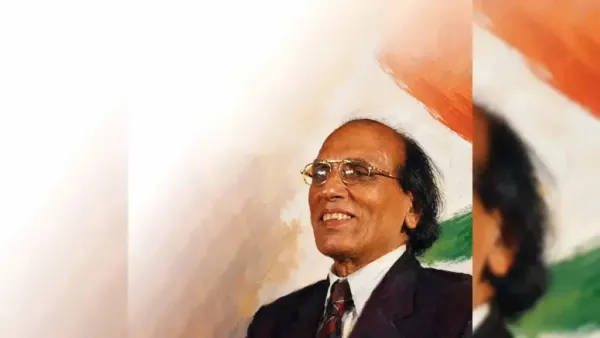
Bashir Badr, the pioneer of modern Urdu ghazal and renowned poet, has passed away at the age of 91. Bashir Sahib, who ruled hearts with his simple words, lived in Bhopal.
In a world of changing relationships and pretenses, Bashir Badr’s poetry still resonates with people. His famous ghazal, “Koi haath bhi na milayega jo gale miloge tapak se,” is not just a couplet but a profound understanding of relationships. Written in simple words, this ghazal paints a picture of life, people’s changing behaviors, and emotions, with which every person can relate. Bashir Badr, the renowned poet who adorned the world of ghazals and love with his words, is no more. As soon as the news of his passing at the age of 91 broke, a wave of grief spread from the literary world to social media. His poetry was not limited to books, but had become a part of people’s lives, relationships, and feelings. Bashir Badr, who expressed profound thoughts in simple words, was considered the greatest face of modern Urdu ghazal. With his passing, it feels as if an entire era of ghazals has fallen silent.
Bashir Badr’s Famous Ghazals in Hindi: The poet who ruled hearts with words
Bashir Badr’s most distinctive characteristic was his simple and heartfelt poetry. He used everyday language instead of complex Urdu words, allowing people from all walks of life to connect with his ghazals. His couplets beautifully expressed the realities of love, relationships, pain, and life. Couplets like “Let the light of your memories remain with us” and “No one will even shake hands if you hug me immediately” remain on people’s lips even today.
Some of Bashir Badr’s most famous ghazals
“Kuch toh majbootiyaan hogi” (Something to be forced … “Let the light of your memories remain with us” is a beautiful glimpse of memories and old love. “People break down in building a home” – the truth of life’s hard work and shattered dreams. “Be a strong enemy, but” – a message of maintaining humanity in relationships. “The mosque is far from home” – a thought that places humanity above religion. “It’s enough that you looked back” – a small feeling of hope and love. “Love is a fragrance” – a ghazal that expresses the tenderness and beauty of love.
Bashir Badr had been battling dementia for a long time.
According to his family, Bashir Badr had been battling dementia for the past several years. His memory had deteriorated significantly with age. His condition had become so severe that he often forgot his loved ones and the ghazals he had written.
Meerut Riots Changed His Life
Born in Ayodhya on February 15, 1935, Bashir Badr studied at Aligarh Muslim University and later served as a professor there. The 1987 Meerut riots brought him the greatest pain. His house was burned down in the riots, and many of his precious unpublished works were lost forever. After this tragedy, he settled in Bhopal. The impact of that pain was felt in many of his ghazals.
When Indira Gandhi recited his couplet
Bashir Badr’s poetry was famous not only in India but throughout the world. Many of his couplets reached high political and social platforms. During the Shimla Agreement, then-Prime Minister Indira Gandhi recited his famous couplet to Pakistan’s Zulfikar Ali Bhutto: “Be fierce enemies, but leave room for us not to be ashamed when we become friends.”
His ghazals will live forever.
Bashir Badr may no longer be in this world, but his words will always live in people’s hearts. He made ghazals not just something to be read, but a way to experience life. Couplets like “No one will shake hands if you embrace them immediately” and “We are travelers, and you are also travelers” will remain on people’s lips for decades to come.
FAQ
Q.
Who was Bashir Badr and when did he pass away?
A.
Dr. Bashir Badr was the pioneer of modern Urdu ghazal, a former professor at Aligarh Muslim University, and a renowned Indian poet honored with the Padma Shri. He passed away in Bhopal at the age of 91.
Q.
Which couplet of Bashir Badr’s did Indira Gandhi recite during the Shimla Agreement?
A.
The then Prime Minister Indira Gandhi once recited this couplet to Pakistani leader Zulfikar Ali Bhutto: “Be fierce enemies, but let there be a chance that if we ever become friends, we should not be embarrassed.”
Q.
What was the most significant characteristic of Bashir Badr’s poetry?
A.
The most significant characteristic of his poetry was his use of simple and understandable everyday language instead of complex Urdu, which allowed every ordinary person to connect with his ghazals.
Q.
What impact did the Meerut riots (1987) have on Bashir Badr’s life?
A.
His house and precious unpublished works were burned to ashes in the 1987 Meerut riots. After this tragic incident, he permanently settled in Bhopal.
Q.
What illness did Bashir Badr suffer from in the last years of his life?
A.
He suffered from dementia in the last years of his life, which severely impaired his memory.
-
Virgo Horoscope Today, August 5, 2026: Avoid rushing financial discussions, do not interfere unnecessarily

-
Cancer Horoscope Today, August 5, 2026: Relationships will strengthen through faith and trust, love bonds will be reinforced

-
Scorpio Horoscope Today, August 5, 2026: Beware of White-Collar Thieves, Employees Will Do Well

-
Linkin Park Drops 'Unshatter' Documentary Trailer, Confirms Official Release Date

-
'Attack Against Christians': US Congressman Criticises FCRA Bill, Warns Of Bilateral Fallout