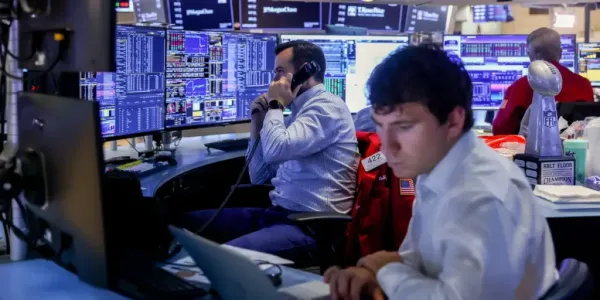
Artificial intelligence has spent the last three years creating fortunes. Then, almost overnight, it reminded investors how quickly those fortunes can disappear.
For months, AI- stocks looked unstoppable. Companies building chips, servers, data centers, and cloud infrastructure became the market’s biggest winners as investors raced to capitalize on the generative AI boom. But when one highly leveraged hedge fund was forced to unwind its positions, the selling pressure rippled across markets, wiping billions from South Korea’s technology sector in a matter of days.
The collapse of Situational Awareness—an AI-focused hedge fund founded by former OpenAI researcher Leopold Aschenbrenner—became a textbook example of how concentrated bets and leverage can transform a single fund’s problems into a broader market event.
Credits: MarketWatch
How One Hedge Fund Became a Major AI Investor
Situational Awareness wasn’t just another technology hedge fund.
Founded around the belief that artificial intelligence would reshape the global economy, the fund was built on an aggressive investment thesis: companies supplying the AI revolution would enjoy years of explosive growth.
Rather than betting on AI software companies alone, the fund focused on the infrastructure powering the revolution.
That meant investments in:
- Semiconductor manufacturers
- High-bandwidth memory (HBM) producers
- GPU supply chains
- AI server manufacturers
- Networking equipment
- Cloud infrastructure providers
This strategy initially looked brilliant.
Demand for AI chips surged as technology giants invested hundreds of billions of dollars into data centers. Every new large language model required thousands—and eventually hundreds of thousands—of advanced processors.
As valuations climbed, the fund reportedly increased its exposure using leverage, magnifying both potential gains and future losses.
That decision would eventually prove disastrous.
Why South Korea Was Right in the Middle of the Storm
When people think about AI, they often think of companies like NVIDIA or OpenAI.
But behind every AI model lies an enormous semiconductor supply chain, and South Korea sits at its center.
The country dominates one of the most critical components in modern AI systems: memory chips.
AI accelerators require massive amounts of high-bandwidth memory to process enormous datasets efficiently. Without advanced memory, even the world’s fastest GPUs cannot deliver their full performance.
This has made South Korea’s semiconductor giants some of the biggest beneficiaries of the AI boom.
The fund held significant exposure to companies directly linked to this supply chain, making the country’s stock market especially vulnerable when positions had to be liquidated.
Samsung Electronics Felt the Pressure
Samsung Electronics was among the largest casualties.
Although Samsung remains one of the world’s most diversified technology companies, investors increasingly view it as a key AI infrastructure supplier because of its memory business.
The company has spent billions expanding production of advanced DRAM and HBM chips aimed at AI data centers.
Its future earnings have become closely tied to AI spending by global cloud providers.
When leveraged investors began reducing exposure, Samsung shares came under heavy selling pressure despite no major deterioration in its underlying business.
This highlighted an important reality of modern markets: stocks can fall sharply even when company fundamentals remain largely intact.
Credits: Business Insider
SK Hynix Became the Biggest Target
SK Hynix arguably faced the greatest impact.
Few companies have benefited from the AI boom as dramatically.
The firm has emerged as one of the world’s leading suppliers of high-bandwidth memory, becoming a critical partner for GPU manufacturers building AI hardware.
Demand for HBM has been so strong that production capacity has remained largely sold out months in advance.
Investors consequently poured money into SK Hynix throughout the AI rally.
But concentrated ownership creates concentrated risk.
When a major institutional investor suddenly becomes a forced seller, even excellent companies can experience sharp declines as liquidity disappears and buyers hesitate.
The result was a rapid decline that reflected market mechanics more than any immediate change in the company’s long-term outlook.
Why SK Square Also Fell
SK Square wasn’t directly manufacturing AI chips.
Instead, it became collateral damage.
The investment holding company owns a significant stake in SK Hynix.
Because much of its valuation depends on that ownership, declines in SK Hynix naturally flowed through to SK Square.
Investment holding companies often amplify movements in their largest assets.
When investors expect a subsidiary’s value to decline, they frequently sell the holding company as well.
This explains why SK Square’s shares also experienced heavy volatility during the selloff.
The Hidden Danger of Leverage
The most important lesson from this episode isn’t about artificial intelligence.
It’s about leverage.
Leverage allows hedge funds to borrow money to increase the size of their investments.
If a fund has $1 billion in capital but borrows another $4 billion, it effectively controls $5 billion worth of assets.
When markets rise, returns become spectacular.
But when prices begin falling, losses multiply just as quickly.
Eventually, lenders demand additional collateral.
If the fund cannot provide it, positions must be sold.
Those sales push prices even lower, triggering additional margin calls.
The process creates a vicious cycle that can overwhelm markets in a surprisingly short period.
This phenomenon has played out repeatedly across financial history—from Long-Term Capital Management in 1998 to Archegos Capital Management in 2021.
Situational Awareness became another reminder that leverage can turn a market correction into a cascade.
Credits: TheEnergyMag
AI Stocks Have Become Increasingly Crowded
Another major takeaway is how crowded AI investing has become.
Over the past few years, institutional investors worldwide have gravitated toward the same relatively small group of companies.
Nearly every portfolio seeking AI exposure ended up owning similar names:
- Semiconductor manufacturers
- Memory chip producers
- AI server suppliers
- GPU ecosystem companies
- Data-center infrastructure businesses
Crowded trades work well while optimism persists.
However, if a large investor exits unexpectedly, everyone rushes toward the same narrow exit.
Liquidity disappears.
Bid-ask spreads widen.
Prices fall far faster than fundamentals justify.
That dynamic appeared throughout the South Korean technology sector.
Why Fundamentals Still Matter
Despite the dramatic selloff, the broader AI investment story hasn’t suddenly disappeared.
Cloud providers continue investing heavily in AI infrastructure.
Governments remain committed to semiconductor manufacturing.
Demand for AI chips continues to outpace supply in several critical categories.
The recent decline therefore appears driven more by positioning than by collapsing business demand.
History shows that forced liquidations often create temporary disconnects between stock prices and company fundamentals.
Markets eventually stabilize once selling pressure subsides.
Long-term investors frequently use these periods to accumulate high-quality businesses at lower valuations.
Whether that ultimately happens again remains to be seen.
A Reminder That Markets Move on Positioning, Not Just Earnings
One of the biggest misconceptions among retail investors is that stock prices only respond to company performance.
In reality, positioning often matters just as much.
A company can report strong earnings, growing revenues, expanding margins, and optimistic guidance—and still see its stock decline if large institutional investors need to raise cash.
Likewise, weak companies sometimes rally simply because short sellers cover positions.
Financial markets reflect supply and demand for shares, not just business performance.
Situational Awareness demonstrated this principle vividly.
The selling wasn’t necessarily driven by doubts about Samsung, SK Hynix, or the broader AI opportunity.
It was driven by the mechanics of unwinding enormous leveraged positions.
Credits: WSJ
The Bigger Picture
Artificial intelligence remains one of the defining investment themes of this decade.
Companies building semiconductors, memory chips, networking hardware, and cloud infrastructure are likely to remain central to the industry’s growth.
Yet the South Korean selloff illustrates that even the strongest long-term trends can experience violent short-term corrections.
As AI investing becomes increasingly crowded, market participants will need to distinguish between changes in business fundamentals and temporary shocks caused by leverage, liquidity, and portfolio positioning.
For investors, that may be the most valuable lesson of all.
Technology revolutions rarely move in straight lines. The companies powering them can remain fundamentally strong while their share prices swing wildly as capital flows in—and just as suddenly, flows back out.
-
Patrice Evra tells £51m Manchester United target Manu Kone to turn down Old Trafford and join Arsenal instead

-
UPI Transactions Above Rs 2,000 May Attract A Fee; Know More About Proposed Law Change

-
‘Ghajini’ And ‘Lagaan’ Fame Pradeep Rawat Passes Away At 74

-
Indians at the Hundred, Matchday 16: Deepti shines with ball in Sunrisers Leeds win over London Spirit

-
Mega transport project back on track in Pune as civic body invites bids for consultants