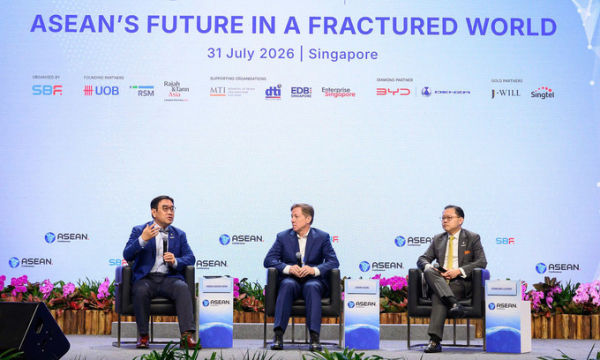
The message emerged during the featured session, “AI Infrastructure & Growth in APAC: Building the Next Digital Backbone for ASEAN,” which brought together Edmund Leong, Head of Group Corporate Banking at UOB and John Kain, Director of Financial Services Market Development at AWS Global. The discussion explored how governments, technology providers, financial institutions, and businesses can work together to build the infrastructure needed to support AI adoption across ASEAN.
Leong said businesses should increasingly view AI not only as a technology story, but as an economic growth story.
While many companies in ASEAN have focused on AI’s ability to improve productivity and operational efficiency, he said technology also presents significant opportunities to drive revenue growth through innovation, personalization and enhanced customer engagement.
Speaking with Read International, Leong said the biggest challenge facing many organizations is not access to AI technology, but the ability to deploy it at scale and translate investments into measurable business outcomes.
“Many companies have already experimented with AI, but scaling requires clear use cases, strong data foundations, workforce capabilities and integration into existing workflows and business models,” he said.
AI’s rapid expansion is also reshaping the role of financial institutions as investment demand spreads across the entire AI value chain.
Leong said financing demand is emerging across a wide range of sectors, from semiconductors, memory chips and devices to renewable energy, cooling systems, fiber connectivity and data centers.
“AI demand drives investment, and AI demand also drives financing,” he said.
As AI infrastructure projects become larger and more capital intensive, Leong said financial institutions are increasingly serving as “super-connectors of capital” rather than simply lenders. Beyond providing bank financing, financial institutions can help connect businesses with equity investors, capital markets and other funding sources needed to support large-scale infrastructure investments.
“No single bank or a few groups of banks can do that,” he said.
Through its regional network, UOB supports clients across the AI value chain, from trade financing for computer equipment manufacturers to debt and equity capital raising for data center operators, utility companies and infrastructure developers. The bank also advises clients on financing structures, risk management and cross-border investment opportunities across ASEAN.
Echoing Leong’s view that AI adoption is entering a transformative phase, Kain described AI as a generational technology shift rather than simply another software upgrade.
Drawing on Amazon’s experience, he said generative AI has shortened software development cycles, reduced costs, and accelerated the deployment of new products and services. Similar applications, he noted, are being implemented across various sectors, such as financial services, healthcare, energy, and scientific research.
|
The panelists discussing in the “AI Infrastructure & Growth in APAC: Building the Next Digital Backbone for ASEAN” session. Photo courtesy of SBF |
As AI adoption accelerates, both speakers said digital infrastructure will play a key role in determining how quickly ASEAN can capture the technology’s economic potential.
Leong noted that AI infrastructure extends far beyond data centers and includes reliable power supply, transmission networks, cooling systems, network connectivity and advanced computing infrastructure.
Kain said AWS has committed US$33 billion to expand cloud infrastructure across ASEAN through 2039, covering Singapore, Malaysia, Indonesia, Thailand, Vietnam, and the Philippines. According to AWS, the investment is expected to contribute about US$65 billion to regional GDP while supporting approximately 53,000 jobs across the data center supply chain.
Energy availability emerged as one of the key challenges as ASEAN expands its AI ambitions. While Kain highlighted the importance of reliable renewable power to support growing computing demand, Leong pointed to initiatives such as the ASEAN Power Grid as a step toward strengthening regional energy resilience and supporting future AI infrastructure growth.
Beyond physical infrastructure, both speakers emphasized that trust and governance will be equally important. As organizations become increasingly data-driven, responsible AI deployment will require strong safeguards around data integrity, cybersecurity, privacy and regulatory compliance, while trust is expected to become a key competitive differentiator.
The discussion also touched on concerns over AI’s impact on employment. Rather than replacing workers, the speakers argued that AI is more likely to augment human capabilities and create new opportunities across the broader ecosystem. Leong noted that investment in areas such as energy, construction, semiconductors and financial services is already generating demand across a range of industries.
Looking ahead, both speakers agreed that organizations will need to invest in people as well as technology to fully capture AI’s potential. Kain noted that AWS has trained more than 2.3 million people across ASEAN in cloud and digital skills since 2017.
Leong added that while the first wave of AI adoption focused largely on productivity and efficiency gains, the next phase will be driven by growth. “Businesses need to move beyond pilots and identify where AI can enhance products, strengthen customer engagement, accelerate innovation, create new revenue streams and open new markets,” he said.
-
Pakistan Tehreek-e-Insaf supporters to march toward Islamabad on Sep 27: Khyber Pakhtunkhwa CM

-
Meta Admits ‘A Lot of Money Was Paid’ To Boost Illegal Content Amid Apology For PM Modi Post Glitch

-
Shreya Kalra Lifts ‘Lock Upp 2’ Trophy, Beats Shivangi Joshi In Grand Finale

-
Indians at the Hundred, Matchday 17: Smriti, Richa fall cheaply in Manchester Super Giants’ three-wicket loss

-
HP govt steps up efforts to secure financial, power entitlements