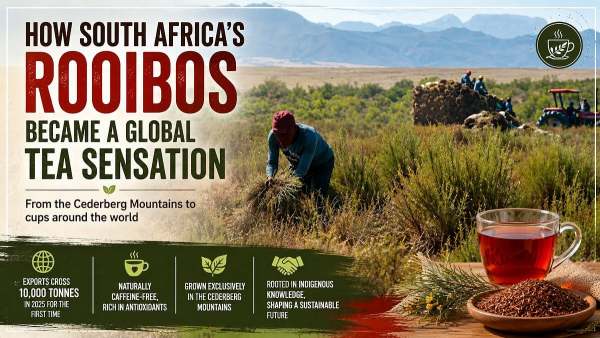
South Africa's rooibos industry has transformed a traditional Indigenous tea into a global success, with exports exceeding 10,000 tonnes in 2025. Rising demand, health-conscious consumers and EU geographical protection have fuelled growth, while climate change, trade uncertainties and historical inequalities remain key challenges for the sector.
Cape Town, August 5, 2026: South Africa’s rugged Cederberg Mountains may be known for dramatic rock formations and wildlife such as baboons and leopards, but the arid region is also home to a plant that has quietly built a global following. Rooibos, which means “red bush” in Afrikaans, grows exclusively in a 60,000-hectare area of the Cederberg region, around 155 miles north of Cape Town.
Its needle-like leaves have long been used by South Africa’s Indigenous communities to make a woody-flavoured tea. Today, rooibos has travelled far beyond its native landscape. Global consumption rose 12.5 per cent between 2022 and 2024, while exports crossed 10,000 tonnes for the first time in 2025, compared with about 5,900 tonnes in 2015.
From Local Brew To Global Cup
“In the beginning, (rooibos) was virtually unknown, so the growth was just driven by more people getting to know it and enjoying its flavour,” said Martin Bergh, Managing Director of South Africa-based Rooibos Limited, the world’s oldest and largest rooibos processor.
-
Air India Names Former Ethiopian Airlines Chief Tewolde Gebremariam As CEO

-
Israel Launches Strikes In Southern Lebanon, Claims Hezbollah Violation

-
Will Kobbie Mainoo make Manchester United’s starting XI after a delayed return and £83m midfield spend?

-
President Trump Warns Iran Of 'Very Hard' Strikes If It Rejects Deal, Threatens Action Over Strait Of Hormuz

-
Massachusetts Governor Declares August 15 As 'India Day' To Honour Indian Diaspora Contributions