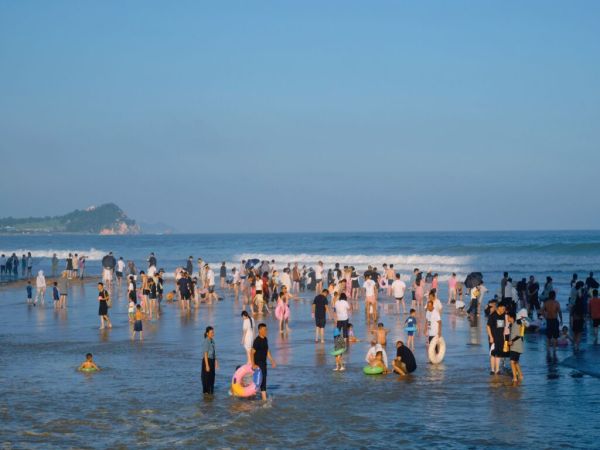
Leaders across the world choose to enjoy their summer holiday at a high-end resort; the top politicians in China go to Beidaihe, a coastal city in the province of Hebei. The city holds one of the most secretive political practices of China every year.
The government of China does not officially acknowledge this practice. No public agenda or official notification is made. However, political analysts say this political practice plays a critical part in forming Chinese policies and strategies.
It seems that this year’s political practice started on August 3, following the meeting between Cai Qi, chief of staff of President Xi Jinping and a member of the Politburo Standing Committee, with prominent scientists and technical experts in Beidaihe. This meeting is perceived as an obvious indication of the arrival of China’s top leaders.
The event is held before a crucial Communist Party meeting, which is scheduled to take place in October, during which the Chinese leaders will deliberate governance, economy, military reform, and political strategy before the 21st Party Congress in 2027.
Why Is Beidaihe So Important to China’s Leadership?
Located 300 km east of Beijing and bordering the Bohai Sea, Beidaihe has been used as the de facto summer retreat of Chinese political leadership for decades.
While most elite vacation sites around the world cater to the tastes of the rich, Beidaihe is a rather down-to-earth resort with Soviet-style villas, state guest houses, workers’ sanatoriums and beaches frequented by tens of millions of Chinese tourists annually.
According to experts, such austerity is a sign of President Xi Jinping’s policy of strict discipline within the party as well as its anti-corruption efforts. The significance of the location was described by modern China historian Rana Mitter. “They don’t want to look like they’re going to any kind of fancy place where corruption might be possible.”
“It would be a good way of symbolizing that, while going to a five-star hotel in Hainan or some international hotel in the Caribbean wouldn’t really have that effect,” he added.
While more than 50 million people from China visit Beidaihe every year, almost none of them get an opportunity to meet the country’s top political leadership face to face as senior officials reside in closed-off government compounds.
What Happens During China’s Secret Summer Retreat?
The Beidaihe retreat usually lasts between 10 and 14 days. During this period, China’s senior leaders almost completely disappear from public view. Except during national emergencies, official appearances become rare. State media also stops its regular reporting on Politburo members, creating an unusual silence that often fuels speculation.
Even though Beijing never officially announces the retreat, several signs indicate it has begun.
Authorities tighten security across Beidaihe and nearby Qinhuangdao every summer. Drones, private aircraft, boats, hot-air balloons, jet skis and speedboats are banned. Roads are closed, and security checkpoints are increased around sensitive areas.
President Xi Jinping was last seen publicly during a Politburo study session on military modernisation before this year’s retreat reportedly began.
Why Does the Retreat Spark So Many Rumours?
Because China’s leadership goes silent during these two weeks, rumours often spread quickly. Ruby Osman, senior policy adviser at the Tony Blair Institute for Global Change, described the period by saying, “The retreat is often China’s ‘silly season.’”
She added, “The radio silence from leadership fuels rumours of political infighting or elite coups.”
However, experts say there is little public evidence that these rumours point to any real challenge to Xi Jinping’s leadership.
What Will China’s Leaders Discuss This Year?
This year’s Beidaihe meeting is considered especially important because it comes before October’s major Communist Party conclave.
One of the biggest priorities is expected to be strengthening party discipline and improving governance under the campaign for “full and rigorous party self-governance.”
Economic concerns will also dominate discussions. China’s leaders continue to face slowing consumer demand, pressure in the real estate market and concerns about long-term economic growth.
Military reforms are another major issue. Recent anti-corruption investigations inside the People’s Liberation Army (PLA) have raised questions about command structures and operational readiness.
Leaders are also expected to begin planning for the 21st Party Congress in 2027, when major leadership appointments and political reshuffles are expected.
Alongside political discussions, Cai Qi has continued his annual meetings with China’s leading scientists, with growing attention on artificial intelligence, innovation and advanced technology.
Has Xi Jinping Changed the Role of Beidaihe?
In earlier decades, Beidaihe was known as a place where serving and retired Communist Party leaders held informal negotiations over major policy decisions and leadership appointments.
That role appears to have changed significantly under Xi Jinping.
Neil Thomas of the Asia Society Policy Institute said, “Historically, the retreat has provided an opportunity for serving and retired leaders to hold informal discussions and negotiate over policy and personnel.”
“But, with power increasingly concentrated within the party and in Xi’s hands, ‘the scope for genuine bargaining has narrowed,’” he added.
Today, many analysts believe the retreat focuses more on building consensus around policies already decided rather than negotiating new political deals.
Rana Mitter also believes the gathering has become even more secretive under Xi’s leadership.
“Then the Xi Jinping era, it’s much more mysterious, like many things under Xi Jinping. (We) don’t know, but there seems to be some consensus that there are meetings year by year.”
The Fascinating History Behind Beidaihe
The history of Beidaihe can be traced back over 2,000 years. Some historical accounts state that Emperor Qin Shi Huang of China passed through Beidaihe in 221 BC while looking for an immortal elixir.
It was developed as a contemporary beach resort city in 1898 when the government of the Qing Dynasty opened the city of Qinhuangdao to treaty port status. Even in 1921, the city had its first tourist guide.
After the ruling of the Chinese Communist Party began in 1949, the villa estates of Kuomintang officials and foreign diplomats were seized.
In 1953, Mao Zedong made Beidaihe the summer workplace for China’s senior leaders. The cooler weather offered relief from Beijing’s heat before air conditioning became common.
However, the most important meeting which was held here occurred in 1958 when Mao Zedong introduced the Great Leap Forward, the policy which would ultimately be responsible for the worst famine in history.
This political retreat was interrupted by the Cultural Revolution only to resume again after the death of Mao Zedong. In subsequent times, Beidaihe would see its revival under the rule of Deng Xiaoping, serving as both a political retreat and a tourist destination for international guests.
The town is also connected with the mysterious death of Lin Biao, Mao Zedong’s previous chosen successor, who is said to have fled Beidaihe prior to his plane crash.
Why Beidaihe Still Matters Today
Even though most of the political deals previously associated with Beidaihe lost their significance in the centralised leadership of Xi Jinping, this retreat remains one of the most important political events in China.
Every year, when the highest officials of China are locked up behind closed doors, the whole world eagerly awaits the decisions made by the government.
Sudeep Singh Rawat is a Copy Editor at NewsX Digital with over five years of experience in digital journalism. He covers national and international news, with a focus on politics, crime, technology, public affairs, and trending topics. Before joining NewsX Digital, he worked with Business Standard, The Sunday Guardian, and other digital media organisations. His reporting focuses on breaking news, enterprise stories, and explainers that inform readers through accurate, balanced, and context-driven journalism.
The post Why Do China’s Top Leaders Secretly Disappear to Beidaihe Every Summer? Inside Xi Jinping’s Mysterious Retreat appeared first on NewsX.
-
Man booked for stalking flight attendant at Hyderabad Airport
-
Man caught with 4.2 kg ganja chocolates in Rangareddy district

-
Mamata attacked during visit to deceased TMC worker’s house
-
'I Know How To Stand My Ground': Netanyahu Rejects 'Great Friend' Trump’s Gaza Plan
-
Apple iPhone 18 Pro Max: Apple iPhone 18 Pro Max will get the biggest battery ever, learn about camera and connectivity