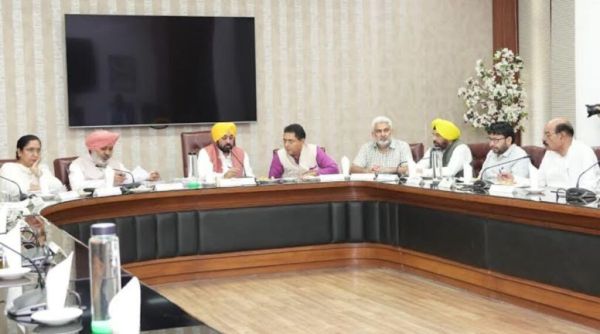
Punjab Education: The Punjab Cabinet, led by Chief Minister Bhagwant Singh Mann, today took several landmark decisions aimed at strengthening the education system, improving governance and public services, and promoting all-round development in the state. The Cabinet passed the “Punjab Regulation of Fees of Unaided Educational Institutions (Amendment) Bill, 2026” to prevent unfair and illegal fee hikes by private unaided educational institutions.
In addition, the “Punjab State Outsourced Transition to Contractual Engagement Bill, 2026,” the establishment of three new digital open universities, and several other important policy initiatives were approved. These decisions were taken during a Cabinet meeting chaired by the Chief Minister here today.
Disclosing this information, the Chief Minister’s Office stated that the Cabinet approved the introduction of the “Punjab Regulation of Fees of Unaided Educational Institutions (Amendment) Bill, 2026,” to prevent unfair and illegal fee hikes by private unaided educational institutions.
This bill became necessary because some private unaided educational institutions were arbitrarily and unfairly increasing their annual fees, placing unnecessary financial burdens on students and their parents. Therefore, to curb the illegal increase in fees by private unaided schools, it was felt necessary to amend the Punjab Regulation of Fees of Unaided Educational Institutions Act, 2016, the Punjab Regulation of Fees of Unaided Educational Institutions (Amendment) Act, 2019, and the rules made under these Acts.
Approval of the Punjab State Outsourced Transition to Contractual Engagement Bill, 2026
The Cabinet also approved the Punjab State Outsourced Transition to Contractual Engagement Bill, 2026, which provides for direct contract employment for eligible outsourced employees who have completed five years of continuous service, or for employees in the risk categories listed under Section 2(1) of the Punjab Act, after three years of service. The remuneration of contractual employees will be determined by the Finance Department and will not be less than the minimum wage rate prescribed under the Code on Wages, 2019, or any other applicable law relating to minimum wages. This bill repeals the Punjab Adhoc, Contractual, Daily Wage, Temporary, Work-Charged and Outsourced Employees Welfare Act, 2016, with effect from the date of its enactment.
Increase in Staff in 582 Veterinary Hospitals
In order to provide better healthcare facilities to livestock farmers, the Cabinet also approved the extension of the services of 449 veterinary pharmacists and 451 sanitation workers serving in 582 veterinary hospitals across the state for another year, from April 1, 2026, to March 31, 2027.
Approval to Create a New Block, Tarsikka, from Block Jandiala Guru, Amritsar
Keeping in mind the larger public interest, the Cabinet approved the creation of Block Tarsikka from Block Jandiala Guru, Amritsar district. Block Tarsikka will be created in Amritsar district by separating 64 Gram Panchayats from Block Jandiala Guru. This new Tarsikka Block will include 64 of the 121 Gram Panchayats of Block Jandiala Guru. The creation of Block Tarsikka will accelerate development work in these 64 villages.
Approval for the establishment of three new digital open universities
To attract national and internationally recognized educational institutions to Punjab, the Punjab government has formulated the “Punjab Private Digital Open Universities Policy-2026.” In accordance with this policy, the Cabinet approved the establishment of Cloud University in Bohan (Hoshiarpur), MS Digital University in Fatehpur (Patiala), and Physicswala Digital University in Nandpur Kesho (Patiala). The establishment of these universities is expected to expand quality education in the region and contribute to its overall development.
Approval for filling 19 Draftsman (Civil) posts in the Public Works Department
The Cabinet also approved the filling of 19 Draftsman (Civil) posts through direct recruitment to strengthen the functioning of the Public Works Department, Punjab, and ensure timely completion of development projects. A large number of posts in the Draftsman cadre had been lying vacant for a long time, adversely affecting project monitoring, quality assurance, technical inspections, and other essential departmental functions. Recruitment of qualified technical staff will enhance the department’s technical capacity, improve the monitoring and quality of development works, and facilitate the efficient implementation of infrastructure projects across the state.
Approval of the Punjab Protection of Trees Bill, 2026
The Cabinet also approved the Punjab Protection of Trees Bill, 2026, to maintain a green environment and ecological balance in Punjab, prevent environmental pollution, provide an institutional framework to compensate for environmental damage caused by deforestation, and protect soil. It is noteworthy that Punjab is an agricultural state, with approximately 83 percent of its land under agriculture. The total forest and tree cover in Punjab is approximately 5.92 percent, and the Punjab government has set a target to increase this to 7.5 percent by 2030.
-
Barcelona aim to beat Real Madrid to Rodri signing

-
Chelsea boss Xabi Alonso pushing for ambitious Martin Zubimendi move: report

-
BRICS nations adopt joint declaration for industrial cooperation, promotion of innovation

-
Gianni Infantino’s 19-word note underlines how Fifa still refuses to learn from its latest crisis

-
Marcus Rashford’s Manchester United future in fresh doubt after Fabrizio Romano update