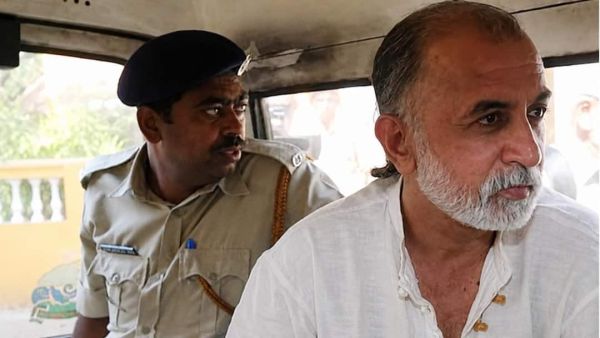
More than a decade after allegations of sexual assault during the 2013 ThinkFest event in Goa, former Tehelka editor-in-chief Tarun Tejpal has been sentenced to 10 years in prison.
On August 6, 2026, the Goa bench of the Bombay High Court overturned his 2021 acquittal in the rape case, convicting him under multiple provisions of the Indian Penal Code. The verdict marks a dramatic fall for a journalist once regarded as one of India's most influential investigative editors.
Early Life And Entry Into Journalism
Tarun Tejpal was born on March 15, 1963. With his father serving in the Indian Army, he spent much of his childhood moving across different parts of the country.
After completing a degree in Economics from Punjab University, Chandigarh, he began his journalism career with The Indian Express in the 1980s before working with several news magazines.
In 1998, he co-founded the publishing company RST IndiaInk, which published Arundhati Roy's Booker Prize-winning novel The God of Small Things.
Apart from journalism, Tejpal authored the novel The Alchemy of Desire, published in 2006, exploring themes of love, sex and ambition.
Launch Of Tehelka
In February 2000, Tejpal founded Tehelka.com, one of India's earliest digital news platforms.
The publication quickly gained prominence for its investigative reporting. International publications including The Guardian, Businessweek and Asiaweek listed Tejpal among India's influential figures, while he came to be described as the "Che Guevara of Journalism."
The Sting Operations That Defined Tehelka
Cricket Match-Fixing Exposé
Tehelka's first major investigation came in 2000, when it worked with former India cricketer Manoj Prabhakar to expose links between betting and match-fixing involving the India-South Africa cricket series.
The investigation was later published as a book titled Fallen Heroes.
Operation West End
Tehelka's most well-known investigation was Operation West End in March 2001.
Journalists posing as arms dealers secretly recorded alleged bribery involving defence officials, politicians and middlemen.
The operation led to then BJP president Bangaru Laxman being caught on camera allegedly accepting a bribe, triggering his resignation.
The controversy also engulfed then Defence Minister George Fernandes. Although he was not directly implicated in the sting, he resigned after the defence scandal came to light.
Following the revelations, the government constituted the Venkataswamy Commission. Tejpal questioned why the commission was not abolished if the government genuinely intended to investigate the scandal.
The sting also attracted controversy after media reports alleged that sex workers had been supplied to defence officials during the operation. Tejpal faced allegations of "immoral trafficking" in connection with those claims.
Gujarat Riots Investigation
In October 2007, Tehelka published a special issue on the 2002 Gujarat riots, claiming to possess evidence suggesting the violence was not "a spontaneous outburst of anger."
The publication featured on-camera statements from more than 20 key individuals.
In his editorial, Tejpal wrote that the incidents were not "spontaneous riots" but "mass murders."
The 2013 Goa Case
The turning point came during Tehelka's ThinkFest, held on November 7-8, 2013, at the Grand Hyatt Hotel in Goa, where Hollywood actor Robert De Niro was among the attendees.
A junior female employee accused Tejpal of raping her in a hotel elevator, alleging that he used his position as editor and employer to force himself on her.
One of the key pieces of evidence in the case was an email sent by Tejpal apologising to the complainant. Although he later changed his position, the email became public, after which the Goa Police registered an FIR.
Timeline Of The Case
- November 22, 2013: Goa Police register an FIR.
- November 30, 2013: Tejpal is arrested.
- May 2014: The Supreme Court grants him interim bail.
- 2017: Trial begins after Goa Police file a nearly 2,800-page chargesheet.
Trial Court Acquittal In 2021
In May 2021, the Goa Sessions Court acquitted Tejpal of all charges.
The trial court observed that the complainant's conduct was "unusual" and pointed to lapses in the police investigation, including missing CCTV footage from one floor of the hotel.
The judgment drew criticism from women's rights activists and legal experts, prompting the Goa government to challenge the acquittal before the Bombay High Court.
High Court Convicts Tejpal In 2026
On August 6, 2026, the Goa bench of the Bombay High Court set aside the acquittal and convicted Tejpal under three IPC provisions:
- Section 376(2)(f): 10 years' imprisonment for rape by a person in a position of trust or authority.
- Section 354A: One year's imprisonment for sexual harassment.
- Section 354B: Up to three years' imprisonment for assaulting a woman with intent to disrobe.
The court directed that all sentences would run concurrently and ordered Tejpal to pay ₹10.21 lakh to the complainant as compensation.
He was initially granted two weeks to surrender, which was later extended to four weeks.
Tejpal Calls Verdict 'Wrong'
Following the verdict, Tejpal told reporters that the High Court's decision was "wrong" and said he would challenge it before the Supreme Court.
He also described the case as a "political vendetta."
Referring to Umar Khalid and Shariful Imam, Tejpal said, "Umar Khalid and Shariful Imam are in jail, I am also one of them."
He further claimed that Tehelka had been targeted because of its investigative journalism.
During sentencing, Tejpal appealed for leniency, telling the court, "I am 62 years old and the father of two daughters."
Opposing the plea, Solicitor General Tushar Mehta argued, "This was not a misunderstanding or a joke. Tejpal showed no remorse after the incident and did the same thing again the next day."
What The Court Heard
During the hearing, Solicitor General Tushar Mehta extensively referred to an email that Tarun Tejpal sent to the survivor after the alleged incidents, NDTV reported.
According to the report, Mehta argued that the email amounted to an admission that the incidents had taken place. He told the court that Tejpal had apologised for his "lapse of judgment", expressed shame and claimed he believed the encounters had been consensual.
Tejpal's counsel, Abad Ponda, however, argued that the email referred only to consensual verbal conversations of a sexual nature.
The email, sent on November 19, 2013, a day after the junior colleague complained to the Tehelka Managing Editor, stated that Tejpal had worked with one of the woman's parents and had violated a "long-standing relationship of trust and respect" between them.
The email also acknowledged that the woman had reminded him that he was her boss, to which he had allegedly replied, "That makes it simpler."
In the email, Tejpal wrote, "You are a young woman I have been very proud of, as a colleague's daughter, and then as a colleague in my own office. I have watched you grow and mature professionally into a journalist of great integrity and promise... It wrenches me beyond describing, therefore, to accept that I have violated that long-standing relationship of trust and respect between us and I apologise unconditionally for the shameful lapse of judgement that led me to attempt a sexual liaison with you on two occasions on 7 November and 8 November 2013, despite your clear reluctance that you did not want such attention from me."
-
Kuwait orders closure of its only Iranian private school

-
Meta admits to Centre lapses in curbing child sexual abuse content
-
Temples, mosques, gurudwaras keep Jharkhand exam protest going
-
Kya Bolti Public: CJP’s nationwide listening tour from September
-
Ex-Mangalore University’s Waheeda Sultana dies from heart attack