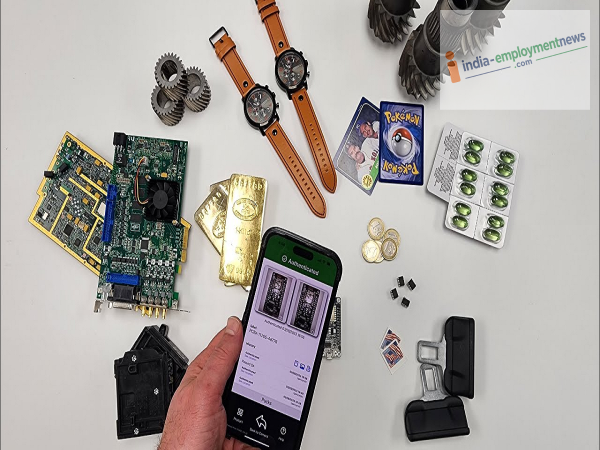
Counterfeit Goods Issue: Counterfeit goods worth thousands of crores of rupees are traded globally every year. A new printing system could help mitigate the losses caused by this issue.
Counterfeit Goods Issue: The global market for counterfeit products is worth thousands of crores of rupees, accounting for approximately 2 percent of total global trade. Counterfeit products cause significant losses for both companies and consumers. Meanwhile, counterfeiters are becoming increasingly sophisticated, making it difficult to distinguish fake goods from genuine ones. Consequently, companies rely on expensive authentication systems that require specialized scanners or proprietary hardware. To address this challenge, researchers have developed a new method that allows counterfeit goods to be identified using just a smartphone.
Let’s find out how this works.
A New Printing System to the Rescue
Researchers have developed a new printing system to produce responsive anti-counterfeit labels. These labels are designed to be durable and easy to mass-produce. Being responsive, they can be scanned using a smartphone. A key advantage is that the entire process is simple and cost-effective. If such labels required expensive equipment, their adoption by companies and the general public would be limited. However, since these labels can be scanned with a smartphone, verifying the authenticity of goods becomes incredibly easy for both consumers and retailers.
Three Technologies Embedded in a Single Label
The new printing system does not produce ordinary labels; it integrates a combination of three technologies. Researchers have developed temperature- and light-responsive microcapsules formulated with UV ink suitable for high-speed printing. Additionally, a portable, smartphone-based detection system has been created to verify the authenticity of the labels. The microcapsules utilize functional materials that react when exposed to light and temperature. This generates unique optical signatures each time—signatures that cannot be replicated using standard printing methods.
Durability has also been a key focus throughout this process. Researchers explained that a nanotechnology-based linker polymer reinforces the capsules, ensuring the label remains stable even in heat and humidity. The ink is free of organic solvents, making it compatible with screen and inkjet printing processes. During testing, the label's color did not fade, demonstrating its ability to withstand the rigors of the supply chain.
The third aspect of the technology involves verification. The system uses a portable detector to observe how the label interacts with light. A machine learning model then analyzes this data to determine whether the product is genuine or counterfeit. In trials, the system demonstrated an accuracy rate of over 97 percent, successfully distinguishing between genuine labels and highly convincing counterfeits.
Smartphone verification to be a game-changer
Currently, companies rely on holograms, QR codes, and RFID-based security features to protect their products from counterfeiting. These methods increase costs and often require specialized verification hardware. The new system, however, enables verification using just a smartphone, eliminating the need for companies to invest in additional hardware. This offers significant benefits for both companies and consumers; customers can easily verify the authenticity of a product from the comfort of their homes using their phones. Researchers noted that this technology is suitable for various sectors within the packaging industry. It is ready for deployment, and companies can integrate it directly into their production lines.
-
Assam flood situation remains grim, toll rises to 97

-
Madhavi Latha backs ‘madrasas are terrorist factory’ remark

-
Siasat review: Toronto’s Biryani Spot nails Hyderabad flavours

-
Man gets 20 years for sexually assaulting minor in Latur

-
Tata Nexon Camo Edition Gets Feature Boost: Price, Variants And What's New