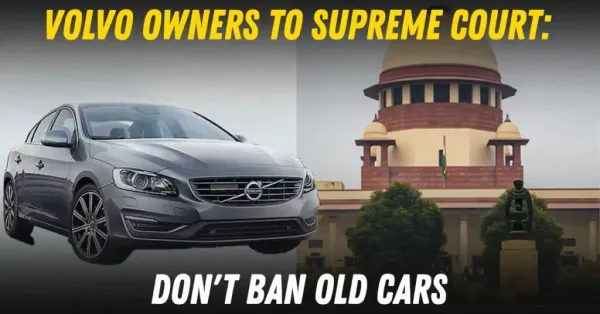
A group of Volvo car owners has now approached the Supreme Court, seeking relaxation of the ‘no fuel for end-of-life vehicles’ rule in the national capital. The mandated ‘expiry age’ for petrol-powered vehicles here. These owners have older Volvo cars and are finding it difficult to obtain fuel. This made them move to the Supreme Court for a solution.
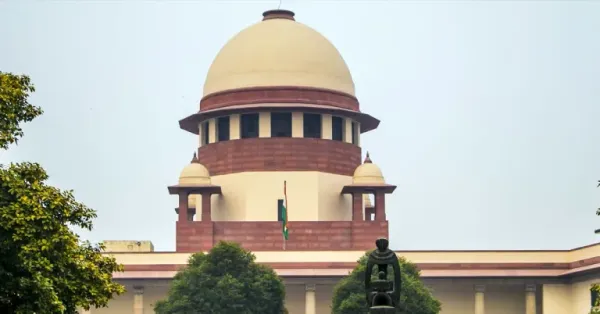
The Supreme Court (SC) on Wednesday, agreed to hear the plea. The owners are seeking relaxation of the rule that bars fuel stations from supplying fuel to older vehicles in the national capital region. Vehicles now have an ‘expiry age’- 10 years for diesel and 15 years for petrol. Any vehicle crossing this is barred from plying on Delhi-NCR roads. They can be denied fuel at bunks. The National Green Tribunal (NGT) was the first to issue this directive. It was further enforced through SC orders that followed.
In this case, a bench comprising Chief Justice of India (CJI) Surya Kant and Justices Joymalya Bagchi and V Mohana was told by the Volvo owners’ lawyer that the matter be listed for urgent hearing, as the petitioners are finding it very difficult to get their cars refuelled. To this, the CJI responded “But this is for pollution… you see”, bringing the environmental rationale into the picture.
The lawyer then argued that the vehicles in question were all high-end Volvo cars, designed and built to last long, and still comply with pollution norms. “These are high-end Volvo cars. They have a long, long life, and we are complying with all pollution norms,”- he said. Compliance with emission norms, he argued, should be prioritised over a vehicle’s age. The decision on whether it stays on the road should be taken based on this. “Anyways, we will list it,” the CJI finally agreed to take up the plea.
The Supreme Court, in October, 2018, banned 10-year-old petrol vehicles and 15-year-old diesel cars from plying on Delhi-NCR roads. A later ruling modified this. In August 2025, following the Delhi government’s recall application, the interim order restrained authorities from taking coercive action against old vehicle owners.
In December 2025, the top court modified the August order and permitted the Delhi government and authorities to take coercive action against old vehicles, particularly those that do not meet Bharat Stage-IV (BS-IV) norms.
After being paused for some time, Delhi NCR’s fuel ban was brought back in July 2025. The ban applied to end-of-life (EOL) vehicles. It was the The Commission for Air Quality Management (CAQM) that made the ban official. It came into force by November, 2025. In the initial phase, this ban applied to EOL vehicles in Delhi, Gurugram, Faridabad, Ghaziabad, Gautam Budh Nagar and Sonipat. In the National Capital Region (NCR), it came into force in April this year. The intent behind this ban is to reduce vehicular emissions and curb pollution.
Camera-based Automatic Number Plate Recognition (ANPR) systems have been installed at fuel stations. These would scan and analyse vehicle number plates and determine their age. The VAHAN database would be used for this. Petrol vehicles that are at least 15 years old and diesel vehicles that are of 10 years of age will be denied fuel.
The move was originally estimated to affect over 6.2 million vehicles. It triggered a massive public outage. In the time that followed. The implementation of this ban was not easy. Technical hiccups and legal challenges made it tough to be put into force, initially.
In Delhi, a valid Pollution Under Control (PUC) certificate is necessary to get fuel, as per a December 2025 notification from the government. The latest challenge, however, is that Pollution Control Centres are refusing to issue PUC to vehicles classified as EOL. This is based on vehicle age and not on pollution compliance. This stays even if the vehicles pass emission tests.
Circling back, it remains to be seen what direction the top court would take in this case. It will be interesting to see the arguments of the petitioner’s side and the court’s responses to it, given the India government’s sharp environmental focus.
-
Yan Diomande says Real Madrid move is a ‘childhood dream come true’ in farewell message

-
Bengaluru Lalbagh Flower Show 2026: Check Here For Dates, Timings, Ticket Prices, Theme

-
Is Your Mixie Not Grinding Properly? Try This Easy Trick Before Replacing the Blade
-
Delhi Private University Bill: 25% Seats for Local Students, Fee Regulation and UGC Rules
-
‘May Not Fit In, But I’ll Fight’: Sarfaraz Khan’s Cryptic Post Amid India Test Snub Goes Viral