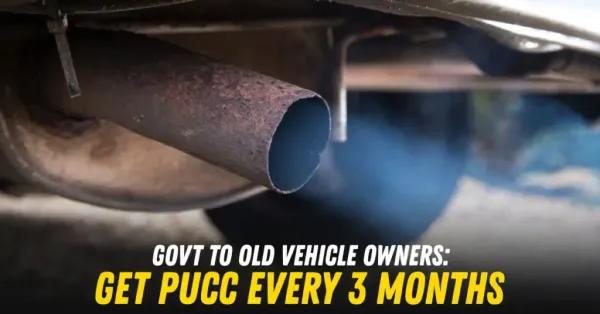
The Indian government is tightening its grip on vehicular emissions. It has now proposed major adjustments in norms linked to Pollution Under Control Certificate (PUCC). Things are getting harder for old cars and motorcycles. According to the draft notification, old cars and motorcycles that comply with BS-I, BS-II and BS-III norms will need to renew their PUCCs every three months.
BS or Bharat Stage essentially refers to standards put forward by the government of India, regarding vehicular emissions. These set limits on pollutants such as carbon monoxide (CO), nitrogen oxides (NOx), hydrocarbons (HC) and particulate matter (PM). These have been modeled on and align with European emission standards (Euro).
The key difference between the two was that the Indian test cycle had a top speed of 90kph while that of Europe had 120kph. India, however, had skipped an entire generation mid-journey- BS5. It later leapfrogged from BS4 to BS6. European regulations, on the other hand, progressed systematically.
According to the new draft notification, BS1, BS2 and BS3 vehicles will face stricter tests. BS1 came into force in 2000. BS3 was rolled out across India in 2010. This should give you an idea of the spectrum and age of vehicles that we are talking about. Previously, the PUCC of these old vehicles (BS1, BS2, BS3) was valid for six months. According to the new draft notification, these vehicles will need to undergo pollution tests every three months. Four times a year. One in every quarter.
The draft notification, proposed by the Ministry of Road Transport and Highways (MoRTH), also states that all motor vehicles complying with BS4 emission norms will need to renew their PUCC every six months. This means two renewals a year. BS4, if you remember, remained in force during the period from 2017 to 2020. India made its BS6 transition in April 2020. The norms that prevail today are the BS6 phase 2, that came into effect in April 2023.
BS6 vehicles, compared to the other generations, are much cleaner. Their emissions are minimal and clean. At present, the PUCC for BS6 vehicles is valid for a year. The government, in its draft notification, proposes to raise this to three years. This move is intended at easing the burden on owners. The amendment will apply to BS6 vehicles which are up to 6 years old. For vehicles which are 6-10 years old, the PUCC will need to be renewed annually. Beyond 10 years, it will need to be renewed every six months.
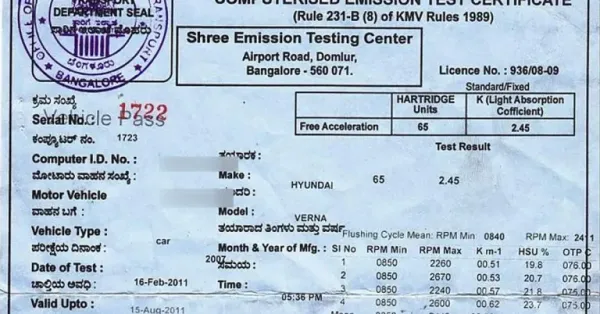
According to the Indian laws, it is mandatory to have a valid pollution under control certificate (PUCC). Brand-new vehicles are exempted from this for the first year of ownership. After this, they will have to be taken to pollution testing centres, get checked and get a valid PUCC issued.
Many states treat driving a vehicle without a valid PUCC as a serious offence. It is in fact, punishable under the Section 190(2) of the Motor Vehicles Act. States like Kerala, Tamil Nadu and others typically impose a fine of Rs 1000 for first-time offence and Rs 2000 for repeat violations.
Regions with critical air quality indices like Delhi-NCR are much stricter with enforcement. Violators may face a flat Rs 10,000 fine and potential suspension of driving license for 3 months!
Delhi also has a ‘No PUCC, No Fuel’ policy in force, which denies fuel to vehicles without a valid PUCC. Fuel stations in Delhi and neighbouring regions have specialised ANPR (Automatic Number Plate Recognition) systems and cameras installed. These scan the number plates and uses VAHAN database to determine the age and PUC status. Based on this, these vehicles can be denied fuel. This move is widely enforced in Delhi and the National Capital Region.
-
Mastantuono fever sweeps Florence as Juventus keep pushing in the market

-
Ranking every Premier League 2026-27 away kit: Elvis, tuxedos and more

-
Young Vietnamese artist builds career as painter, gallery owner in New York

-
Young Vietnamese artist builds career as painter, gallery owner in New York

-
Tamil Nadu CM Vijay’s wife withdraws divorce petition