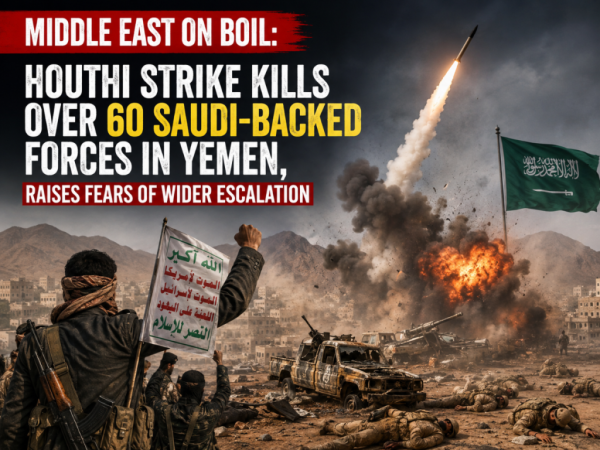
Houthi forces have killed at least 61 Saudi-backed soldiers belonging to the internationally recognized Yemeni government during intensive coordinated strikes on Thursday and Friday. In one of the deadliest days in the civil war in recent years, a barrage of ballistic missiles and explosive drones launched by the Houthis on Thursday killed at least 58 government troops. A subsequent drone attack on a military camp in Marib on Friday killed three additional soldiers. Houthi military officials defended the strikes as pre-emptive, claiming they were countering a planned military offensive by Saudi-backed forces aimed at advancing toward the Houthi-controlled capital, Sanaa.
Concerns Mount Over Fresh Attacks on Saudi Infrastructure
Military analysts warn that the Houthis may soon launch fresh strikes against Saudi Arabia’s energy infrastructure, commercial ports, and regional airports. Houthi officials have signaled that missile and drone operations against Saudi Arabia and its regional allies will continue across Yemeni territory. The rebel group alleged that the Yemeni government is coordinating directly with Riyadh for a large-scale ground and naval invasion against Houthi-controlled positions. Conversely, the Saudi-led military coalition accused the Houthis of violating international humanitarian law by indiscriminately shelling civilian areas, pointing to a cross-border attack in Najran province that injured 11 civilians, including a four-year-old child.
Saudi Arabia and Yemeni Forces Prepare Counter-Offensive
In response to the Houthi offensive, coalition reports indicate that Saudi Arabia and the Yemeni government are preparing comprehensive counter-attacks to regain strategic positions. Saudi military forces remain on high alert, maintaining direct operational coordination with the Yemeni government and US Central Command (CENTCOM). Simultaneously, the geopolitical landscape in West Asia has shifted following the landmark Mecca Joint Defence Agreement signed on Friday by leaders from Saudi Arabia, Pakistan, and Turkey. The NATO-style mutual defense pact establishes a “collective deterrence” framework, treating an armed attack on any of the three signatory nations as an attack on all. As tensions intensify, Riyadh is expected to leverage this trilateral coalition—combining Saudi financial backing, Turkish defense technology, and Pakistan’s military capabilities—to stabilize its borders and counter Houthi threats.
Shamshad Ali is a New Delhi–based journalist with over six years of experience spanning breaking news writing, on-the-ground reporting, and editing. When he isn’t chasing headlines, Shamshad is usually exploring new destinations, discovering hidden culinary gems, and striking up conversations with strangers. Many of whom turn out to be great sources, and even better friends. He can be reached at shamshadali.dar@gmail.com.
The post Middle East On Boil: Houthi Strike Kills Over 60 Saudi-Backed Forces in Yemen, Raises Fears Of Wider Escalation appeared first on NewsX.
-
Mastantuono fever sweeps Florence as Juventus keep pushing in the market

-
Ranking every Premier League 2026-27 away kit: Elvis, tuxedos and more

-
Young Vietnamese artist builds career as painter, gallery owner in New York

-
Young Vietnamese artist builds career as painter, gallery owner in New York

-
Tamil Nadu CM Vijay’s wife withdraws divorce petition