India Electric Three-Wheelers Cross 65% as July EV Record Tops 327,000 Units
Sanjeev Kumar | August 8, 2026 10:22 AM CST
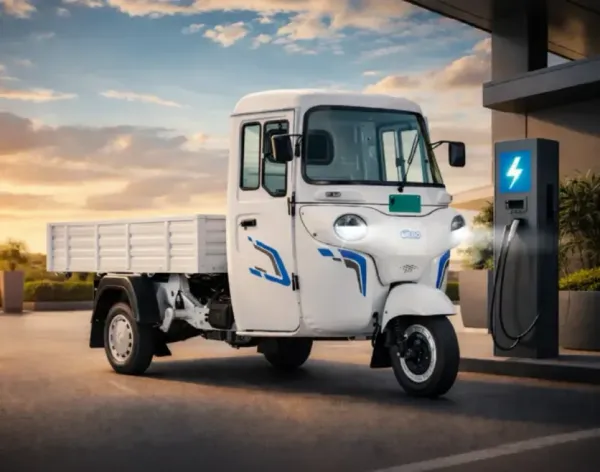
India's electric vehicle market sold more cars, scooters, and cargo vehicles in a single month than it ever has — 327,901 units in July 2026, a 66 percent year-on-year jump — while simultaneously crossing a structural threshold that matters more than any record: electric three-wheelers now hold a 65.1 percent market share, making electric the default mode of transport in the segment that carries millions of India's commuters and last-mile workers every day. The data was , the Federation of Automobile Dealers Associations.
That data covers every major vehicle segment — two-wheelers, three-wheelers, passenger cars, and commercial vehicles — with each one posting its best-ever July performance simultaneously. Nearly one in every eight vehicles sold in India during the month was electric, up from roughly one in ten a year ago. For buyers, fleet operators, and investors tracking India's EV transition, the July numbers confirm what the data has been building toward for two years: this is no longer a forecast.
"The EV transition has stopped being a forecast," said FADA Vice President Sai Giridhar in the statement accompanying the data. "It is now a showroom reality — and Bharat is driving it."
What Buyers Need to Know Right Now
The most urgent decision signal in this month's data is the expiry of the PM E-Drive scheme's demand subsidy for electric two-wheelers. The subsidy — set at ₹2,500 (approximately $26) per kWh of battery capacity and capped at ₹5,000 (approximately $52) per vehicle .The record two-wheeler volumes in July were partly a subsidy-driven surge — buyers rushing to lock in the incentive before the deadline — which means August may see a mechanical pullback before underlying demand reasserts itself. For three-wheelers, the picture is structurally different. The PM E-Drive incentive for e-rickshaws and e-carts , a 20-month runway that the data suggests may no longer be necessary: with 65.1 percent market share, the segment has already electrified past the point where ICE variants can mount a competitive comeback.Electric Two-Wheelers Cross 200,000 Units for the First Time
July's most-watched milestone belonged to electric scooters and motorcycles, which crossed 200,000 monthly retail sales for the first time in recorded history. Registrations in the segment to 204,362 units, and market share climbed to 11.2 percent from 7.7 percent a year earlier and 10.6 percent in June 2026. The seven-month cumulative tally for calendar year 2026 reached 1.17 million electric two-wheeler units, up 56 percent year-on-year — a pace that puts the segment on course to more than double its 2024 full-year output. The OEM race was reshaped decisively by established manufacturers. TVS Motor Company set a new all-time monthly record with 55,477 electric scooters — a 135 percent year-on-year increase — giving it a 27 percent market share, up from 22 percent a year ago. Bajaj Auto sold 45,592 Chetak units — a 122 percent increase — with Joint Managing Director Rakesh Sharma noting the recently launched Chetak 2501 model already accounts for around 12 percent of the brand's scooter portfolio. Ather Energy delivered 30,323 units, up 70 percent, and updated the battery chemistry of its Rizta range in July, adding a alongside its existing NMC option — a move that lowers cost and improves thermal stability for a price-sensitive, heat-intensive market. Hero MotoCorp's Vida line recorded 22,887 units — a 111 percent year-on-year rise and its best-ever monthly result. The exception is Ola Electric, which sold 14,105 units — a 23.5 percent year-on-year decline that left the company, once the undisputed market leader, trailing four rivals. The slide is structural: Ola built its early dominance around a direct-to-consumer model but did not build the service infrastructure — parts logistics, service center density, technician training pipelines — that a high-volume two-wheeler business requires in India's geographically sprawling market. TVS and Bajaj, with six decades each of dealer and service ecosystem engineering behind them, exploited that gap. On Friday, Ola announced it was in favor of a conventional dealership model, a pivot that represents the company's largest structural change since its founding.Why Are Electric Three-Wheelers the Real Story?
The headline number is 65.1 percent market share — meaning electric three-wheelers now outnumber petrol and CNG three-wheelers in India by roughly 2 to 1. But the mechanism behind that number is what matters, because it explains why the share will keep rising rather than reverting. An electric rickshaw costs ₹60,000 to ₹1,10,000 (approximately $630 to $1,155) at purchase. A comparable petrol or CNG auto-rickshaw runs ₹1,50,000 to ₹3,00,000 (approximately $1,575 to $3,150). That price gap from day one. The operating economics then compound the advantage: electric three-wheelers run at roughly ₹0.50 to ₹0.70 per kilometer (approximately $0.005 to $0.007 per kilometer) compared to ₹3 to ₹4 per kilometer ($0.032 to $0.042 per kilometer) for petrol or CNG alternatives — a five-to-seven times per-kilometer cost advantage that translates to roughly ₹1,00,000 ($1,050) more in annual earnings for a driver .At those economics, the question facing an e-rickshaw driver is not "why should I buy electric?" but "why would I not?" "Three-wheelers, at 65.1 percent, have made electric the default, not the alternative," said FADA's Giridhar. That threshold matters beyond this month's data. Once a technology holds majority share in a commercial segment where buyers are running cost-sensitive businesses, the process tends to be self-reinforcing: more electric vehicles on the road justify more public charging infrastructure, which reduces range anxiety, which attracts more buyers, which attracts more OEM investment, which lowers per-unit costs further. The 65 percent mark is not a peak — it is a floor.Passenger EVs: Supply Is the Binding Constraint, Not Demand
Electric passenger vehicles registered 83 percent growth over a year ago, holding a 7.9 percent market share in July 2026 — up from 5.1 percent in July 2025 but unchanged from June's 7.9 percent. In absolute terms that translates to 32,928 units — strong growth, but growth rather than buyer demand., but growth constrained by manufacturing output rather than buyer demand. Giridhar flagged this directly, noting that passenger EV growth was "held back only by supply of in-demand models" and urging automakers to resolve production constraints before the festive season. That season — running from late August through Diwali in November, India's peak auto-sales window — will determine whether passenger EV OEMs can match demand-side momentum with supply-side delivery. A sector research report by Asit C. Mehta Investment Intermediates, released this week, confirmed that July's robust demand occurred despite monsoon uncertainty and that festive season tailwinds are expected to in the months ahead.Commercial Vehicles: From Pilots to Purchase Orders
In commercial vehicles, electric adoption reached a 3.57 percent market share in July — up from 1.65 percent in July 2025 — representing in a single year. "Fleet electrification has moved from pilots to purchase orders," said Giridhar — a signal that logistics operators, e-commerce players, and fleet managers are now making bulk procurement decisions rather than running small-scale EV trials. Flipkart, Amazon, and quick-commerce platforms have already deployed thousands of in their delivery fleets — not for press releases but because per-parcel cost drops materially when the vehicle running cost is a fraction of ICE. The commercial vehicle number suggests that dynamic is spreading from e-commerce into broader freight and transport.The Battery Chemistry Behind the Numbers
The competitive results in July reflect technology choices made years ago. Ather's decision to update the Rizta's battery options to include LFP alongside NMC in July illustrates the tradeoff facing every Indian EV maker: NMC batteries deliver higher energy density (200–250 Wh/kg versus 120–160 Wh/kg for LFP) and thus greater range, but LFP uses cutting costs by 20 to 30 percent and providing far better thermal stability in conditions where Indian summer temperatures regularly hit 40–45°C (104–113°F). For a market where the median buyer is choosing a commuter scooter or commercial rickshaw rather than a long-range premium vehicle, LFP's safety, durability, and cost profile is the better engineering fit. TVS went further this month, introducing Battery-as-a-Service on its Orbiter V1 model — a financing structure that separates battery ownership from vehicle ownership, with , shifting the battery's capital cost to a monthly subscription fee. For high-mileage users, it lowers the psychological sticker-price barrier while preserving the per-kilometer economics that made the purchase decision rational in the first place.What Comes Next: Subsidy Cliff and Festive Season Test
The next 60 days represent the most important test of whether July's record reflects genuine structural demand or a subsidy-inflated spike. The two-wheeler figures were almost certainly elevated by buyers rushing to capture the ₹5,000 ($52) PM E-Drive incentive before the July 31 deadline, a pattern documented in India's prior subsidy transitions — the FAME-II phase-out in 2023 and the PM E-Drive two-wheeler extension from March to July 2026. August data, released in September, will reveal the structural floor. If monthly two-wheeler registrations stabilize near 150,000 to 170,000 units — consistent with pre-surge baseline trends — the July record reflects borrowed demand and real underlying growth. If volumes hold closer to the 200,000-unit range, the subsidy story was a smaller factor and the structural demand is stronger than even July's headline implies. The festive season — Onam, Navratri (October), and Diwali (October/November) — will layer additional demand on top of whatever baseline August establishes. Passenger EV OEMs face the most acute test: the segment is supply-constrained, not demand-constrained, meaning automakers who resolve production bottlenecks before October will capture festive-season volume that competitors with waiting lists will forfeit. Geopolitical risks add a macro tailwind: renewed disruptions from the West Asia crisis could push oil prices higher, reinforcing the economic case for every vehicle category that runs on electrons rather than imports. "India has never bought more electric vehicles in a month than it did in July 2026," said Giridhar. "With nearly one in eight vehicles retailed now electric — and every category telling the same story in its own way — the data speaks."Frequently Asked Questions
Why did PM E-Drive two-wheeler subsidies expire now, and what does that mean for August buyers?
The PM E-Drive scheme was designed with a fixed outlay of ₹10,900 crore (approximately $1.14 billion) and a fund-limited structure — meaning subsidies end when either the money runs out or the deadline passes, whichever comes first. The two-wheeler incentive was extended from its original March 31, 2026 deadline to July 31, 2026, and has now lapsed. Buyers who purchase an electric two-wheeler from August onward will not receive the up-to-₹5,000 ($52) per-vehicle grant. The practical impact varies by model and budget: the ₹5,000 cap is modest relative to total vehicle cost for premium scooters but is meaningful for entry-level models. Three-wheeler and e-rickshaw buyers are unaffected — their subsidies .Why is Ola Electric losing ground to TVS and Bajaj?
Ola Electric built its early market leadership on a product-first, direct-to-consumer strategy without prioritizing after-sales infrastructure — the service centers, spare parts availability, and technician networks that high-volume scooter ownership requires. Competitors like TVS (more than 80 years of dealer network engineering, 50,000-plus outlets) and Bajaj (six decades of distribution infrastructure) already had those systems in place and could redirect them toward EVs. As service complaints mounted — repair delays reported at up to nine days, parts shortages, scooters stranded at service centers — buyers migrated to brands where ownership experience matched purchase promises. Ola's announcement on Friday that it is abandoning its direct-to-consumer model and is an acknowledgment that service infrastructure, not product innovation, determines market share at scale in India's two-wheeler segment.Why is the 65 percent electric three-wheeler market share more significant than the overall EV record?
Volume records can be driven by short-term factors — subsidies, price cuts, festive timing. A 65 percent segment market share reflects the underlying economics of the product itself, stripped of temporary incentives. Electric three-wheelers cost half to one-third the upfront price of equivalent ICE auto-rickshaws and run at one-fifth to one-seventh the per-kilometer fuel cost. For a commercial driver running 100 to 120 kilometers per day, switching to electric delivers roughly ₹1,00,000 (approximately $1,050) in additional annual earnings — a payback period measured in months, not years. At that level of economic advantage, market share . The ICE three-wheeler is now the product that needs an incentive to compete, not the other way around.Will India's EV sales hold above 300,000 units per month, or was July a one-time spike?
The August data will answer this definitively, but the structural signals favor sustained high volumes rather than a sharp reversal. The three-wheeler segment — at 65 percent electric share — will continue to grow on economics alone. Commercial vehicle electrification is in early innings, with fleet operators now placing bulk orders rather than running pilots. Passenger EVs are supply-constrained, not demand-constrained, meaning latent demand is queued up for delivery. The two-wheeler segment is most likely to see a near-term mechanical correction after the PM E-Drive subsidy expiry, but the segment's baseline monthly run rate heading into 2026 was already 150,000 to 170,000 units — which would still represent a structural step-change from the 108,516 units sold in July 2025. The festive season from October to November will test the ceiling; the August and September numbers will reveal the floor.READ NEXT
-
Will Pio Esposito turn down Arsenal and Manchester United? Inter Milan striker moves closer to new San Siro deal

-
According to Garuda Purana, when you see these signs in your life, then understand that your thinking and direction are changing.
-
According to Garuda Purana, when you see these signs in your life, then understand that your thinking and direction are changing.
-
Sawan 2026: Want to have children? Anoint the Shivalinga with this item during Sawan, and your wish may be fulfilled.

-
15 August DIY Ideas: Give children fun tasks on the 15 August holiday, make tricolor crafts from household items