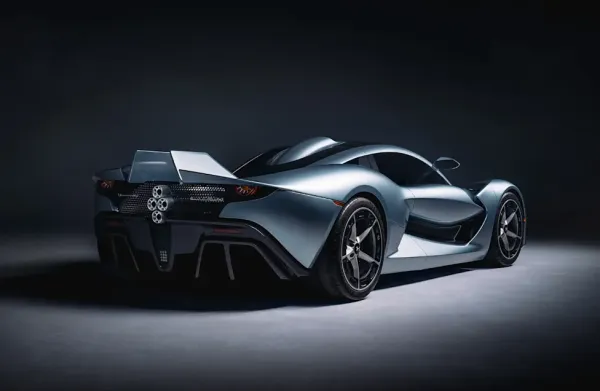
Hennessey has spent fifteen years building cars whose entire personality was a number. The Venom GT chased 270 mph. The Venom F5 chased 300. The new Blackbird, revealed August 3 from Sealy, Texas, tops out at 220 mph and has a stick shift. That is not a step back so much as a complete change of argument.
Here's what : a naturally aspirated 6.2-liter V8 developed with Ilmor Engineering, targeting 800–850 horsepower and more than 9,000 rpm, driving the rear wheels through a six-speed gated manual. Bespoke carbon tub, carbon body, inboard suspension, adaptive dampers, Michelin Pilot Sport Cup 2 tires, target dry weight under 3,000 pounds, 0–60 in 2.5 seconds. Seventy-one cars, $2.5 million before tax, customer production targeted for 2029–2030, more than two-thirds already spoken for. Public debut at The Quail on August 14.
Now the parts that actually deserve your attention.
The engine is the hardest promise on the list
Hennessey says the Ilmor unit is expected to be the highest-revving and most powerful naturally aspirated road-car V8. That's a real record to take. Chevrolet's 5.5-liter LT6 in the Corvette Z06 was billed at launch as in any production car — 670 hp with an 8,600-rpm ceiling. Blackbird has to clear both figures with a bigger engine, which is the harder direction to go.
Bigger displacement means bigger cylinders, and bigger cylinders resist revs. Divide 6.2 liters by eight and you get 775cc per cylinder — roughly a Z06 cylinder plus 20 percent. Assume a very oversquare 104mm bore and the stroke works out near 91mm. At 9,000 rpm that's a mean piston speed around 27 meters per second. The LT6, with its 80mm stroke at 8,600 rpm, sits closer to 23. Production road engines almost never live above 25. This is prototype-racing territory, sustained on pump fuel, on a warranty, for a customer who wants to drive 800 miles in a day.
Which is exactly why Ilmor's name on the project matters more than the horsepower estimate. Mario Illien and Paul Morgan founded the company to build a turbocharged Indy V8 with Roger Penske's money, and won at Long Beach with Mario Andretti in 1987. Ilmor knows how to make a piston survive at 27 m/s. Whether it can also make one survive a decade of cold starts and 500-mile Sunday drives is the interesting engineering question, and the Pennzoil partnership Hennessey highlighted in the release is a tell about where the development risk sits.
The number Hennessey didn't publish
Look at the spec table and you'll notice torque is absent. That omission is informative. Take 850 hp arriving around 8,500 rpm and the arithmetic gives roughly 525 lb-ft at the power peak, with a broader peak likely somewhere in the mid-500s.
That's the figure that makes a gated six-speed feasible. The Venom F5's twin-turbo Fury produces torque on an entirely different order, and building a manual behind it — the F5-M — was a genuine feat of clutch and gearset engineering. Blackbird asks far less of the same hardware. Natural aspiration also removes the boost-spike problem: torque arrives on a predictable ramp instead of a step, which is easier on synchros and much easier on the driver trying to place a shift at 9,000 rpm.
The claim I'd want to see verified is 2.5 seconds to 60. That's rear-drive only, on Cup 2s rather than the stickier Cup 2 R, with a human operating the clutch. No launch control, no dual-clutch, no front axle to lean on. Dry weight under 3,000 pounds helps enormously — but note that word. Dry means no fuel, no oil, no coolant. Add fluids and a full tank for a car engineered to cover 800 miles between stops and real-world curb weight climbs meaningfully.
The regulatory bill nobody mentions
Hennessey says Blackbird will be homologated for key global markets. In the U.S., that route runs through NHTSA's temporary exemption process under , which caps exemptions at 2,500 vehicles per manufacturer per year — no constraint at all for a 71-car run. Worth noting that NHTSA just on July 31, 2026, clarifying that an exemption can now cover vehicles built before its effective date at the Administrator's discretion — a small change that matters a great deal to builders whose cars leave the shop years apart.
Then there's the Gas Guzzler Tax. It applies to cars with an unadjusted combined rating below 22.5 mpg, and the for anything under 12.5 mpg. A 6.2-liter naturally aspirated V8 hunting 9,000 rpm will land in that bracket without breaking a sweat. On a $2.5 million invoice it's noise, but it's a line item, and it's one every buyer of a car like this pays.
The screen-free cabin is a depreciation strategy
Hennessey frames the analog interior — no infotainment display, no digital cluster, no steering-wheel buttons, physical ignition key, big central tachometer, dash-mounted whiskey compass — as an emotional choice. It's also a shrewd one, and here's the part collectors already understand.
The single worst-aging component in a modern hypercar is its screen. Capacitive touch panels delaminate, backlights fail, and the head units are sole-sourced from suppliers who stop making them long before the cars stop being valuable. Restoring a 2010s supercar increasingly means hunting a discontinued display module. Hennessey's approach — premium speakers, navigation and CarPlay running off the owner's own phone in a bespoke holster — moves that failure point outside the car entirely. In thirty years the phone will be an antique and the car won't care.
What buyers are actually signing up for
Two-thirds allocated, four years before customer production, an all-new tub and an all-new engine that doesn't exist in finished form yet. Every number in the release is a target, and Hennessey says so plainly. Deposit holders are funding the development of a clean-sheet program, and F5 production is expected to end around 2028 — meaning there's a gap between the two cars where the company has no hypercar rolling out the door.
Hennessey also notes it owns the registered Blackbird trademark for high-performance vehicles, which is the sort of detail that reads as trivia until you remember how many small manufacturers have lost naming fights they didn't budget for.
The pitch is sound: high-revving, unassisted, three pedals, no screens, and enough luggage room for two carry-ons. If Ilmor delivers 850 naturally aspirated horsepower at those piston speeds with an ownership experience that doesn't require a rebuild every 15,000 miles, it will be one of the more remarkable engines of the decade. That "if" is doing a lot of load-bearing work until 2029.
-
Will Pio Esposito turn down Arsenal and Manchester United? Inter Milan striker moves closer to new San Siro deal

-
According to Garuda Purana, when you see these signs in your life, then understand that your thinking and direction are changing.

-
According to Garuda Purana, when you see these signs in your life, then understand that your thinking and direction are changing.

-
Sawan 2026: Want to have children? Anoint the Shivalinga with this item during Sawan, and your wish may be fulfilled.

-
15 August DIY Ideas: Give children fun tasks on the 15 August holiday, make tricolor crafts from household items