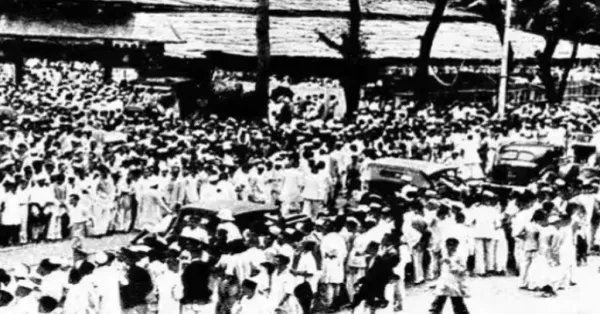
Quit India Movement History: The day of 8th August is recorded in golden letters in the history of India’s freedom struggle. On this historic date in 1942, Father of the Nation Mahatma Gandhi blew the bugle of the country’s biggest movement against the British rule, ‘Quit India Movement’. The historic Gowalia Tank Maidan of today’s Mumbai and then Bombay became witness to this great revolution, which today the entire country knows as ‘August Kranti Maidan’. Today, on the anniversary of this historic event, the entire country is saluting those great martyrs and freedom fighters who sacrificed their all to break the shackles on the feet of Mother India.
That immortal night of ‘Do or Die’
Following the failure of the Cripps Mission, the country was filled with despair and discontent. At this juncture, Mahatma Gandhi resolved to wage a decisive and final struggle to drive the British out of the country. On the night of August 8, 1942, the All India Congress Committee’s Mumbai session passed the “Quit India” resolution with an overwhelming majority.
Addressing the nation from the stage at this very convention, Mahatma Gandhi delivered that historic and magical slogan, which instantly awakened the dormant patriotism within millions of Indians. Gandhiji had said, “I am giving you a small mantra, which you can engrave in your hearts and express with every breath. That mantra is – ‘Do or Die.’ We will either liberate India or give our lives in the attempt.”
A young leader from Mumbai gave the slogan “Quit India”.
An interesting historical fact is that the phrase “Quit India” was not coined by Mahatma Gandhi himself. Yusuf Meherally, the then mayor of Mumbai and a socialist leader, coined the exact slogan. Gandhi liked the phrase so much that he made it the main theme of his largest movement against the British Empire.
Operation Thunderbolt: Top leaders of the country arrested overnight
Gandhi’s speech so alarmed the British government that it immediately launched Operation Thunderbolt to crush the movement. Before sunrise on August 9th, all top Congress leaders, including Mahatma Gandhi, Jawaharlal Nehru, Sardar Vallabhbhai Patel, and Maulana Abul Kalam Azad, were arrested. Gandhi was placed under house arrest at the Aga Khan Palace in Pune, while other leaders were imprisoned in the fort at Ahmednagar (now Ahilyanagar).
When a leaderless movement became a people’s revolution
The British believed that imprisoning the top leaders would end the movement, but the tables turned. In the absence of leadership, the people of the country became their own leaders. On the morning of August 9th, at Mumbai’s Gowalia Tank Maidan, brave woman Aruna Asif Ali hoisted the tricolor flag amid a strict curfew and police presence, galvanizing the movement.
The movement then spread like wildfire from Mumbai to the entire country. Doctors, engineers, laborers, farmers, and millions of students took to the streets to challenge British rule.
Maharashtra’s unique sacrifice in the Quit India Movement
The land of Maharashtra displayed unprecedented bravery in this movement. From child martyr Shirish Kumar Mehta of Nandurbar to Krantisinh Nana Patil of Satara, Maharashtra’s brave sons sacrificed their lives.
- Child Martyrs of Nandurbar: During the Quit India Movement, people in every village took out processions carrying the tricolour, chanting “Vande Mataram” and “Bharat Mata ki Jai.” On March 9, 1942, a large rally was held in Nandurbar. Shirish Kumar Mehta, a student of just 16 years of age, led a procession in Nandurbar holding the tricolour in his hand. The British police opened fire on them, killing Shirish Kumar and four of his schoolmates on the spot.
- Hutatma Chowk of Palghar: On 14 August 1942, five local heroes were martyred together by police bullets while protesting against foreign rule in Palghar.
- Prati Sarkar of Satara: Krantisinh Nana Patil overthrew the British rule in Satara and established his own parallel government (prati sarkar), which functioned successfully for several months.