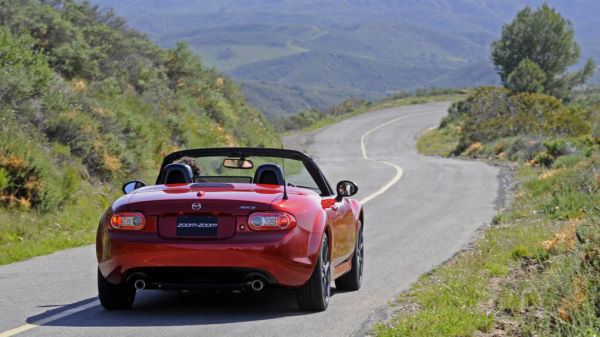
When you picture setting off for a road trip, what car pops in your head? Maybe the perennially romanticized lazy wagon that rides on a bed of clouds, or a big RV towing a Jeep. It could be a fuel-efficient crossover with plenty of legroom, or a pickup truck carrying an RV and a cooler of zesty refreshments. Not many people are liable to peg a Mazda MX-5 for that role, though, and it’s easy to see why. Whether it’s because we’ve grown accustomed to larger vehicles in recent years or the MX-5 simply doesn’t match that “road trip car” paradigm, it’s hardly ever anyone’s top choice, enthusiast or not.
But the real question is: Is the MX-5, also called the Miata, actually good at road trips? Despite the lack of cargo space, the stiff ride, the gear ratios, and a number of other issues we’ll discuss, do its quirks make up for all that? Remarkably, according to drivers, absolutely.
We browsed journalistic blogs, forums, professional articles, and personal anecdotes alike to confirm this because we didn’t believe it at first, either. Sure, they’re widely-known as some of the best enthusiast cars of all time, but the MX-5 is without question a more specialized machine. It’s not designed for long-distance highway driving, yet it actually does just that with spirited aplomb — provided you can deal with the downsides.
This isn’t even an entirely unknown phenomenon, either. Plenty of enthusiasts around the world, in all sorts of climates and road conditions, have driven their Miatas for hundreds or even thousands of miles in single trips. We’ll be considering all of these, ranging from long American freeway excursions to tight European and urban landscapes, to be as comprehensive as possible.
What’s so good about road tripping in a Miata MX-5?
First and foremost, it goes without saying that hitting the road in a convertible is already a win if you prefer fresh air and open skies, and the MX-5 is easily one of the best sports cars on the market for that purpose — not to mention one of the cheapest. They’re relatively fuel-efficient as well, at least for a pure combustion-powered sports car; obviously they’re never beating something like a Prius. But let’s be real, you’re not driving the Miata because it’s the most efficient vehicle on the road. It’s a well-rounded and plucky car, and that doesn’t always fade after hours of driving to the enthusiast.
Where this car really comes alive, to the surprise of no one, is back roads. MX-5s are legendarily fun to throw around twisty wooded areas and mountain passes, making them perfect for taking the scenic route. The peppy four-cylinder is rev-happy no matter what generation you opt for, so you’re bound to have a wonderful time trekking through something like the Pacific Coast Highway, the Appalachian back-roads of New York’s Catskills, or even northern passes in Scandinavia. Anything where you’re not just constantly holding it at 80 mph for hours at a time, which isn’t exactly thrilling in any car.
The pros, then, rely more on where and how you drive the MX-5. The whole point of road tripping an enthusiast-centric roadster is to use those qualities as much as possible. Give it scenic vistas and plan for both pit stops and bouts where you foot gets a little heavy, and the car will reward you in kind.
Are there any downsides to road-tripping with a Miata?
The most obvious downside doesn’t need much of an explanation — just look at it. The MX-5 can be the greatest invention since sliced bread, but that’s about all it can fit. It’s a two-seater sports roadster, complete with stiff suspension, barely any cargo space in comparison to a sedan or wagon, and it’s loud. That much is also apparent, especially with the soft top. A car’s general shape and aerodynamics affect wind noise a lot, and the Miata wasn’t exactly designed to deal with that. Coupled with the short gear ratios, expect a lot of droning noise on the highway.
Those gear ratios also lend another quirk: high RPMs. Owners report holding the car at over 4,000 RPM on American interstates, not exactly ideal to do for hours on-end — and you’ll have to in order to keep up with interstate traffic. These cars are small and light, so they can get tossed around by slab-sided vehicles like semi trucks and buses if there’s a substantial speed difference. Remember, they weren’t built for wide-open roads, but rather technical, twisty passes. And that’s not including the MX-5’s inherent issues, like its tendency for dead batteries and its less-than-ideal air conditioning.
A lot of these downsides can be mitigated, though. Racks exist for these cars to help with cargo space. Pulling over and stretching your legs a bit works wonders if you’re feeling claustrophobic or your legs are getting tired, though every model having cruise control is a huge plus for that as well. And if the noise is bothersome, then swap in a hard top or add some sound insulating carpets and such; they work wonders for road noise.