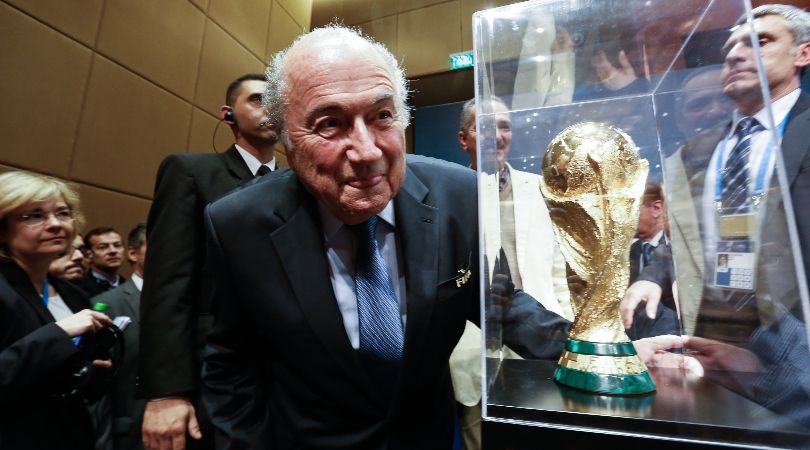
The former FIFA President’s repeated barbs at his successor are a depressing reflection of where the game stands.
“Now it is up to the fans, players and national associations to reclaim football and bring it back to its roots under new leadership.”
That was Sepp Blatter writing on X on July 21, as the former FIFA President argued that World Cup 2026 was the point at which the tournament had “lost its credibility” in his latest swipe at his successor, Gianni Infantino.
Yet that line would have felt just as apt in the aftermath of Blatter’s own resignation as head of world football’s governing body in June 2015, during a major corruption investigation involving senior FIFA officials. The fact that Blatter is now speaking as though he is the sport’s moral authority while criticising Infantino is embarrassing for him, for FIFA and for football.
Blatter is not especially active on X, which is perhaps no surprise for someone who turned 90 in March. But the man who describes himself in his bio as a ‘Football Philosopher’ has stepped up his social media activity this summer, with the World Cup and Infantino’s failed attempt to sell stakes in the tournament and other FIFA competitions to private investors giving him plenty to comment on.
Since June 13, the Swiss has posted several messages on X attacking FIFA on a range of matters, including the decision to revoke USA striker Folarin Balogun’s one-match suspension after President Donald Trump became involved, the World Cup final half-time show, and Infantino’s investment proposal. Those posts have almost always included the hashtags #GianniInfantino and #DonaldTrump.
Blatter’s opinions are certainly legitimate and will be echoed by millions of supporters, but it is astonishing that he is able to express them without any apparent sense of contradiction.
In two of those posts, the former FIFA boss used the Latin phrase ‘Quo vadis’, meaning ‘where are you going?’. It was Blatter’s way of questioning the direction FIFA is taking under Infantino — something he might well have reflected on during his own spell in charge.
Between his election in 1998 and his resignation 17 years later, the organisation was mired in numerous controversies, including corruption allegations and the deeply contentious decision in 2010 to award the 2018 and 2022 World Cups to Russia and Qatar respectively. That period reached its breaking point in 2015, when seven senior FIFA officials were arrested in Zurich on the eve of the FIFA Congress, with Blatter stepping down a few days later.
It is important to point out that Blatter was not among those arrested, and last year he was cleared of corruption charges linked to his time at FIFA. Those charges related to a payment of 2m Swiss francs, now about £1.84m, which he made in 2011 to the then UEFA President Michel Platini.
However, in 2015 FIFA’s ethics committee banned him from football for eight years, a sanction later reduced to six on appeal. Then, in March 2021, he was handed another suspension of six years and eight months for multiple breaches of FIFA’s Code of Ethics, including the provisions titled ‘duty of loyalty’, ‘conflicts of interest’ and ‘offering and accepting gifts or other benefits’.
That is why Blatter must surely recognise the irony in claiming that the World Cup has “lost its credibility”, when the process to award the 2018 and 2022 tournaments was itself clouded by corruption allegations. More than half of the 22 members of FIFA’s Executive Committee that selected the host nations have since received sanctions ranging from fines to lifetime bans from football.
That is also why Blatter’s criticism of Infantino’s plan to sell off World Cup interests lost some force when, in another post, he said FIFA has a “fiduciary responsibility to protect the global game”.
‘Fiduciary’ means putting someone else’s interests ahead of your own, which sits uneasily with the 2014 report by US attorney Michael Garcia into the bidding processes for the 2018 and 2022 World Cups. Garcia said the Executive Committee under Blatter operated in a culture of “expectation and entitlement” and that many of its members “displayed a disregard for ethical guidelines”.
It is also why FIFA should feel embarrassed to be receiving lectures from its former President, whose 2015 resignation was meant to signal a fresh start.
As difficult as it may seem to believe now, Infantino was once viewed as the figure who would repair FIFA’s image when he was elected in February 2016. The then FA chairman Greg Dyke described Infantino as a “straightforward guy”, while David Gill, the former Manchester United chief executive who was FIFA Vice-President at the time, said it was a “good day for football”.
Infantino, for his part, said: “We’ll restore the image of FIFA and make sure everybody will be happy with what we do.”
Needless to say, that is not how things have unfolded.
Among a host of unpopular moves, there has been the expansion of the World Cup to 48 teams, with the possibility of 64 in 2030, the awarding of the 2030 tournament across three continents to clear the path for Saudi Arabia to host in 2034, a 32-team summer Club World Cup with Infantino’s name engraved on the trophy, the launch of the FIFA Peace Prize in what looked like a desperate effort to curry favour with Trump, soaring World Cup ticket prices and, of course, Infantino’s sell-off plan, which could yet cost him the presidency.
When all of that is taken into account, Blatter begins to look like the lesser of two evils — and that is precisely why football should feel ashamed.
Even in 2015, when FIFA’s reputation was already at rock bottom, many of the decisions taken during Infantino’s time in office would have sounded absurd.
And yet, before his World Cup investment proposal exploded in his face, more than 200 of FIFA’s 211 member associations had supported Infantino’s re-election, underlining just how untouchable he had become.
Countries and confederations have since come together in an effort to remove him from office, but the fact that they allowed so much to pass unchecked before that does not inspire much belief that football will be taken “back to its roots”, as Blatter now appears to want.
That opportunity has gone — and Blatter has to accept that he played a part in creating what football has become.
-
4 former warehouse workers in Hong Kong jailed over plots to steal Chanel bags and wallets worth $1.1M

-
4 former warehouse workers in Hong Kong jailed over plots to steal Chanel bags and wallets worth $1.1M

-
Injuries to Six Key Players Put Team India in Trouble Ahead of Sri Lanka Test Series

-
China refuses FIFA ASEAN Cup invitation to host friendly tournament
-
Bomb and hijack claim sent Indonesia’s second-busiest airport searching two boarded flights