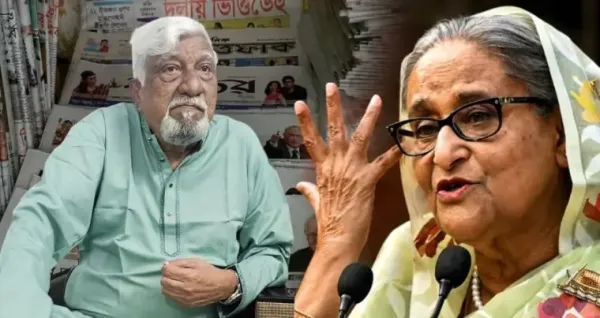
Sheikh Hasina’s first public speech from Delhi and her claim to return to Bangladesh has sparked political turmoil in Bangladesh. The Bangladesh government, led by Tarique Rahman, strongly objected to Sheikh Hasina’s address, calling it an insult to Bangladesh and those killed in the July uprising.
Dhaka: A statement has sparked a new debate in Bangladeshi politics. Nasir Uddin Chowdhury, a lawmaker with the Bangladesh Nationalist Party (BNP), led by Prime Minister Tariq Rahman, has claimed that the Awami League, the party of former Prime Minister Sheikh Hasina, could merge with the BNP in the future. At a public event, he described the Awami League as an ally of the BNP.
This statement comes at a time when Sheikh Hasina’s recent public address from India has drawn sharp reactions from Bangladesh’s current government and BNP leaders. However, clarity is needed as to whether this statement by the BNP MP represents official party policy or her personal opinion. For now, it is being viewed solely as a statement by an MP.
Sheikh Hasina’s address sparks controversy in Bangladesh
Former Prime Minister Sheikh Hasina addressed the public for the first time since leaving Bangladesh. The event took place during a press conference held in New Delhi, which Hasina attended virtually. She reportedly spoke and answered questions from journalists via audio, keeping the camera off. This appearance was significant because Hasina left Bangladesh on August 5, 2024.
In her address, Sheikh Hasina expressed her desire to return to Bangladesh. She stated that she would try to return to her country by December. Hasina also stated that she was aware of the possibility of arrest or threats to her life, but that these circumstances would not deter her from her decision to return. Her statement became a major topic of discussion in Bangladesh’s political environment.
BNP MP calls Awami League an ally
A few days after Hasina’s statement, BNP MP Nasir Uddin Chowdhury offered a different perspective on the Awami League. At a rally, Chowdhury, the MP from Sunamganj-2, said that the Awami League should be considered an ally, not an enemy, of the BNP. He cited the historical ties between the two political parties, referring to Bangladesh’s Liberation War.
According to reports, the MP also claimed that the Awami League could merge with the BNP in the future. However, it would be premature to conclude from this statement that any formal merger process between the BNP and the Awami League has actually begun.
Has the BNP’s official policy changed?
This question is important because several senior BNP leaders have taken a strong stance against the Awami League and Sheikh Hasina in the past. Senior BNP leader Ruhul Kabir Rizvi criticized Sheikh Hasina after her address from India. He called Hasina’s address an insult to those killed in the July uprising and questioned her political statements from India.
This indicates that it would not be appropriate to consider MP Nasir Uddin Chowdhury’s comments regarding the Awami League within the BNP as the party’s unanimous policy.
BNP’s old stance against Sheikh Hasina
The BNP and the Awami League have long been major political rivals in Bangladeshi politics. During Sheikh Hasina’s long tenure, the BNP consistently criticized her government’s policies and political system. This opposition has intensified following recent political developments.
BNP leaders have accused Sheikh Hasina of political responsibility for the violence and deaths that occurred during the July 2024 movement. Supporters of Sheikh Hasina and the Awami League, on the other hand, view these incidents and the allegations against her in a different political context.
Why is Hasina’s statement from India important?
Sheikh Hasina’s public address from India isn’t limited to Bangladesh’s domestic politics. It has also sparked discussion about India-Bangladesh relations. The current Bangladesh government has objected to Hasina’s stay in India and her political statements from there. Pro-government leaders argue that commenting on Bangladeshi politics from Indian soil is a sensitive matter. Meanwhile, Hasina’s supporters consider it her right to express her political views.