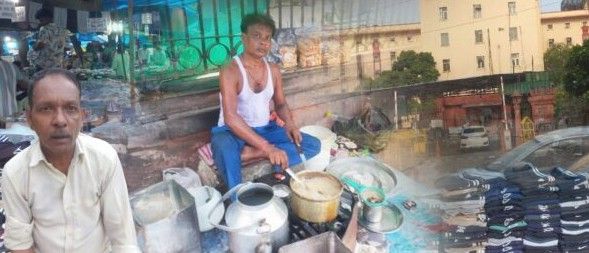
The Central Vista project is transforming the face of Delhi. New buildings are being constructed, and government offices are being transformed. But amidst these changes, concerns also emerge for the hands that have worked tirelessly throughout their lives to keep their homes afloat. For the poor laborer who runs a small roadside shop, a cart, sells tea, or polishes shoes, employment is not just about earning money, but also about providing for their children’s food and their family’s hope. Amid the radiance of development, if their place is destroyed, a family’s dreams are shattered.
The poor, who make ends meet, say, “We need work to run our households. What good will simply changing cities do?” The question is, who will protect the livelihoods of these hardworking people on the path to progress?
Indeed, the face of Delhi’s Raisina Hill and Central Secretariat areas is rapidly changing. Old government buildings are being replaced by new offices, and new residences are being created for bureaucrats. While the ongoing construction and redevelopment under the Central Vista project is preparing to modernize the capital, the future of those who have been supporting their families by setting up small roadside shops, carts, stalls, or kiosks in these areas for years is now being challenged.
Karan, who supports his family by polishing shoes in front of Shastri Bhawan, shares a similar concern. When asked what will happen to his livelihood as old government buildings on Raisina Hill are being demolished, new ones are being constructed, and bureaucrats are moving from one place to another, will he be able to support his family by polishing and repairing shoes as before?
Karan said that it is now difficult to survive here. He feels he is only a temporary guest here. According to Karan, he used to earn around 600 to 700 rupees daily, but now this has dropped to 200 to 250 rupees. He says that he too will be evicted from here in the near future.
1. Where will Karan, who has been doing this job for years, go now?
Karan says that he has been polishing and repairing shoes and slippers at this very spot for years. This has been his source of income and has been the source of his family’s needs.
Now, his biggest concern is finding a new place. Karan says that if he has to move, he will have to start work elsewhere, but he doesn’t know how many customers he will get there daily and how much he will earn.
His concern isn’t just about changing locations, but about his family’s livelihood. He says that leaving the place where he has built both work and customers over the years and starting over will not be easy.
2. What worries Jagannath Mandal, who has been selling tea for 35 years?
Jagannath Mandal, who sells tea in front of the Congress office on Raisina Road, also appeared worried about his future. He says that he has been supporting his family by selling tea at this very spot for nearly 35 years.
Jagannath Mandal says that finding a new place at this age is not easy. He’s unsure of how his life will unfold and how he will support his family.
He says that the pace at which the Central Secretariat’s old buildings are being demolished and new construction is underway, he fears that roadside workers may also be displaced in the future.
Jagannath also worries that people like him have no strong alternatives. He says that ultimately, whatever the government decides, they will have to accept it. The biggest question for him is his family’s livelihood.
3. What will be the impact on those selling clothes, juice, and tea?
The market in front of the Central Secretariat and around the Press Club of India, which has been around for years, houses numerous small shops selling clothes, juice, tea, cold drinks, betel leaves, beedis, cigarettes, and other daily necessities.
Many of these shopkeepers seemed reluctant to discuss the issue openly. Some shopkeepers fear that speaking out could result in losses. A female shopkeeper, speaking on the condition of anonymity, said they can’t do anything; whatever the government decides will be the final decision.
These shopkeepers’ livelihoods depend largely on the movement of nearby government employees, security personnel, drivers, and other workers. Therefore, if the movement pattern changes after construction in the area is completed or new regulations are implemented on roadside businesses, their earnings could be affected.
4. Will not just shopkeepers, but small workers, also be affected?
Chandrakant, a driver for a senior official posted at Rail Bhavan, says that someday those selling essential goods from shops, carts, and stalls in this area may have to move away.
According to Chandrakant, the Central Vista project is in its final stages, and the area will be further organized with the planning of groundwork. He claims that there are over 250 small shops and stalls in this area, many of which have been operating for years.
He says that the removal of these shops will not only exacerbate the problems of the shopkeepers. It could also impact the common people, drivers, sanitation workers, security personnel, and other small workers.
Chandrakant argues that low-income people cannot afford to go to hotels or expensive restaurants every day for tea and snacks. They have to rely on these shops for betel leaves, beedis, cigarettes, juice, and other small needs. Therefore, their removal could also create problems for ordinary workers.
-
Govt expected to find ways to raise additional Rs 1 crore needed for girl's treatment of girl: MP HC

-
Heavy Rain Triggers Severe Waterlogging In Vasai-Virar; Viva College Area Among Worst Affected
-
Donald Trump completely misses the point with one-word defence of FIFA President Gianni Infantino

-
Trump Warns Iran Of 'Massive Attack', Slams Tehran: 'They Are Dishonest People'

-
The massive challenge before Enzo Maresca at Manchester City as the shadow of the past hangs heavily