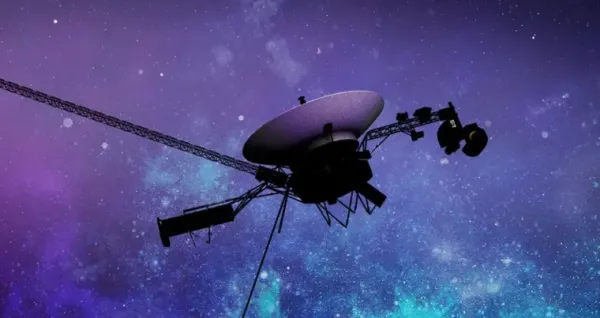
NASA engineers have successfully implemented a new power-saving upgrade on Voyager 2. This will allow the nearly five-decade-old spacecraft’s three scientific instruments to continue operating and sending data from interstellar space for at least another year.
USA: NASA has successfully implemented a new energy-saving technology on the nearly 49-year-old Voyager 2. This power-saving upgrade, dubbed ‘Big Bang,’ will allow the spacecraft’s three remaining science instruments to remain operational for at least another year. Voyager 2 is currently gathering scientific data in interstellar space, approximately 21.35 billion kilometers from Earth.
Voyager 2’s energy saved by ‘Big Bang’ upgrade
Voyager 2 was launched on August 20, 1977. Initially scheduled for a mission spanning only a few years, the spacecraft remains operational nearly five decades later. It is currently approximately 21.35 billion kilometers from Earth, sending scientific data from interstellar space.
Voyager 2’s power comes from Radioisotope Thermoelectric Generators (RTGs). These systems convert heat generated by the radioactive decay of plutonium into electricity. However, their energy production capacity decreases over time. At approximately 4 watts per year, NASA is constantly having to reduce the power consumption of its instruments and systems.
To address this challenge, engineers at NASA’s Jet Propulsion Laboratory developed the ‘Big Bang’ power-saving fix.
Changed the settings of the heater and tape recorder
The new arrangement involved disabling two of Voyager 2’s long-used heaters. A Digital Tape Recorder, primarily intended for heat generation, was also deactivated.
Instead, two other heaters and another device were activated, which are capable of keeping the spacecraft’s vital parts warm enough while consuming less power.
Engineers conducted tests to this change in May and June. The final command was then sent to Voyager 2 on July 9. Due to the vast distance between Earth and Voyager 2, it takes approximately 20 hours for a command to reach the spacecraft. It then takes approximately 20 hours to confirm that the command was successfully executed.
The three science instruments will last at least one more year.
According to NASA, this power-saving upgrade will allow Voyager 2’s three remaining scientific instruments to operate for at least an additional year, ensuring the continued collection of vital scientific data from interstellar space.
NASA has also modified Voyager 2’s onboard software. If a technical fault causes the spacecraft to enter Safe Mode, the new low-power system will automatically remain active. This will reduce unnecessary energy consumption.
This achievement of Voyager 2 is also important because there is currently no other active spacecraft studying this region of interstellar space.
Now a similar upgrade will be implemented on Voyager 1.
Following the successful upgrade of Voyager 2, NASA is now preparing to implement a similar system on Voyager 1. Voyager 1 is currently approximately 25.4 billion kilometers from Earth, even further away than its twin.
Engineers have completed initial power tests on Voyager 1. Thermal tests are scheduled for later this month. If the tests are successful, Voyager 1’s mission could also proceed.
Additionally, it is likely to reactivate its Low-energy Charged Particles Experiment when sufficient power is available. This instrument has studied charged particles and cosmic rays beyond the heliosphere and has been helping scientists understand the boundary between the solar system and interstellar space.
Both Voyager spacecraft are now operating several decades beyond their original plans. NASA’s new power-saving measures are an attempt to keep these historic missions going as long as their power sources provide enough electricity to run their scientific instruments.
-
‘Will Not Allow’: West Bengal CM Suvendu Adhikari Orders Action Over Derogatory Netaji Posts
-
Liverpool told to hijack Manchester United and Chelsea move for Arsenal youngster Myles Lewis-Skelly

-
Jose Mourinho calls one of his earlier roles in football a ‘big bulls***’ in new Netflix documentary

-
Awarapan 2 or Batwara 1947: What is Hyderabad booking?

-
Jharkhand protest: Health of 4 students on hunger strike stable