
Kerala’s Motor Vehicles Department has begun round-the-clock patrols on newly built national highways after several speeding vehicles skidded during the monsoon. The month-long drive follows incidents including a recent crash at Kuttipuram in Malappuram, where wet-road loss of grip was identified as a concern.
Enforcement teams will focus on speeding because aquaplaning becomes more likely when a vehicle enters standing water too quickly. The department has said motorists found speeding on the new highways will be booked.
Aquaplaning, also called hydroplaning, occurs when a tyre cannot push water away through its tread quickly enough. A layer of water forms between the tyre and road, reducing or completely removing grip. Steering, braking and acceleration then have little effect until the tyre reconnects with the surface.
The amount of rain is only one part of the problem. Vehicle speed, water depth, tyre condition and tyre pressure decide how effectively the tread clears water. A shallow patch that causes little trouble at low speed can unsettle the same car when crossed much faster.
Drivers should slow down before reaching standing water, rather than braking after the front wheels enter it. The safe speed cannot be reduced to one universal number because water depth, road condition and tyres change from place to place. The basic rule is to travel considerably slower than in dry weather and leave more distance from the vehicle ahead.
Cruise control should be switched off in heavy rain. It can encourage the car to maintain speed when the driver should be adjusting gently to changing grip. Large SUVs, all-wheel-drive vehicles and cars with wide tyres are not protected from aquaplaning. All-wheel drive can help a vehicle accelerate, but it cannot make a floating tyre grip the road.
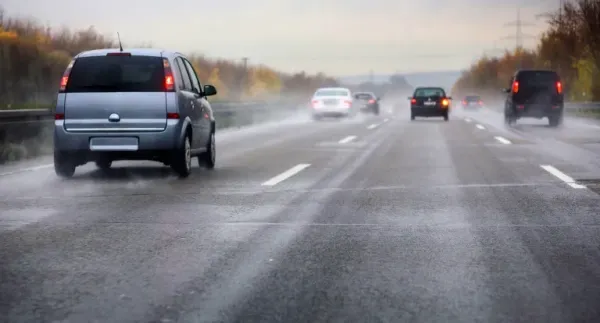
Aquaplaning can be recognised by suddenly light steering, rising engine speed without matching acceleration or the car drifting away from the intended line. The natural reaction is to brake hard or make a sharp steering correction. Both can make the situation worse when the tyres regain contact.
The safer response is to ease off the accelerator smoothly, hold the steering wheel firmly and keep the wheels pointed in the intended direction. Avoid sudden braking unless a collision is otherwise unavoidable. Once the tyres begin clearing the water and grip returns, reduce speed progressively.
Anti-lock brakes and electronic stability control can help manage a skid after grip begins returning. They cannot overcome the absence of physical contact between the tyre and road. Driver-assistance systems are therefore a backup, not permission to maintain dry-road speed.

Tread grooves provide routes through which water escapes. Worn tyres have less depth available to move that water and can lose contact earlier. Drivers should inspect all four tyres, including the inner edges that are difficult to see, and replace tyres that are near their wear indicators.
Correct inflation is also important. Pressure should be checked when the tyres are cold and set to the vehicle manufacturer’s recommendation, not an arbitrary higher value for the rain. A badly underinflated tyre may deform and clear water less effectively.
Kerala recorded 23,042 road accidents and 1,765 deaths between January and May 2026, although those figures cover all causes and cannot be attributed specifically to aquaplaning. The latest patrol programme targets a preventable part of the risk on faster new highways.
The warning is relevant wherever intense rain leaves water across the carriageway. The most effective protection remains simple: reduce speed early, maintain tyres, avoid sudden inputs and never assume that a modern SUV or electronic safety system can defeat standing water.
-
India-Japan Trade At $27.5 Billion, But Potential Is Much Higher: Piyush Goyal

-
Noida Property Prices Jump 125% Since 2019, Gurugram Close Behind At 117%: ANAROCK

-
CBSE KVS NVS Tier-II Result 2026 Phase 2 Out At examinationservices.nic.in; Check PGT, TGT And Non-Teaching Posts
-
Batwara 1947 Box Office Collection Day 5 Prediction: Will Reasonable Ticket Pricing Give Sunny Deol Starrer A Boost?

-
'Hey Bhagwan, Ghor Kalyug': Kacha Badam Girl Anjali Arora Cast As Mata Sita In Mahakavya Shri Ramayan Katha; Netizens Upset