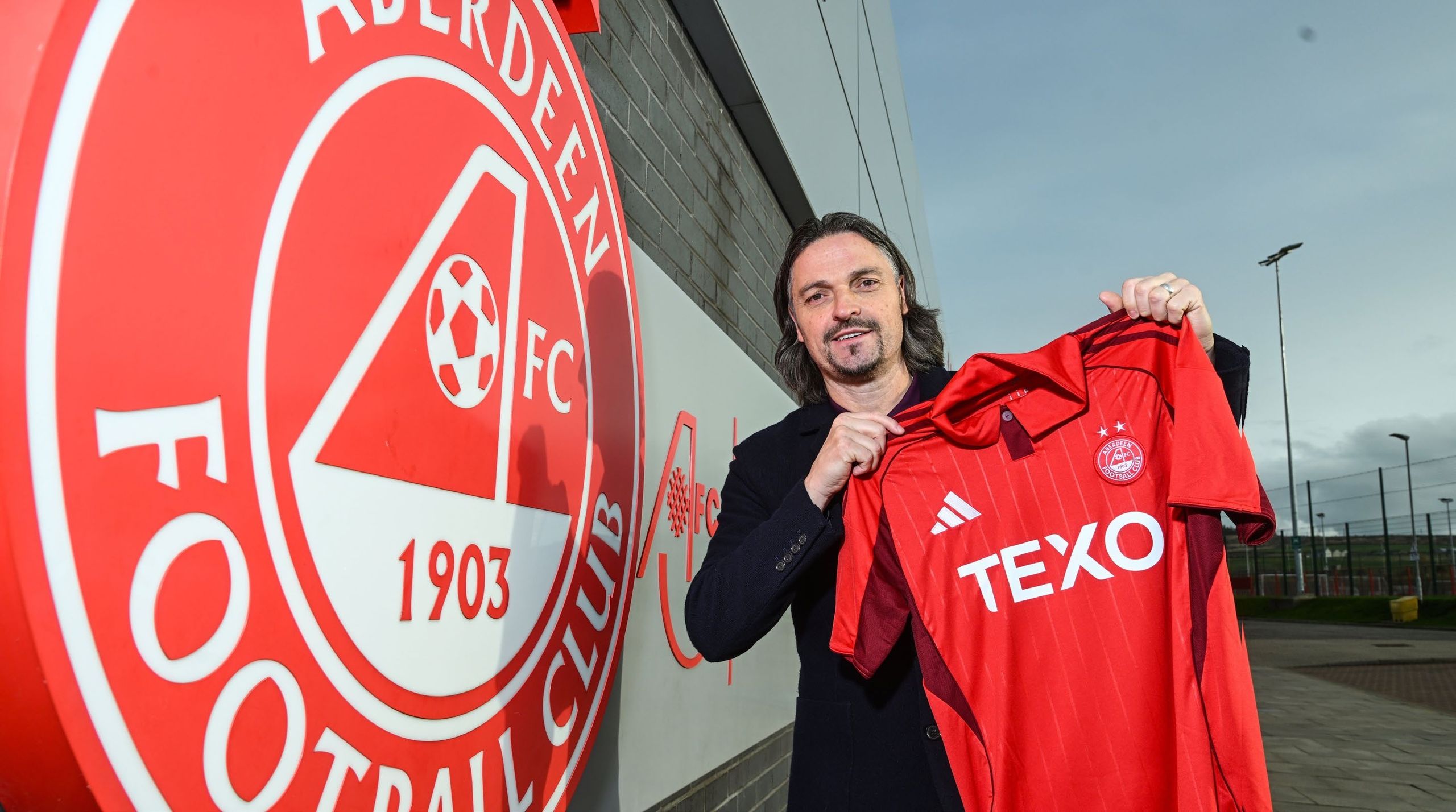
The Aberdeen sporting director has had what may well be one of the most astonishing careers in football history — and in 2011, he spoke in detail about it.
“I was held in one of the roughest prisons in Singapore for 101 days. There were no beds or proper toilets. I was in cells with rapists and murderers. I was punched and beaten up every day. My nose was broken twice. I needed stitches for my eyes, my armpits and my chin. They tried to rape me.
“After two weeks, one guy tried to help me out. He said, ‘You have to fight back, or it will never stop.’ I was never a fighter before, but for the next 10 days I beat the s**t out of anyone who crossed me. I was so angry. Eventually, they began to leave me be. The worst thing was, I hadn’t even committed a crime.”
It sounds more like the plot of an improbable sequel to The Shawshank Redemption, but for Lutz Pfannenstiel it was terrifyingly real. For most people, those events alone would define a lifetime. For Pfannenstiel, they form only one chapter in a remarkable story that also features him lying clinically dead on the pitch for three minutes, being pelted with stones by hostile crowds, comas, post-apartheid Johannesburg, failed businesses, fast cars, faster women, legal battles and trance music.
And then there was the football. Pfannenstiel played plenty of it — more than 400 matches across 25 different clubs. The German goalkeeper became the first player in the world to play professionally on all six FIFA continents, taking in stops from Armenia to Albania, Bavaria to Brazil, and from New Zealand and Namibia to Norway and Nottingham. That list also included a suitably chaotic spell with Wimbledon’s Crazy Gang.
“I’ve never stopped anywhere long enough to buy a house,” he told FourFourTwo. “But at some point I may buy a tour bus.” It was a fitting line for one of the most rock ’n’ roll stories football has produced.
What may look like a career planned by throwing darts blindfolded at a map was never designed that way. Born in Bavaria in 1973, Pfannenstiel was a gifted young goalkeeper who dreamed of one day playing at the Maracana. He came through at his hometown club, Bad Kotzting, and represented Germany at junior level. Bayern Munich offered him a contract when he was 18, but he chose a different route. “I was obsessed with playing and didn’t fancy sitting on the bench,” he said. “Then a scout asked me if I wanted to sign for Penang. They offered me $5,000 and a car, which was decent. I thought I’d get some experience out there and then return to Europe.”
In Malaysia, he played in front of crowds of up to 40,000 and also spent his nights working as a techno DJ on the Kuala Lumpur club circuit. “I was a s**tty DJ, but I had the top records from Germany three months ahead of everyone else,” he said with a laugh. “I’d just jump around like a lunatic.
“I liked new languages, religions and traditions — even if I was just a boy. But the football was average, and in 1994 Wimbledon came in for me. I would have gone anywhere in England. It’s a special football country for me.”
“I WAS A S**TY DJ, BUT I’D GET THE TOP RECORDS FROM GERMANY MONTHS BEFORE EVERYONE ELSE”
Joe Kinnear and Terry Burton had heard about the young goalkeeper through a scout, but if Penang had opened his eyes, Wimbledon gave him a completely different shock. “It was a big surprise,” he said. “I went to training in Roehampton Park and imagined that England would have high-quality facilities. But we were in a park with two shacks, and two old ladies dishing out baked beans every morning! I signed a week-to-week deal anyway, lived in Kilburn, played in the reserves and made enough to just survive.”
Before long, he had his own taste of Dons insanity. “Gary Blissett and Mick Harford became good friends,” he said. “They took me out drinking once and I nearly died, so I didn’t drink again after that! I didn’t speak good English either, and the lads became my teachers. All they ever said was ‘f**king hell’ and ‘stupid c**t’. I sounded like a gangster because I copied them. Once we went for a meal and two girls were looking over at me. Gary told me that English girls loved polite foreigners, so to go over and say, ‘Hello, I’m Lutz from Germany, you little c**ts.’ I said, ‘What does it mean?’ They told me it meant ‘darling’.
“So I went over and said, ‘Hello, c**ts!’ The girls nearly choked on their cake. But they realised I’d been tricked and told Gary off. Another time I bought some nice shoes, but the dressing room was very dirty so I put them on the bench. The boys didn’t like that and when I got back in, they’d nailed my shoes to the bench. I went home barefoot. The shoes are probably still there now.”
Pfannenstiel never broke into Wimbledon’s first team, but after an outstanding performance against Nottingham Forest’s reserves, he earned a move to the City Ground. “I thought I had a chance of ousting Mark Crossley, but the coach didn’t fancy me, so I went out on loan to South Africa,” he said.
He joined Johannesburg club Orlando Pirates just after the end of apartheid, with the country still deeply volatile. “It was very tense,” he said. “People were vicious to each other. Black and white were in different corners. It was very difficult, because the whole team was black and they really disliked me. But once they realised I was European and liberal, it got better. I enjoyed playing and the crowds were amazing.”
Ignoring warnings not to venture into the city’s dangerous townships, Pfannenstiel did exactly that. “I was in a hotel in Hillbrow, the most criminal part of the city,” he said. “They told me, ‘Don’t leave or you’ll get shot.’ But after a week I was bored and thought, ‘Screw it.’ People knew me from the team and I ended up being OK. That gave me a nose for danger.” At the end of the season, he swapped that environment for a very different one in Finland. “I played for TPV and Haka, and it was nice, though very cold,” he said. “Finnish people are also difficult to get to know, until they get drunk, at which point they start telling you stuff you don’t want to hear. The language is also impossible — I can count to three and say a couple of swear words, that’s about it.”
When the Finnish clubs could not match his wage demands, Pfannenstiel returned to Germany with Wacker Burghausen in the third tier, but no longer felt settled there. Then, in 2000, an offer arrived from Geylang United in Singapore — a move that would alter his life completely.
Geylang were one of Singapore’s biggest clubs and he went straight into the starting XI, quickly becoming a local star. He was even picked up for modelling work with Armani Exchange, while also doing media duties, analysing Premier League matches for Singaporean television and ESPN.
“I’d gone from zero to 100 in a few weeks,” he said. “I was playing in front of lots of fans and living like some kind of royalty. They party until they drop in Singapore. I was going mad with the cars and the girls — living it large. It was a huge high, but then everything came crashing down.”
His nightmare began when an Indian man approached him at a petrol station and, recognising him, asked how Geylang would fare in their next match. “I said, ‘We’re in good shape, we’re going to win!’” Pfannenstiel recalled. “It was an everyday conversation.” Two weeks later, the same man approached him again while he was at a restaurant with friends, and they spoke about the upcoming weekend’s game. “I said, ‘We’re going to murder them!’ and that was that,” he said. A third meeting took place in a shopping centre, where Pfannenstiel, with his girlfriend beside him, again told the man that he believed his side would win. “I never saw the guy again,” he said.
At that time, corruption was rife in Singaporean football and the authorities were carrying out a broad crackdown. One Sunday, while he was watching television with Australian footballer Mirko Jurilj, his home was raided. “The doorbell went and my friend opened the door,” he said. “A fist knocked him to the floor. It was four guys and they smashed up my whole house. They were corruption police — a rough unit. It was like something from a film. I said, ‘Guys, what are you looking for?’ They replied, ‘Money and betting slips.’ I said, ‘My money is in the bank, and I don’t bet.’ I even joked, ‘You’ve forgotten to break my lamp — maybe there’s a million pounds in it!’ So they smashed that, too. They found nothing.”
The joking ended quickly. Pfannenstiel said the pair were arrested, held for 48 hours without a lawyer and tortured. “I was being interrogated like a hardened criminal,” he said. “I was slapped, put naked into a cold cell, they tried to break my fingers. They asked me the same s**t and I just denied it. Then the Indian guy appeared. I confirmed I’d met him and I signed a statement. The policeman said, ‘You’re going to prison.’ I said, ‘Listen up, mother f**ker, if you jail me for this, you must be a world champion. I’ve done nothing.’”
“THE PHYSIO BROUGHT ME BACK TO LIFE THREE TIMES AND THE DOCTOR THOUGHT I MIGHT BE HANDICAPPED”
After being released from custody, he continued to play for Geylang and kept seven clean sheets in the final eight matches of the season. By then, he believed the scandal had passed. But after the final game of the campaign, he was instructed to report back to the police, where he was handcuffed and informed that he was being charged with making a ‘verbal corrupt agreement’.
“This crime doesn’t even exist,” said Pfannenstiel. “The bookie said that I’d agreed to share his bonus if we won games. It was my word against his. But how could I be corrupt by trying to win a game, anyway? I always try to win!”
At the trial, several witnesses gave evidence in his favour, while the prosecution relied only on the bookmaker. Even so, Pfannenstiel was found guilty, with the judge ruling that he had intentionally played better than usual in the matches that had been discussed. “It was even proven in court that no money changed hands,” he said. Yet he was sent to the notorious Queenstown Remand Prison.
“When you’re fighting someone who has been given the death penalty, they don’t have much to lose,” he said. “I stepped over my shadow and learned how to fight. People were dying in there. It’s the worst place on the planet.”
Pfannenstiel was eventually freed after passing a lie detector test and returned home. His ordeal was over, but its impact remained. He had lost 16kg and was mentally fragile. “I had the biggest party ever when I got out,” he said. “But I was carrying around a prison mentality. Every time someone looked at me, I felt like knocking them out. I threatened this guy at a beer festival. I had to get myself in check. I scared people.”
He then moved to Bradford with his English girlfriend. “I liked Yorkshire,” he said. “I had a week-to-week contract with Huddersfield, and Lou Macari and Joe Jordan helped me a lot. I never told them about prison, but they knew.
“I trained with Bradford Park Avenue and a guy called Trevor Storton, who’d played for Liverpool, helped turn my life around. He got me thinking straight.” But still not fully ready for English football again, Pfannenstiel accepted another trial — this time more than 11,000 miles away. “I had a friend in the south of New Zealand, in Dunedin,” he said.
“All I wanted was a chance to do my studies in sports and tourism management quietly, and play a little football. So I flew 48 hours straight for the trial. Manchester to London, London to Los Angeles, Los Angeles to Auckland, and Auckland to Dunedin. I slept for two hours, then went to the club. At the trial, they hit shots at me for 40 minutes and I was on f**king fire. The chairman was open-mouthed and I said to him, ‘You decide what to pay me.’ I slept for 24 hours, then the next day they made me the best-paid player in the club’s history, as well as one of the best in the league.”
For the next five years, Pfannenstiel played in New Zealand’s league for five months of each year, while spending the rest of the time out on loan elsewhere. Yet more drama followed. During a spell back in English non-league football with Bradford Park Avenue, he was involved in a serious collision with Harrogate Town’s Clayton Donaldson. His lung collapsed and his heart stopped for three minutes.
“In England, it takes a nuclear war to stop a game, but they stopped it after that challenge!” he said. “I was dead. I had no pulse. The physio brought me back to life three times. I was in a coma for a few hours and the doctor thought I might be mentally handicapped. But then I woke up. Everything was a blur. I thought I was still playing, and I started shouting at the nurses, ‘Get me the f**k out of here, we’re winning 2-1!’ The nurse told me that the game had stopped. I was fuming. I tried to move, but couldn’t. I thought I was paralysed, but was tied down. I told them, ‘Cut me off this bloody board’, then got up and walked home. But I couldn’t breathe, so I got driven back to the hospital.”
Just 10 days after cheating death, Pfannenstiel was back playing again. Soon enough, he was travelling once more. He turned out for Baerum in Norway (“peaceful”), Calgary Mustangs (“they went bust while I was there”), Vancouver Whitecaps (“professional, and a lovely city”), Albania’s Vllaznia Shkoder, where away supporters threw rocks and fireworks at him (“they’re passionate”), and Armenia’s Bentonit Ijevan. He also returned to New Zealand with Otago United, where he took home a penguin and kept it in his bathtub.
Then came the call from his agent that finally delivered a personal dream. “He said to me, ‘Lutz, you’ve played on five different continents, how do you fancy making it six and going to Brazil with Atletico Ibirama?’” Pfannenstiel said. “It took me back to my childhood dream. The next thing I knew it was sunshine, beautiful people and football as a religion.”
He eventually fulfilled that dream of playing at the Maracana too. “I’d been searching for something all my life, and it felt like that was it,” he said. “I smiled for the whole 90 minutes. For the first time in my life, I didn’t feel restless.”
Further spells with Floy and Manglerud Star in Norway, along with Namibian side Ramblers, brought his playing days to a close. “I’d been the goalkeeping coach of Cuba,” he said. “Then I was a sports director in Norway, coached Ramblers and was assistant coach of Namibia.”
During the 2010 World Cup, he worked alongside Oliver Kahn as a pundit on German television, before going on to become Hoffenheim’s director of international relations and scouting in the Bundesliga. “It’s easy for me to scout, because I know people all over the world!” he said with a laugh. “My phone book is bigger than the Bible. I’m the ultimate example of football’s globalisation. When I did well in weaker leagues, my ambitions meant I tried to better myself by taking new opportunities. And sometimes, like in England, I wasn’t quite good enough to make it, so I moved on. Circumstances just keep me moving.”
The sense you get is that once he started moving around the globe, there was never any chance of him stopping. By the latter stages of his career, that nomadic existence had become a unique selling point — something he even monetised by writing a book about his adventures.
Along the way, Pfannenstiel picked up some major life lessons. Travel gave him plenty. “I have more air miles than any other person in the world, and I should be in the book of records for packing suitcases,” he said, before revealing an ambition to complete the final continent by playing a charity match in Antarctica. Plenty of penguins there. Not many bathtubs.
This article first appeared in the August 2011 edition of FourFourTwo magazine.
-
WATCH: Yuvraj Singh, Abhishek Sharma, Arshdeep Dance At Ramandeep Singh’s Wedding Reception

-
Top 5 Batsmen To Face 500+ Balls In A Test Inning
-
Too Young To Retire? 5 Cricketers Who Walked Away From International Cricket Early
-
Bengaluru Food Safety Raid: How Spoiled Food Can Trigger Serious Health Problems

-
Typhoon Dolphin Weakens, But Heavy Rain, Flood Alerts Disrupt China; 1,000+ Flights Cancelled