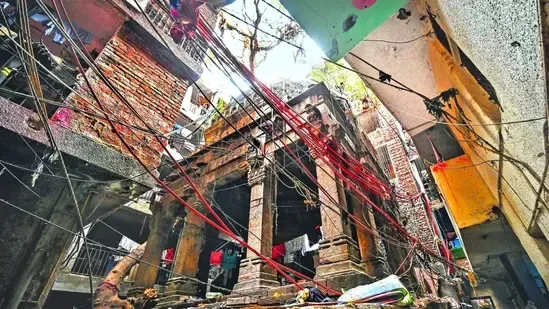
Afew hundred metres from Greater Kailash-1, the neatly lined bungalows, luxury boutiques and chic bars give way to cramped lanes, skies blocked by rows of tightly packed houses and their extended balconies, tangled overhead wires, unkempt streets and piles of uncleared trash.
But hidden from sight in this congested urban village, Zamrudpur, are centuries-old slices of Delhi's past. During spot checks in June and July, HT found at least four Lodhi-era tombs listed by the Delhi government as Grade 1 heritage buildings, walled off by unplanned houses and, in some cases, doubling up as storehouses, cattle sheds or even garbage dumps.
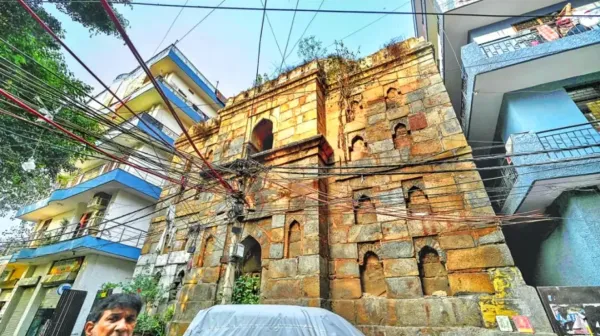
The towering tombs were built by Zamrud Khan, an Afghan noble during the reign of Sikandar Lodhi in the late 15th century, and their decay is a story of Delhi's rich heritage being subsumed by the contemporary pressures of a swelling population, civic apathy and administrative disinterest.
Khan was given the jagir of then Kanchan Sarai for his personal use, which he renamed after himself.
In Delhi's early years, GK-1 was carpeted in farmlands that produced rich Kharif yields. The land, spread over hundreds of acres across Zamrudpur and Devli villages, was owned by about 90 farmers.
In 1955, the Centre acquired the plots as part of a large-scale acquisition plan and handed them over to DLF to carve out a residential colony. The agricultural fields became some of the most sought-after addresses in the national capital. The two villages, however, were left behind.
A left turn from Lala Lajpat Rai Marg, a lane leads to the badi chaupal - the meeting spot in a village, at the intersection of four major roads. A right turn near a Lord Shiva temple leads to the largest tomb in the village.
Almost three storeys high, the domed structure is walled off by houses on three sides, with their walls just inches away. Two private gates have been erected on either side, their arches decorated with flower pots.
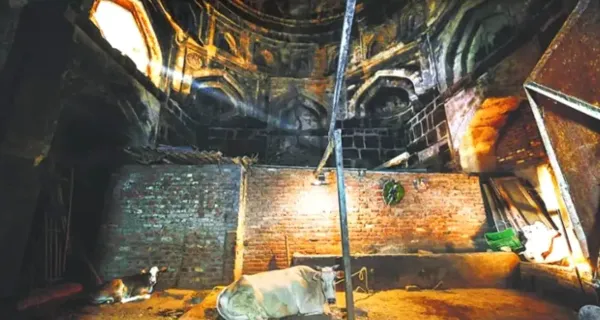
Inside, the tomb is now also home to a cattle shed.
A cow and her calf, tied near the feeding area, rest beside an 8ft-tall wall that splits the structure. The rest of the space, lit by a single bulb hanging from the 15th-century deep dome, is used as a dumpyard for furniture and construction waste.
During the spot check, the owner of the cattle objected to pictures being taken.
"This is our building. We have taken care of it for generations and will continue to do it," said the man, who declined to be identified. Municipal Corporation of Delhi (MCD) records list the monument as a public building, with maintenance the civic body's responsibility.
MCD spokespersons did not respond to requests seeking comment.
The entry for the monument in Delhi: The Built Heritage, compiled by the Indian National Trust for Art and Cultural Heritage (INTACH), lists the building as "Grade A" or "Grade 1" for its archaeological value.
Grade A heritage designations refer to cultural properties, structures, or precincts of exceptional national, regional, or historical importance. These buildings embody top-tier architectural style, design, or have deep association with historic events and prime city landmarks. Grade 2 includes structures of regional or local importance with special architectural features, while Grade 3 comprises those that contribute to the townscape and evoke architectural, aesthetic, or sociological interest.
These monuments were documented by Zafar Hasan, then assistant superintendent of the Archaeological Survey of India, in his 1916 work Monuments of Delhi.
The tomb is spread over an 8.35sqm area. On its north, south and east sides are recessed arches enclosing three openings. They once presumably looked onto fields of wheat, chickpea, cauliflowers, or tobacco. Now, the arches are blocked off, inches away from the unplastered walls of unauthorised buildings.
On the west are three mehrab (an arched wall) recesses, while the high dome rises from an octagonal drum.
Past the chaupal, a left leads into a dim alley. MCD records list a tomb nearby, but its geo-coordinates do not point to any visible structure. But the eyes deceive.
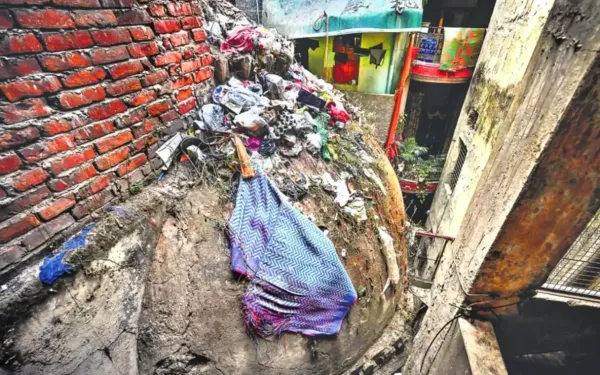
A flight of stairs leads up five storeys to a rooftop. Around 20 metres below, the dome of another tomb creeps up, jostling for air with buildings plastered around it.
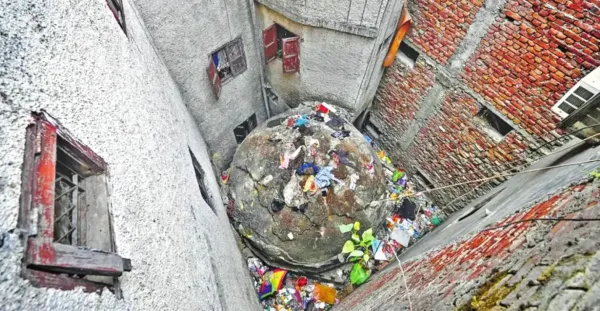
The dome is now the landing spot for garbage flung off balconies and windows by residents of the buildings, most of whom are tenants.
Sheila Devi, who has lived in the area for 30 years, said she watched buildings grow around the tombs. "There are five-six chhatris and gumbads, but they are in extremely poor shape," she said.
The walls of these tombs are made of rubble masonry, finished with plaster. The pillars are mostly dressed with finely cut stone. Lodhi-era tombs traditionally used Delhi quartzite stone and red sandstone.
The third tomb is about 50m away.
This one is enclosed by at least six five-storey buildings with small rooms rented out to daily wage workers. The snaking trunk of a gular tree twists around the structure, ending in a canopy above it.
Residents use the tomb as a clothesline. The raised stone platform is, like its sibling structures, layered in trash.
This tomb is spread over a 6.58sqm area, its dome supported by 12 carved pillars of dressed stone. It rises from an octagon topped with a lotus cresting.
Anchal, a local resident, said the gumbad serves as a local landmark - but largely to guide guests, delivery agents and postal services. "But everyone uses it to dump their waste. It has been cleared a few times, but the garbage returns," she said.
Md Jamshed, another resident, said if the gumbad were cleaned and restored, it could serve as common space in a neighbourhood starved of any. "After years of neglect, it is still beautiful," he said.
HT found a fourth tomb, also packed with garbage, its dome used as a base by one of the buildings abutting it - almost completely subsumed.
INTACH's compilation lists a fifth tomb, which HT was unable to trace. The compilation says it was illegally occupied and inaccessible, but had 12 dressed stone pillars with a lotus cresting on the dome.
A senior MCD official said the tomb may have been demolished. "We surveyed some of these tombs in April for the ongoing Supreme Court case regarding monuments, and three tombs were in poor condition with heavy encroachment, while the fourth was relatively better maintained. After assessing the required conservation work, a budget will be sought to restore them," the official said.
The official did not say why the tombs were not given even a basic clean-up.
Om Prakash, a worker from Bihar who lives in Zamrudpur, said migrant labourers are forced to live in such conditions.
"A small room for ₹4,000-5,000 can be shared. During the day, I mostly stay out in search of work and need this room only to sleep in. The tombs may have value, but we have our own share of problems," he said.
-
WATCH: Yuvraj Singh, Abhishek Sharma, Arshdeep Dance At Ramandeep Singh’s Wedding Reception

-
Top 5 Batsmen To Face 500+ Balls In A Test Inning

-
Too Young To Retire? 5 Cricketers Who Walked Away From International Cricket Early

-
Bengaluru Food Safety Raid: How Spoiled Food Can Trigger Serious Health Problems

-
Typhoon Dolphin Weakens, But Heavy Rain, Flood Alerts Disrupt China; 1,000+ Flights Cancelled