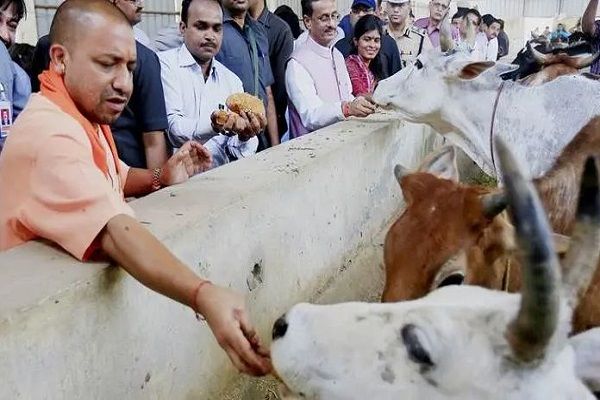
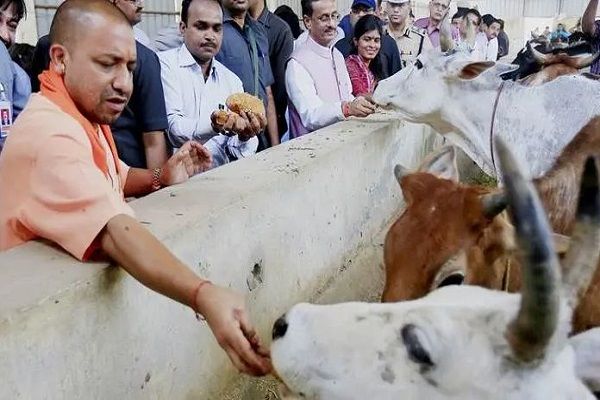
In line with the vision of Uttar Pradesh Chief Minister Yogi Adityanath , the state government has launched a new initiative to link cow protection with the rural economy, women’s empowerment, and organic farming. Under this initiative, cow urine procurement has been initiated as a pilot project through Farmer Producer Organizations (FPOs) in Bulandshahr, where cow urine is being purchased from farmers and cattle rearers at a rate of ₹10 per liter.
If successful, preparations are underway to extend the model to other parts of the state.
Following the success of the pilot project, plans are underway to expand this model to other parts of the state. This will provide cattle-rearing families with a way to generate additional income from cow urine in addition to milk. This experiment, initiated through an FPO under the leadership of Dr. Praveen in Narsaina village of Bulandshahr’s Syana tehsil, has connected 15 surrounding villages. Local centers have been established in these villages to collect cow urine.
About 500 liters of cow urine is being collected daily through FPO.
Currently, approximately 500 liters of cow urine is being collected daily through these centers. There are also plans to increase the purchase rate to 20 rupees per liter. Tanks with a capacity of 200 liters have been installed in villages to collect cow urine. This eliminates the need for cattle herders to travel far to sell their urine. Arrangements have been made for its purchase and collection within the village itself. This local collection system has made it easier to connect cattle herders, especially women, with the project. Rural women play a crucial role in this entire system.
Women who cooperate will get a commission of Rs 2 per litre.
Women who help collect cow urine in villages are being paid a commission of two rupees per liter. This has created a new source of additional income for women while living in the village. Dr. Praveen explained that this initiative is not limited to the purchase and sale of cow urine, but is also linked to women’s empowerment. This work has been started with the cooperation of approximately 300 women, and all of these women have been made shareholders. This means that women are not only part of the collection system, but are also directly involved in this entire economic model.
Possibility of connecting more rural women to it
The commission earned for collecting cow urine is becoming a regular source of small income for women. As its scope expands, it has the potential to involve more rural women. Especially for women from cattle-rearing families, it can become a means of supplementing their income while remaining at home and in the village. The collected cow urine is being used to create agricultural products. Various herbs are mixed with cow urine to create medicines for farm use. These are then distributed to farmers through committees.
The model aims to promote cow urine based products as an alternative to chemical products.
This model also aims to promote cow urine-based products as an alternative to chemical products in agriculture. This will increase the use of cow products and encourage natural and organic farming. A local market is also being developed by selling finished products to committees. Until now, income from cattle rearing in rural areas has primarily depended on milk and milk products.
There is also a plan to increase the purchase rate to Rs 20 per liter in the future.
Through this experiment, an attempt is being made to develop cow urine as an economic resource. By purchasing it at the rate of Rs 10 per liter, cattle herders can earn additional income from cattle. If the plan to increase it to Rs 20 per liter is successful, the income of cattle herders can increase further. By earning income from other products besides milk, their conservation can get an economic basis. By developing a system for regular purchase of cow urine, cow herders will get additional incentive to take care of the animals.
Shyam Bihari Gupta, Chairman of the Cow Service Commission, stated that this model, launched in Bulandshahr, is being seen as an experiment that integrates cow protection, rural employment, women’s empowerment, and organic/natural farming. Cow urine is collected from villages, providing income to women, and the collected urine is used to produce agricultural products and market them through committees. It is completely chemical-free and helps promote crop growth.
Based on the pilot project’s experiences, there are plans to expand it to other areas of the state. This will develop a network of cow urine collection centers in villages, creating an additional source of income for cattle herders and making cow conservation economically sustainable.
-
Did Mahira Khan just confirm Fahad Mustafa’s alleged 2nd nikah?

-
In Which Area Is Virat Kohli Better Than Sachin Tendulkar? Aakash Chopra Answers

-
World Cup set for a return? England lines up possible bid to host 2038 or 2042 tournament

-
FIFA imposes heavy fine and sporting penalty on Argentina after Falklands banner controversy

-
Relationship Tips: Have you started talking to someone new after breakup? Just keep these 3 things in mind; Will identify Red Flag in a jiffy