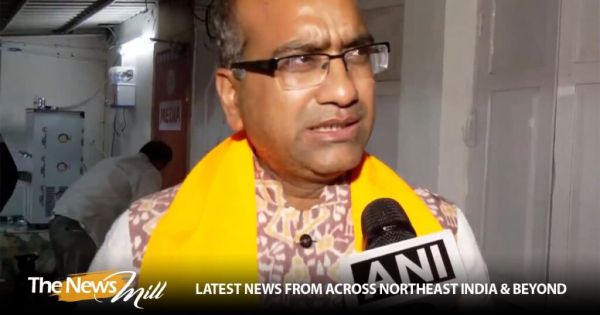
BJP Rajya Sabha MP Sujeet Kumar has written to US Congressman Riley Moore disputing his statements about the proposed Foreign Contribution (Regulation) Amendment Bill, 2026, which he described as an “exaggerated and misguided version” of the law. Kumar denied claims that the legislation would permit the government to take control of churches.
Addressing Moore’s concerns over religious liberty, Kumar stated, “I carefully read your public statements on the proposed FCRA Bill, 2026. Concern for religious liberty is a serious thing, and I do not doubt that yours is sincerely held. As a Member of Parliament (MP) from India, I deem it my duty to address the concerns and apprehensions that you have highlighted in your statements, which, in my view, are an exaggerated and misguided version of the proposed bill.”
He added, “This kind of misconceived statement by a sitting Congressman serves neither of our countries, least of all the Indian Christians in whose name you claim to have raised the concerns.”
Kumar clarified that the Bill contains no provision allowing government takeover of churches. Instead, it regulates foreign contributions and assets associated with such contributions if an organisation’s FCRA registration is cancelled, surrendered, or ceases to exist. The legislation establishes a Designated Authority to oversee, manage, and dispose of those assets.
The framework applies equally to temple trusts, madrasas, mission hospitals, universities, secular development agencies, and wildlife foundations. Kumar highlighted that the Bill specifically protects places of worship, stating, “That safeguard was written in so that a church remains a church, a temple remains a temple and a mosque remains a mosque.” The Designated Authority must ensure that the religious character of vested places of worship is maintained.
He further explained that the vesting of assets is provisional and reversible if the organisation obtains a new certificate or its registration is renewed, at which point the assets and any unused foreign contributions are returned.
Regarding Christianity’s status in India, Kumar noted the faith’s deep historical roots and cited constitutional protections that guarantee freedom of conscience and the right to profess, practise, and propagate religion. He also emphasised the rights of religious minorities to establish and administer educational institutions.
Kumar acknowledged that the Bill might face criticism within India and recognised the role of opposition parties, the media, civil society, and citizens in scrutinising and offering constructive criticism. However, he stated, “What I cannot accept is the leap from those concerns to the phrase ‘a clear attack against Christians’, as it transforms reasoned criticism into a biased and politically motivated diatribe.”
Moore, a Republican Congressman from West Virginia, had previously expressed concern that the proposed amendments could allow government control over churches and religious charities. He described the Bill as “a clear attack against Christians” and warned that its passage could strain India-US relations.
The amendments aim to establish a framework governing assets and foreign contributions when an organisation’s FCRA registration ends, and propose reducing the maximum imprisonment for certain violations from five years to one year.
Kumar invited Moore to visit India and offered to arrange meetings with Christian institutional leaders to provide an opportunity to hear their perspectives directly. Kumar wrote, “Should you visit India, I would be happy to arrange meeting with Christian institutional leaders in India, so that you may hear their assessment directly rather than through intermediaries.”
-
National anthem row: HP Assembly disrupted as Congress, BJP spar
-
Neeraj Chopra’s 88.05m throw earns him second at Lausanne Diamond League

-
Mosquito Problem at Home? Try These 5 Simple Tricks Using Cloves, Lemon, Soap Water

-
Commercial, used-car loans drive India’s vehicle lending growth: CRIF
-
Spirit Producer Brings THIS Huge Script Leak Allegations Against Deepika Padukone