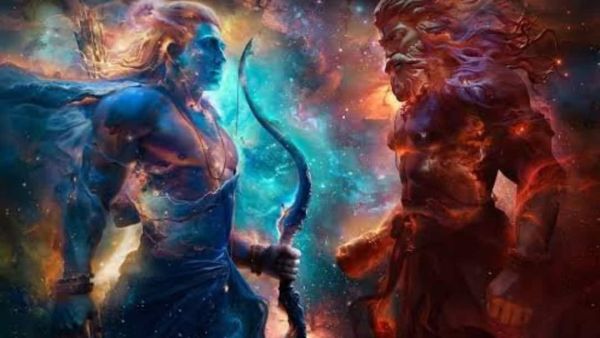
Namit Malhotra’s Ramayana is being positioned as an Indian epic made for a worldwide audience, but its release plan has triggered a debate at home. Nitesh Tiwari’s two-part film, starring Ranbir Kapoor, Sai Pallavi, Yash and Sunny Deol, will open internationally on November 6, 2026, before reaching Indian theatres on November 8, Diwali. For a film rooted in Indian cultural memory, that two-day gap has become more than a scheduling detail. The makers have cited realities and the festive calendar, while some observers question whether an India-first release would better reflect the story’s origins and its domestic audience and scale.
Ramayana Release Strategy
The decision to release Ramayana internationally on November 6, followed by its India release on November 8, has created an unusual situation for a film based on one of the country's most familiar epics. The film, directed by Nitesh Tiwari, is being mounted on a reported combined budget of around Rs 4,000 crore. Ranbir Kapoor plays Ram, Sai Pallavi stars as Sita, Yash portrays Ravana and Sunny Deol plays Hanuman. DNEG is handling the visual effects, while the film is planned for IMAX and 3D formats. AR Rahman and Hans Zimmer are attached to the music.
Sony Pictures is handling the international distribution. Producer Namit Malhotra has repeatedly stressed that the film is being made for audiences beyond India. Speaking to the Los Angeles Times, he said he would consider the film a “failure” if audiences in the West did not like it. He described it as “meant for the world” and added, “I’m not trying to make it to appease Indian people in India.”
That approach makes the international-first release particularly interesting.
Why India Gets Ramayana After The West
There is a straightforward trade explanation behind the dates. November 6 falls on a Friday, which is a standard opening day in several international markets. In India, the makers have chosen November 8, coinciding with Diwali. Trade analyst Taran Adarsh believes the decision could be linked to the festival calendar and auspicious dates.
“I think this was taken keeping the auspicious dates in mind,” Adarsh told India Today. “As far as the international release is concerned, we are releasing on a Friday, which is fine, but because films release on Fridays over there, here auspicious times are considered, we look at muhurat here, we consider the day here.”
View this post on Instagram
Trade analyst Komal Nahta offered another explanation. According to him, the days immediately before Diwali can be commercially weaker because families are occupied with shopping, cleaning, preparations and puja. “Going to a cinema is definitely low on the priority list for those two days,” he said.
For a film carrying such a massive reported investment, the domestic opening is clearly an important consideration. Nahta added, “If he releases around the 6th here, he has to be prepared for not a great opening.” On paper, therefore, the strategy is easy to understand: give overseas markets their Friday opening while securing the Diwali period in India. But Ramayana is not an ordinary commercial release.
Global Ambition Vs Indian Ownership
The emotional response to the release dates comes from the fact that the Ramayana already belongs to India's cultural landscape. Ram, Sita, Hanuman and Ravana are deeply familiar figures, and versions of the epic have travelled across India, Southeast Asia and the wider Indian diaspora.
That makes the two-day difference feel more significant than it would for a conventional international release. “If it was any other commercial film, two days advance wouldn’t matter,” Nahta said. “But because it is Indian mythology, a lot of sentiments are attached to it.”
There is also the question of piracy. By November 6, international audiences will have watched the film while Indian viewers are still waiting. Reviews, social media reactions and potentially unauthorised clips could circulate before the domestic premiere. The strategy could help if the first international response is strongly positive. It could also create complications if the reaction is mixed, particularly because Indian audiences already have strong expectations about the characters and story.
The bigger issue is the messaging around the film's global ambition. Malhotra's focus on Western audiences has led some observers to wonder whether international approval is being given too much importance. Independent film critic and content creator Anmol Jamwal questioned this approach.
“The belief that North America’s interest in this epic is exponentially higher than the Indian subcontinent and even countries in Southeast Asia, where people are well versed with the Ramayana, I believe, lacks basic market research,” he said.
“In the pursuit of being India’s representation in the West, Namit, I believe, is trying to emulate the success of Dune and Avatar, not realising that such success is not reverse engineered,” Jamwal added. “Anything that becomes a global phenomenon often ties into it being unanimously celebrated first, in its native country.”
His criticism raises an important point: Ramayana does not need to create an audience from scratch. It already has one. Films such as Dangal and RRR also show that Indian cinema can find major international audiences without first receiving Western approval. Dangal became a huge success in China after its Indian release, while RRR built an international following through its distinctly Indian storytelling, scale and emotional style.
Neither film proves that an India-first release is mandatory. But they do show that global success does not necessarily require an India-to-Western rebranding strategy. The Indian diaspora could also be crucial to Ramayana's international journey. Audiences in the US, UK, Canada, Australia and the Middle East include large Indian and Indian-origin communities who already understand the epic and may be among the strongest supporters of its theatrical release.
So, is the release strategy wrong? Not necessarily. The commercial reasoning is sound, particularly for a film carrying a reported Rs 4,000-crore price tag.
The real challenge is perception. There is nothing contradictory about making an Indian epic for the world. But if the film wants to turn Indian cultural familiarity into global curiosity, its messaging has to make Indian audiences feel like the starting point of that journey, not the second stop.
As Nahta summed it up, “One is pure commercial thinking, that is the producers, and the other is pure emotional thinking, that is the audience.” For Ramayana, the success of the strategy may ultimately depend on whether both sides feel heard.
-
Dubai ruler confronted in London over UAE role in Sudan genocide

-
Dipke condemns police action against fasting student in Jharkhand
-
Delhi CM, ministers take out Tiranga Yatra in Assembly premises
-
Ram Temple Trust begins interview for selection of full-time CEO

-
HC extends interim protection from arrest to Abhishek Banerjee