Artificial intelligence in India is usually discussed in terms of research labs, large technology companies, and heavy computing power. But a very different picture is emerging from schools and colleges across the country, where teenagers and young adults are using AI to fix problems they see in their own neighbourhoods.
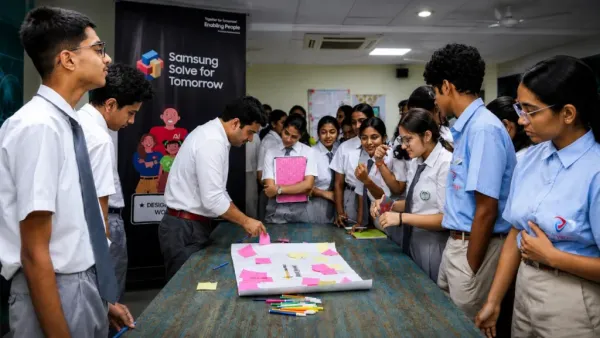
This shift is visible in the fifth edition of Samsung Solve for Tomorrowthe company’s nationwide innovation programme for young people between the ages of 14 and 22. The Top 100 teams selected this year have built AI-based concepts that address everyday challenges in healthcare, road safety, accessibility, disaster response and sanitation, showing that India’s next wave of innovators is less interested in AI as a showcase of technical skill and more focused on AI as a tool that can genuinely help people.
Innovation Rooted in Everyday Experience
What sets this year’s participants apart is that none of their ideas began in a laboratory. Each concept grew out of a problem the student had personally witnessed, whether it was a family member struggling to communicate, a broken-down vehicle on a highway, or a community cut off during a flood. The teams then used a structured design-thinking process, observing the problem closely, defining it clearly, and building a prototype, to turn that observation into a working AI-based solution.
Shubham Mukherjee, Head of CSR and Corporate Communications at Samsung South West Asia, said artificial intelligence creates its greatest impact when it is used to solve the everyday challenges faced by people and communities. He noted that this year’s Top 100 teams stood out for applying AI with purpose, pairing technology with empathy to address problems they understood firsthand, and said Samsung hoped the programme would help these young innovators convert promising ideas into solutions capable of making a real difference in society.
Protecting Sanitation Workers with Smart Sensing
One of the more striking projects comes from a student in Uttar Pradesh who focused on the dangers faced by sanitation workers who clean septic tanks and sewer lines by hand. These confined spaces often contain toxic gases that can prove fatal within minutes, and manual scavenging remains a serious safety concern in many parts of the country. The student’s response was an AI-assisted sensing system built on edge computing that can detect hazardous gases before a worker enters a tank. The system then gives a simple visual warning, offering workers a chance to recognise danger before it becomes life-threatening.
AI-Powered Help for Stranded Motorists
In Assam, a participant took on a more everyday but equally frustrating problem: what happens when a vehicle breaks down in a remote area with no mechanic in sight. The student is developing an AI-powered roadside assistance platform that can analyse a vehicle fault using text, voice or images submitted by the driver, estimate what repairs might be needed, and then connect the user with a verified mechanic nearby. The platform is also designed to support live tracking and emergency assistance, aiming to shorten the anxious wait that usually follows a breakdown on an unfamiliar road.
Giving Sign Language a Voice
Communication barriers remain a daily reality for millions of Indians with hearing or speech disabilities. A student from West Bengal is addressing this gap by building a system that translates Indian Sign Language into speech and text in real time. The goal is to make everyday conversations easier in classrooms, workplaces and public spaces, places where the absence of a shared language often leaves people with disabilities excluded from ordinary interactions.

Keeping Communities Connected During Disasters
Floods, landslides and earthquakes routinely knock out mobile networks in India, leaving entire communities unable to call for help when they need it most. A participant from Madhya Pradesh has conceptualised an offline emergency communication platform that uses mesh networking to let smartphones relay SOS alerts to one another even when conventional networks are down. The idea is to keep a community connected long enough for rescue and relief efforts to reach it, without depending on cell towers that may already be damaged.
What Comes Next for the Top 100
The Top 100 teams are now working toward the next stage of the competition, where they will compete for one of 40 spots in the programme’s next round. Teams that make the Top 40 will receive advanced mentoring from industry experts, help strengthen their prototypes, guidance on product development and market validation, and greater exposure to entrepreneurship as they carry their projects forward.
-
West Ham United close to record Championship transfer as Troy Parrott valuation emerges

-
Chalta Hai Attitude Wont Be Tolerated: Tukaram Mundhe To NDTV
-
Mitchell Marsh created history, broke Tim David's big record; Became the first Australian to do so

-
Delhi Capitals cricketer Abhishek Porel arrested

-
IPL cricketer Abhishek Porel arrested, medical student alleges rape and threats