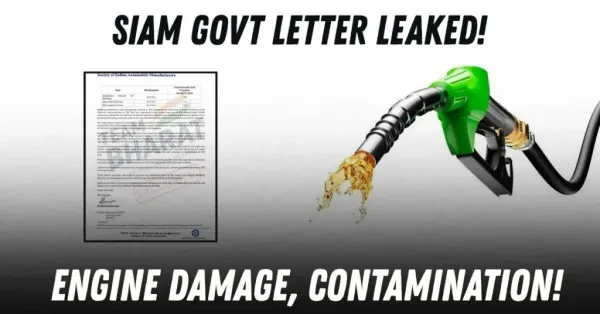
Political activist Tehseen Poonawalla has now exposed the document that the government has allegedly been trying hard to erase. He has published soft copies of a letter that the Society of Indian Automobile Manufacturers (SIAM) sent to the government raising concerns around E20 fuel. It has flagged fuel contamination and engine problems in the vehicles tested.
Interestingly, excepts of this letter had leaked earlier as well. Media had taken it up, and SIAM soon came up with an official clarification. The original story, published by CNBC TV18, was taken down and SIAM also informed through an official statement that it is withdrawing the letter.
Poonawalla has shared this letter on his official X (previously Twitter) handle. In the description he alleges that the letter was suppressed by the government and says that Team Bharat, the political outfit he leads, accepts full responsibility for releasing it online. The letter warns the government that the Chloride content in E20 petrol is actively damaging vehicles.
The letter mentions that the quality of fuel being dispensed to customers need to meet the specifications and quality requirements set by various bodies. It also says that strict measures need to be taken to avoid fuel contamination. More importantly, it also adds that measures need to be taken to avoid the adverse impact of Ethanol blended fuel itself.
SIAM’s letter further advises a two-stage control to achieve this. The first is to mandate the control limit fuel specification. Secondly, focussed drives should be conducted to verify fuel quality.
Then comes the most interesting part. The letter says that SIAM members are observing huge increase in issues in vehicle parts and increased replacement of components like fuel injectors, fuel pumps, EGR valve, exhaust and others. Most of these are parts that are in direct contact with the fuel or with exhaust gasses. Investigations, the letter says, have revealed that these failures occurred due to corrosion or wear caused by high Chloride content. Deposits from damaged parts have also shown the presence of Chloride. These can be attributed to the fuel used.
It further enforces this claim by stating that fuel samples from vehicle fuel tanks have shows increased chloride levels. Even in the range of 500 mg/kg. In some cases, fuel chloride was detected in the engine oil of failed vehicles.
The letter then talks about Chloride contamination at pump level. It says that SIAM members keep analysing fuel samples from various retail outlets (petrol pumps). Samples, it claims, had chloride contamination of up to 350 mg/kg. It further states that Chloride- issued increased specifically after E20 implementation.
For the uninformed, Chloride is very harmful to engine parts. Its accumulation in fuel or exhaust systems can cause corrosion and other damages, especially over a period of time. This is why the body wants to set permissible Chloride limits in fuel specifications and implement strict quality control. The letter states that fuel contamination- issues will create a wrong impression about the E20 program in consumers’ minds.
According to the letter, SIAM members have been asking to set Chloride levels at BIS committee for more than 2 years. The severity of the situation was even explained in the recent BIS meetings. Action on the same is still pending. SIAM wants Chloride-free fuel to be sold to customers- a goal that is yet to be fulfilled.
The letter also requests the government to direct oil marketing companies to find the root cause of chloride contamination and get the same addressed. SIAM has also noticed high moisture content in the E20 fuel dispensed at some pumps.
High moisture content (above 1.0%) will trigger phase separation. This is a process in which the ethanol from the blended fuel will bind with water and form a water-ethanol layer at the bottom of the storage tank. This will then be pushed into vehicle’s fuel tanks by the dispensers. This can potentially paralyse vehicles sooner than many of us would expect. Proper maintenance of underground storage tanks at pumps is critical to keep moisture away, especially in the rainy season. SIAM advises periodic audits and inspections at fuel stations to ensure there is no phase separation.
In the later section of the letter, SIAM requests the government to mandate total chloride control in diesel, as well. This is now optional.
Read the letter again and we can clearly understand why the government chose to withhold it. It has enough to create panic among users and shape the public sentiment against the E20 program. However, SIAM seems to have proposed changes that should ideally be welcomed- those that would improve the overall experience with ethanol blended petrol. The government, we hope, will take these into consideration.
-
Southern Zonal Council meet: DyCM pushes for cooperative growth

-
Cecilia Cheung and Nicholas Tse’s 19-year-old son draws attention for looks, musical talent

-
Indra Kumar, Ashok Thakeria face FIR over Dhamaal rights dispute

-
3 Zodiac Signs Attract Major Financial Success On August 21, 2026

-
World’s second richest country among 10 best places for Americans to settle down