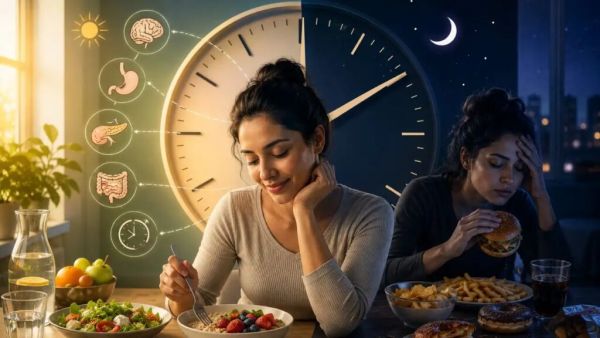
Importance of eating time
In today's fast-paced life, people often lose their meal time. Returning late to office, having snacks while watching web series, or eating dinner late at a party has become a common thing. In such a situation, the question arises whether the timing of eating is really important, or it only matters what and how much we are eating. Also, does eating late make the body sluggish, and what effect does it have on health? Answers to these questions are being discovered through studies on chrono-nutrition in the last few years.
What is Chrono-Nutrition?
Chrono-nutrition is a scientific term made up of 'chrono' (time) and 'nutrition' (nutrition). This science studies how meal timing affects our body's internal biological clock, called the circadian rhythm.
Late eating and body rhythms
Our body has a 'master clock', which is located in the brain, and each organ such as the liver, pancreas and intestines has its own 'peripheral clock'. These clocks regulate hormones, digestive enzymes, and metabolism according to day and night. Studies show that breakfast can advance the body's peripheral clock, while eating late at night pushes it back, disrupting the body's internal rhythms.
Wrong eating time and health
Research shows that when meal timing does not match the body's internal clock, it has an adverse effect on metabolism. One important study found that blood sugar levels rise at night by about 17% more than during the day, and the initial insulin response after meals is reduced by about 27%. This means that not only our habits, but also the body's internal circadian clock determine how well we will be able to digest and process food.
Need for personal rules
Studies show that the basic principle of chrono-nutrition (timing of eating affects metabolism) is true for everyone, but the most appropriate time may differ from person to person. Every person's chronotype is different, as some people are morning people while some stay awake at night. These factors also determine how the body processes nutrients. Therefore, researchers are emphasizing on determining the right time for eating differently for every person.
What to do?
There is an old saying, 'Eat breakfast like a king, lunch like a prince and dinner like a fakir.' This means starting the day with a nutritious breakfast, eating a balanced meal in the afternoon and eating a light dinner at night. Additionally, maintain regular eating and sleeping times. Finish dinner 2-3 hours before sleeping, so that the body gets enough time to digest the food. Avoid late night snacking, and if hungry, choose light and nutritious options.
-
Manchester United vs Milan: Official line-ups confirmed as Modric gets the call and Ramos starts

-
Paneer, Chicken, Dal And More: Inside Diljit Dosanjhs Fun Meal Preparation

-
Samsung One UI 9.5 Leak Uncovers Exciting Galaxy S26 Changes and Android 17 Support

-
“We’ll be aggressive and explosive,” says injury returning Satwik ahead of BWF World C’ships

-
1st Test: Padikkal’s ton takes India to 288/2 against SL on Day 1