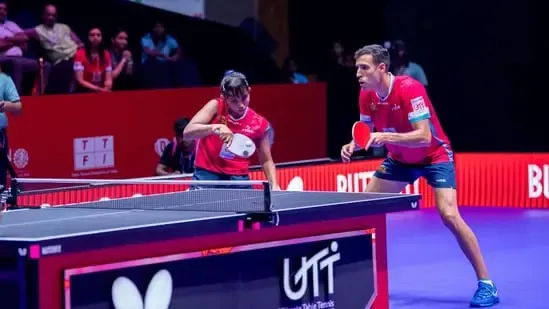
For six seasons, Ultimate Table Tennis ran the same way every other table tennis tournament in the world operated for decades - on the eyes and instinct of the umpire in the chair.
This year, that changed. When UTT Season 7 got underway in Goa last month, matches, for the first time, were backed by an AI system that could rule on a contested serve in under 20 seconds. The Table Tennis Review, or TTR, built by Gurugram-based Stupa Sports, made UTT only the second table tennis league in the world to adopt a dedicated AI review system for officiating.
Since the third season in 2019, Stupa has been UTT's data and technology partner. A season later, the sports technology company built the league's AI-powered live statistics and scoring system, then added shot-speed analytics in Season 5, steadily expanding from managing UTT's data ecosystem into shaping how matches are consumed by broadcasters and fans. TTR was the next, and perhaps the biggest, step.
The scale of that step becomes clearer when set against Stupa's own calendar this year. In March, its Instant Review System (IRS) for badminton was certified by the Badminton World Federation with 99 per cent accuracy, clearing the federation's 98 per cent threshold and making Stupa the only Indian technology provider to hold that certification. Three months later, Stupa Sports took its first giant leap beyond racquet-ball sports as it ventured into Rugby. In the second season of the Rugby Premier League in Hyderabad, the Advanced Decision Review System (ADRS) went live. And in July, TTR arrived at UTT. Three AI officiating systems, across three different sports, inside the same four months, each carrying its own technical demands and its own margin for error.
With UTT's season over, Megha Gambhir, Founder and CEO of Stupa Sports, spoke to Hindustan Times on what a full competitive season taught the company that a pilot never could, why rugby was a natural next step and not a detour, and why officiating - once a side project - is now central to how Stupa sees its own business. Here are excerpts:
Q) UTT's season ended recently, and TTR has now been through a full competitive season rather than a pilot. What did real match pressure teach you that the testing phase couldn't?
The biggest difference between testing and a live competitive season is that there is no controlled environment once the tournament begins. In a pilot, you can test different scenarios, fine-tune the system and understand how the technology behaves under specific conditions. A full competitive season puts the technology into the real rhythm and pressure of professional sport, where decisions have to be accurate, fast and dependable every single time.
TTR's deployment through UTT gave us that validation. We learnt that building an AI-based officiating system is not only about achieving high accuracy in a controlled environment; it is about making the entire system robust enough to work consistently across different players, playing styles, match situations, lighting conditions and venues, while fitting seamlessly into the workflow of officials and the broadcast.
-
Which elements of regular health check-up can be important for early detection of cancer risk? Know in detail

-
Recipe to make Jave-Makhana Kheer on Rakshabandhan

-
Entry of realme 16x 5G! 7000mAh 'Titan' battery and powerful performance; Know the price and features

-
Amy Hunt Targets Four European Championship Golds After Winning 100 Meters

-
Carrick urges Manchester United to make more signings to keep up with Premier League title rivals