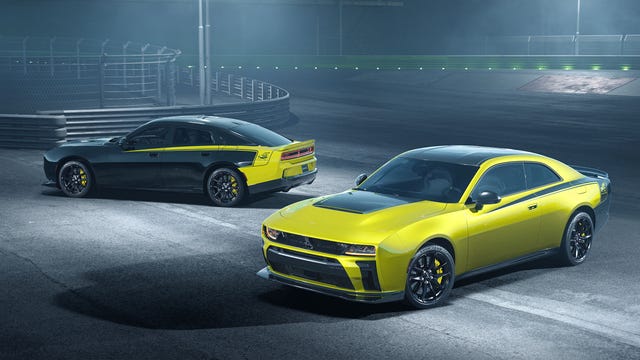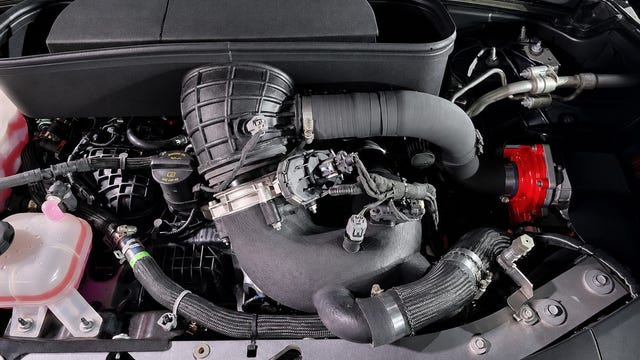
Turbocharging is now so widespread that it stands out when a new car or truck arrives without those air-forcing snails. Even so, while turbos help engineers boost efficiency and performance without increasing displacement, they are not a perfect answer to every challenge. On Thursday, Stellantis announced that its SRT Performance Division is developing a new technology called eBoost Air to tackle one of the biggest drawbacks of turbocharging: turbo lag.
Put simply, a turbocharger is a type of forced induction system that makes use of the exhaust gases an engine is already producing. Those gases flow into the turbocharger, where they spin a turbine connected to a compressor on the other side of the unit at the engine’s air intake, increasing air density for combustion. However, as turbo size grows, the volume of air moving through it also rises, and the larger the turbo, the longer it generally takes to spool the compressor. That delay is what we refer to as “turbo lag.”
Many modern vehicles address this issue by using slightly smaller turbos in twin-turbo setups, or through other solutions such as electrified turbochargers that use electrical energy to spin the impellers up to their ideal rpm. SRT’s eBoost Air system takes a different route to solving the same problem.
The eBoost Air setup includes what SRT calls an “e-compressor”, an electrically powered turbine positioned in the intake path independently of the conventional mechanical turbochargers located downstream. eBoost Air is not a traditional e-turbo because it does not include an exhaust side, but it works in a broadly similar way: when the driver asks for more torque and the turbos are still below their operating speed, eBoost Air begins forcing air down the intake path. This helps the turbos spool more quickly, after which the system redirects airflow back to the normal route.
It is not an especially complicated idea, but SRT says it performs exactly as intended. With the system fitted to a High Output Hurricane, the company says the engine’s response feels much closer to that of one of Dodge, Ram, or Jeep’s supercharged V-8s. Considering how laggy the high-boost 3.0-litre engine can be, that is a significant claim.
“Enthusiasts aren’t interested in technology for the sake of technology. But when technology improves performance with no downside, they’re all in,” said Tim Kuniskis, head of American brands and marketing, North America. “eBoost Air delivers exactly that kind of tangible benefit. It's a smart, simple idea that attacks turbo lag head-on and reflects what SRT does best—moving fast, challenging assumptions, and chasing more performance.”
For now, eBoost Air remains only a concept. That said, if the cost is not too high to amortise, it could become a worthwhile addition to the Hurricane line-up. It may even allow the brand to fit even larger turbos to the inline-six and more seriously challenge the power output of the Hellcat engines.
Update, 4:30pm: This story has been updated with revised wording about how a turbocharger operates.
-
PSG move closer to stunning €55m deal for World Cup hero

-
AS Monaco set to end Paul Pogba contract

-
Myles Lewis-Skelly decides to stay at Arsenal despite Manchester United links

-
Polaris’s new side-by-side brings 275 turbocharged horsepower to the party
-
Dodge’s 2027 Charger Sixpack Super Bee Brings a 600-Horsepower Twin-Turbo Punch