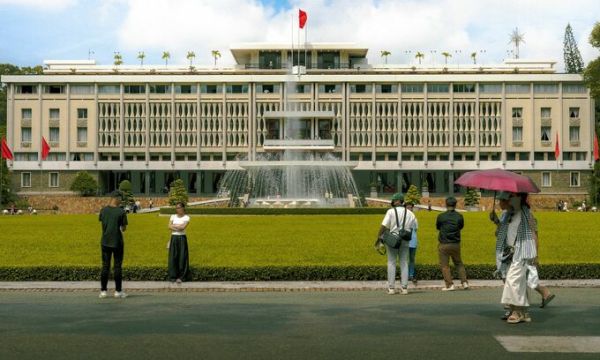
The special national relic on Aug. 1 introduced a new fee schedule for visitors bringing cameras onto the historic grounds: They must pay VND500,000-10 million (US$383), depending on the type and scale of the photography.
But visitors are unsure whether they are required to pay simply for bringing a camera to take personal photos.
“I was surprised to hear that bringing a camera into the palace could cost 10 times the entrance ticket,” Mai Vy, a Hanoi resident who is planning to visit Ho Chi Minh City in August, says.
She says she usually carries a small camera when traveling to take personal photos and finds the new fee structure confusing, particularly because it is unclear who exactly the charges apply to.
A visitor bringing a camera or equivalent device must pay VND500,000 for photography inside and outside the palace.
For photography crews of up to eight people, the fee is VND1.5 million for outdoor shoots and VND3 million for shoots covering both indoor and outdoor areas.
The palace also offers a VND10-million monthly package that allows a crew of eight to conduct 10 outdoor photo shoots in 30 days.
Commercial productions like films, music videos, TV commercials, and high-end fashion shoots have to contact the management for separate arrangements.
|
Visitors tour the Independence Palace in Ho Chi Minh City. Photo by DUYTRG TRUONG |
Bui Huu Toan, Director of Independence Palace, says the new fee regime was introduced to regulate professional photography crews and prevent them from hassling visitors.
Some bring clients to the palace for professional shoots, occupying popular photo spots for long periods, using bulky equipment and blocking walkways, he said.
“The fee is a tool to regulate the use of the space, not to generate revenues or profits.”
But it only applies to photography service providers, not ordinary tourists using their cameras for personal photos, he said.
He admitted the wording is unclear and causes confusion, and promised that the management would revise the terminology to make things clear.
The palace security staff currently identify professional photographers based on their equipment, the number of people involved, and how the shoot is conducted.
The management has claimed there have been no disputes or complaints from visitors since the new fee schedule took effect, but photographer Chuong Tran said he had a different experience.
He visited the palace on Aug. 1 to take graduation photos for a student client, but was asked by security staff to pay a VND500,000 photography fee though he was carrying only a digital camera and not a tripod, lighting equipment, or reflectors.
It was the first day of the new regime, and so he was surprised also because there was no notice at the entrance or inside the site.
He said VND500,000 is pretty expensive for ordinary tourists and students taking graduation photos.
Charging for filming at heritage sites and museums is not unusual in Vietnam.
The Vietnam National Fine Arts Museum in Hanoi charges VND300,000 per camera for regular photography, VND1 million for wedding photography crews, and VND3 million for fashion photography.
Film crews producing reportage or documentary content are charged VND5-20 million and require approval from the museum director.
Other heritage sites have a flexible approach.
At An Dinh Palace in Hue, visitors can take personal photos with phones or their own cameras after purchasing an entrance ticket. The Hue Monuments Conservation Center requires registration and requires additional fees for wedding photography, commercial shoots, and professional filming.
Elsewhere in the world, most attractions commonly distinguish between personal and commercial photography.
At the Louvre and the Palace of Versailles in France, visitors can take personal photos, while professional and commercial shoots require prior permission and may incur location fees depending on their scale and conditions.
 |
|
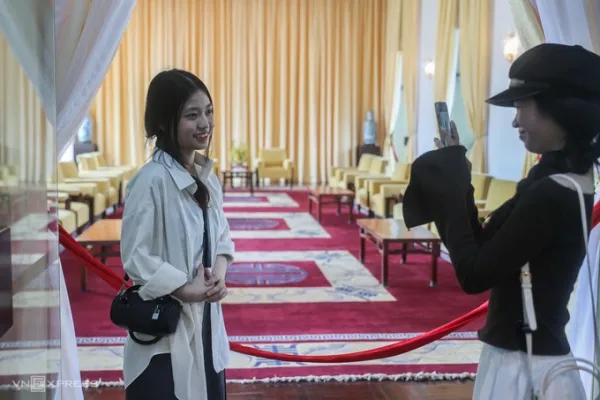
Visitors at the Independence Palace in Ho Chi Minh City on April 30, 2024. Photo by Read/Tran Quynh |
Nguyen Tran Hoang Phuong of the Tourism Research Institute said heritage sites should not charge visitors for personal photography since taking photos is part of the travel experience.
If the goal is to prevent professional crews from occupying public spaces, management should regulate those activities directly rather than introduce rules that could make ordinary visitors think they have to pay simply for carrying a camera, he said.
Fees should be reserved for clearly commercial activities such as advertisements, music videos, and commercials, he said.
“Visitors’ photos should be seen as a way to promote the site since images shared on social media generate publicity and attract more tourists.”
-
Snake Behaviour: Why Do Snakes Flick Their Tongues So Often? Strange Science Behind This Action

-
Gardening Tips: 7 Terrace Plants That Could Help Keep Mosquitoes Away Naturally

-
17 Goals, No Proper No.9: How Manager Hansi Flick is Rewriting Barcelona’s Attacking Blueprint

-
Nayanthara’s ‘Hi’ Box Office: Kavin Starrer Gets Mixed Reviews, Here’s How Much It Earned
-
Ravi Teja’s Irumudi Creates Box Office History, Crosses Rs 200 Crore