Like any seriously committed petrolhead, I find it hard to warm to the idea of simulating such an important part of the driving experience. Yet almost every time I have given these kinds of systems a chance, I have ended up liking them more than expected. I say almost because there are exceptions. Cough, Fratzonic exhaust, cough.
Honda’s S+ Shift system is exactly the sort of puzzle I mean. The two-motor hybrid powertrain in the Prelude does not actually use a conventional transmission. In most situations, an electric motor drives the front wheels, while an electronically controlled clutch allows the engine to drive the car directly during steady, high-speed cruising. As you would imagine, that arrangement can make for a fairly unexciting powertrain, and Honda clearly decided that was not acceptable in the Prelude. That is why it developed this new simulated eight-speed dual-clutch transmission. It is unusual. In fact, the Prelude even appeared in our Weird issue, largely because of this very feature.
Oddness aside, I was also optimistic. Honda has a long record of delivering a driving experience that feels much better than the hardware might initially suggest. The different generations of Prelude have always been an important part of that legacy, so I spoke to Yoshiharu Saito, Prelude powertrain project leader, to understand how the system works.
Honda highlights two earlier advances in hybrid drive technology that paved the way for S+ Shift: Linear Shift Control and Direct Acceleration. The first of those, Linear Shift Control, was created to make what the driver hears from the engine match their inputs more closely. Honda’s two-motor hybrid system naturally uses the internal combustion engine as a generator, which means it can simply drone away at its own preferred speed while trying to charge the battery pack as efficiently as possible. Meanwhile, the electric traction motor uses battery power to accelerate the car. Drivers found that disconnect between engine sound and actual forward motion rather strange, so Honda developed Linear Shift Control to make the engine note sound as if it is revving and “shifting” through gears under throttle, much like a traditional transmission. Direct Acceleration, meanwhile, is essentially a way to start the engine earlier, ensuring plenty of power is fed into the battery, so the car can deliver more natural and effective torque from a standstill when the driver wants a quick launch.
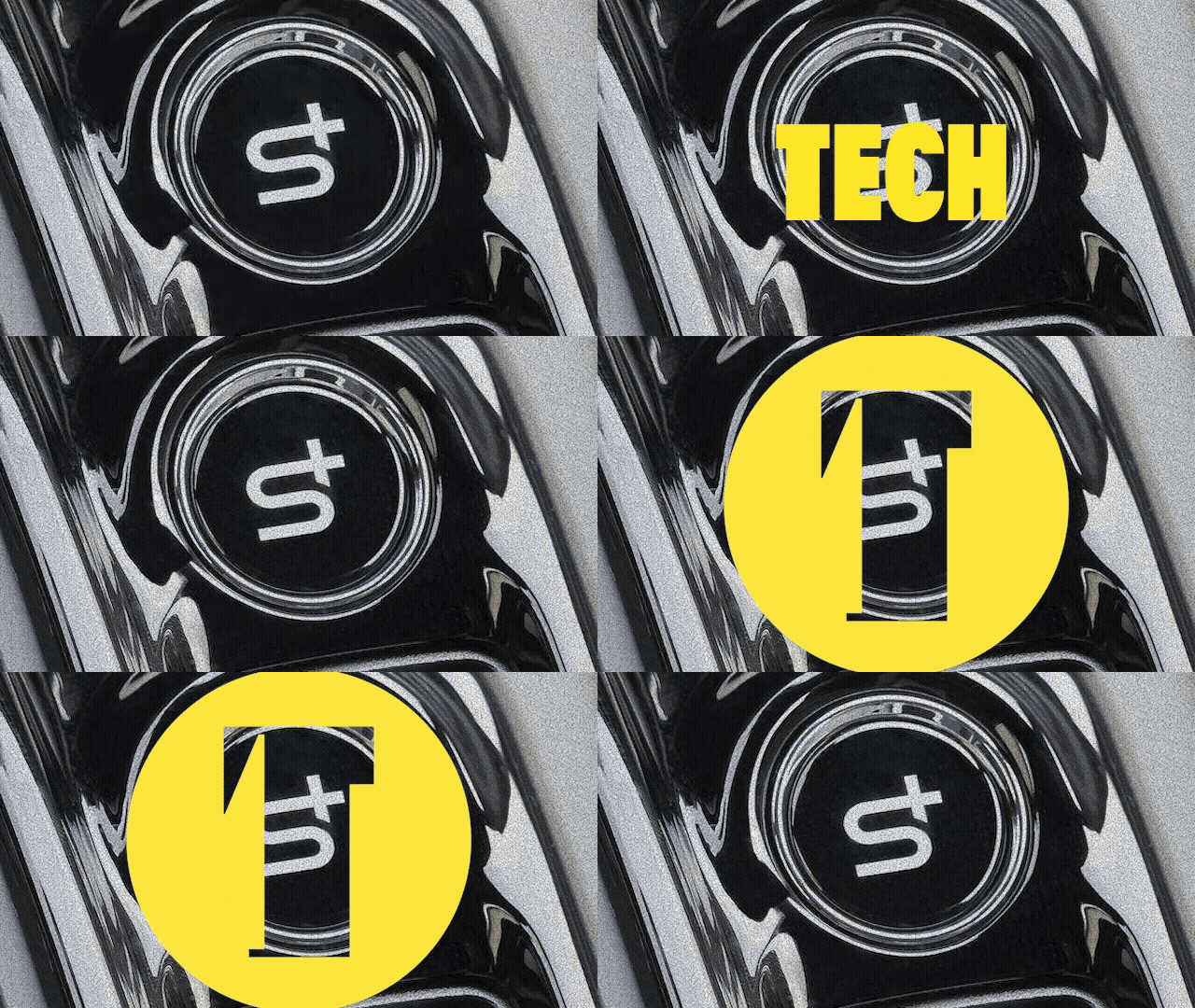
As you might expect, nearly all the wizardry behind S+ Shift lies in the software. If you never press the S+ Shift button on the centre console, the Prelude behaves like Honda’s other hybrid models. But once you enter the S+ Shift world, you step into Honda’s own Narnia of simulated gear changes.
(Ed note: Saito’s quotes in this story were translated from Japanese by Honda.)
“Honda S+ Shift was developed not only to create the enjoyment of behaving like a DCT, but also as a technology that enhances the fundamental powertrain values of responsiveness and linearity,” Saito says. “The response and linearity to even slight accelerator input changes during acceleration and deceleration, such as on uphill roads or freeways, are capabilities not previously achieved in conventional hybrids, and we believe this allows drivers to enjoy a true dialogue with the vehicle.”
The real secret behind what makes the new Prelude’s powertrain engaging lies in the fine calibration of the electric motor and the internal combustion engine. Honda says it is not trying to recreate the sound of any particular engine from its history, but it does admit that the torque curve and acceleration are intended to resemble a 2.4-litre naturally aspirated four-cylinder. That sounds entirely reasonable given that the electric motor doing the actual acceleration is a mildly torquey little unit.
The fun truly starts when you use the steering wheel-mounted shift paddles. When you pull a paddle for an upshift in S+ mode, Honda says it briefly switches the motor into regeneration mode. That immediately drops the revs of the internal combustion engine and, naturally, also reduces the electric motor’s output, recreating the interruption in acceleration you would expect during an upshift in a conventional transmission. Even the sound aims to stay faithful to the sensation, with Honda using its Active Sound Control system to play the noises you would expect to hear through the Prelude’s four speakers. These interruptions are also the reason the Prelude takes 0.8 second longer to reach 60 mph when S+ mode is engaged.
“The system reads real-time engine data such as engine speed and throttle opening, and selectively emphasizes specific frequency components through the cabin speakers,” Saito said. “The settings are significantly adjusted for each drive mode. In particular, during downshifts, the system is tuned to make the blipping sound stand out.”
That rev-blipping effect on downshifts is perhaps the most satisfying part of the S+ Shift system. Every time you pull a paddle for a downshift, Honda artificially increases the generator motor’s power generation, which naturally causes the internal combustion engine to flare its revs and produce the same quick blip you would expect from a DCT during a downshift. Depending on the situation, Honda says it will even briefly reduce the drive motor’s output during a downshift, giving the same forward-pitching deceleration sensation that usually comes with a big change in revs. Yes, there is a “man behind the curtain”, but the sensations you feel in the car are still real responses from the actual powertrain components, simply shaped by Honda’s software tuning.
The previously mentioned ASC plays a major role in making the whole system feel “real”, and getting that implementation right was one of Honda’s biggest mechanical challenges.
“Applying ASC requires noise smoothing as a prerequisite,” Saito started. “This involves a wide range of design considerations, including engine block and crankshaft rigidity, coupling stiffness with the Front Drive Unit (front-mounted motor), placement of component natural frequencies, and the vehicle’s sound insulation package. While fully leveraging the knowledge gained from the Civic Type R, we tailored the sound to align with the Prelude’s concept and the driver’s intentions, creating a sound experience that feels appropriate and engaging.”
If you are not familiar with it, Honda began its ASC journey, meaning simulated engine sound, with the Type R. That car obviously produces plenty of genuine noise on its own, so engineering the Prelude’s system was a very different challenge altogether. The sound has a Honda-like character, but it is generic and only “revs” to around 6000 rpm. In other words, it is no VTEC screamer.
Beyond the sound alone, Honda’s shift logic also follows a clear method, and the company drew from its experience with earlier DCTs such as the one in the now-discontinued NSX. The same shift control logic used in that car’s nine-speed DCT has been applied here in the Prelude.
“For example, during cornering, upshifts are held in order to prepare for acceleration after exiting the corner,” Saito tells me. “Similarly, downshifts during braking are determined to prepare the driving force needed for acceleration after braking. In addition, the system is tuned to perform sequential downshifts that take advantage of the close gear ratios.”
By “downshifting” into a lower gear and holding it there through corners, the system sends more power into the battery and keeps it charged for maximum acceleration on corner exit. It behaves exactly as you would expect from a normal DCT, while also helping make the Prelude feel more eager and punchy when driving out of a bend.
Honda could have engineered a one-pedal drive mode, or something close to it, but it deliberately chose not to. Once again, that decision came from Honda’s effort to make the driving experience feel as close as possible to that of a normal internal combustion car. Even the choice of an eight-speed “transmission” was deliberate. Interestingly, Honda says it picked eight because that is the current number of gears used in Formula 1 transmissions. In practice, the ratios are fairly close together, which suits a naturally aspirated four-cylinder that needs to stay in the rev range to build speed. Honda even matched eighth-gear cruising revs, 2160 rpm at 60 mph, to the same overall ratio used when the engine directly drives the front wheels, all in an effort to smooth that transition.
Much of this simulation is impressively convincing, but there are still some major gaps Honda needs to address. For instance, there is no way to permanently lock the car into manual shifting mode. If you pull a paddle and enter manual mode, you have to keep interacting with it, otherwise the car returns to an automatic mode. It still “shifts”, but the car takes over control of the ratios. Does that weaken the illusion in my view? Absolutely. Honda also does not allow the car to hit a virtual rev limiter, because it automatically upshifts when you reach redline in manual mode, once again reducing how believable the simulated gearbox feels. Still, all is not lost, because Honda has left room for future changes.
“During development, we validated the behavior by driving on a wide variety of courses, and we believe the current hold time is optimal,” Saito says. “However, we understand that depending on individual customer preferences and driving environments, there may be situations where it feels short, and we would like to reflect this feedback in future development.”
Honda will happily tell you that this flexibility is one of the system’s strengths. Although it chose an eight-speed setup for this application, there is no reason it could not create another version with a six- or seven-speed transmission instead. After all, the crucial elements here are all software-based. Honda says it did not need to develop any new hardware to make the system work. Even the existing computer chips were more than capable of running this sophisticated transmission simulator, thanks in part to earlier technologies such as Linear Shift Control. The Civic Hybrid has already been confirmed to receive S+ Shift technology in its next update, which should make that excellent economy car a bit more entertaining to drive. And if you have not noticed already, Honda and Acura are going all-in on hybrids, so expect S+ Shift to remain part of the driving experience in Hondas for a long time to come.
-
Your Complete Monsoon Skincare Guide For Sensitive Skin: Simple Tips To Protect Against Humidity & Flare-Ups

-
Nearly 73% Students Drop Out Before Higher Secondary, Parliamentary Panel Flags Alarming School Shortage

-
‘Maharashtra Should Have Taken This Stand Years Ago’: MNS Leader Amit Thackeray Reacts To Tamil Nadu’s NEET Abolition Resolution

-
'Exercise Due Caution': NBEMS Warns Against ‘False, Incorrect Or Misleading’ NEET PG 2026 Test City Information On Social Media

-
Ohh My Dog Box Office Collection Day 6: Pankaj Tripathi Starrer Earns ₹20 Lakh On Wednesday