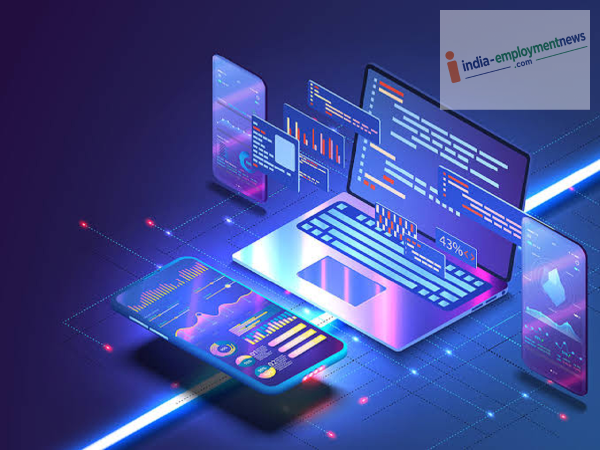
How India’s Technology Changed: Back then, computers were massive and expensive, used only for complex tasks, scientific research, and within large organizations.
How India’s Technology Changed: When India gained independence on August 15, 1947, the country faced the monumental challenge of building a robust infrastructure and improving the lives of millions. At that time, India lagged significantly in terms of technology; concepts like computers, the internet, mobile phones, and digital payments were beyond the imagination of the average citizen.
However, the picture has completely transformed by 2026. India now ranks among the world’s major technology markets, and digital technology has become an integral part of everyday life.
Technological development begins after independence
In the early years following independence, India focused on rapidly building its scientific, engineering, and industrial capabilities. Scientific institutions and technical education were actively promoted. The country gradually began to strengthen its foothold in sectors such as nuclear energy, space research, and telecommunications.
Computing technology made its debut in India during the 1950s and 1960s. At that time, computers were massive and expensive, used only for complex tasks, scientific research, and within large organizations.
Computers transformed the world of work
By the 1980s and 1990s, computers began to make their way into government offices, banks, and corporate firms. Simultaneously, India’s software industry witnessed rapid growth.
Following economic liberalization in the 1990s, Indian IT companies gained the opportunity to establish themselves in the global market. Indian engineers and software professionals began working for companies worldwide. This era played a pivotal role in establishing India as a leading global IT and outsourcing hub.
The internet revolution
The internet was introduced in India in the mid-1990s. Initially, however, internet access was limited to only a few locations. Due to dial-up connections, slow speeds, and high costs, its usage was largely confined to institutions and a select group of users.
Subsequently, the expansion of broadband, 3G, and 4G brought the internet to the masses. The digital revolution gained momentum as smartphone prices dropped and mobile internet became more affordable. Today, online education, video streaming, social media, shopping, and digital services have become integral parts of the lives of millions of Indians.
Smartphones Brought Technology to Everyone’s Hands
It is worth noting that mobile phones gained rapid popularity in India after the year 2000. Initially, they were used primarily for calls and SMS. However, the advent of smartphones and mobile internet transformed the mobile phone into a pocket-sized computer.
Today, smartphones enable people to handle banking, ticket booking, education, office work, video calls, and even online shopping. Moreover, with smartphones reaching villages and small towns, residents there have also learned to perform many tasks online.
UPI Revolutionized Digital Payments
India’s digital technology sector has evolved rapidly. A major milestone in this journey was the introduction of UPI, which made online payments easy for everyone. Unified Payments Interface (UPI) simplified the process of transferring money via mobile phones. Today, anyone can transfer funds directly from their bank account to another person’s account in mere seconds.
From tea stalls to large retail stores, and for activities ranging from online shopping to bill payments, the use of QR codes and UPI has become commonplace. This has given fresh impetus to cashless and digital payments across India.
5G Accelerated Digital India
While 4G played a pivotal role in bringing mobile internet to the masses, 5G has ushered in high-speed connectivity. Beyond offering faster downloads and lower latency, 5G is fostering the growth of smart cities, automation, cloud gaming, industrial IoT, and various other cutting-edge technologies across the country. With the advent of 5G, users can now access the internet at high speeds and download content rapidly. This technology has significantly enhanced the smartphone user experience.
Now, it is AI’s turn.
By 2026, India’s technological journey has entered a new phase. Artificial Intelligence (AI) is now developing rapidly across the country. The adoption of AI has surged in sectors such as education, healthcare, banking, cybersecurity, content creation, customer service, and software development.
Generative AI has made technology even more accessible. People are now using AI to find answers to questions, generate images, comprehend information, write code, and manage their daily tasks.
Generative AI has made technology even more accessible. People are now leveraging AI to find answers, generate images, comprehend information, write code, and manage various daily tasks.
India’s Giant Leap: From Space to AI
When India gained independence in 1947, the nation was grappling with a lack of basic technological resources; today, however, it demonstrates its prowess to the world in sectors such as satellites, digital payments, mobile networks, software, electronics, and AI.
India’s technological journey from 1947 to 2026 is not merely a story of the evolution from computers to smartphones or from the internet to 5G. It is the story of a transformation where technology gradually transcended a few select institutions to become an integral part of the daily lives of millions of Indians. In the years ahead, AI, robotics, quantum computing, and advanced connectivity could steer India’s technological journey in a new direction.
-
Hairline is thinning? For thick hair, use onion peel in this way, within a month, hemp will look fuller

-
Independence Day Special: A colorful feast of patriotic stories on Airtel IPTV
-
Google Pixel 11 Pro Fold launched in India, the company's most expensive phone with a price of Rs 1.86 lakh and a foldable screen

-
Pitch invaders take selfies with Fernandes as Manchester United draws with Leeds in friendly

-
IND vs SL: Even if Team India loses against Sri Lanka, Gautam Gambhir's chair remains? Big decision by BCCI