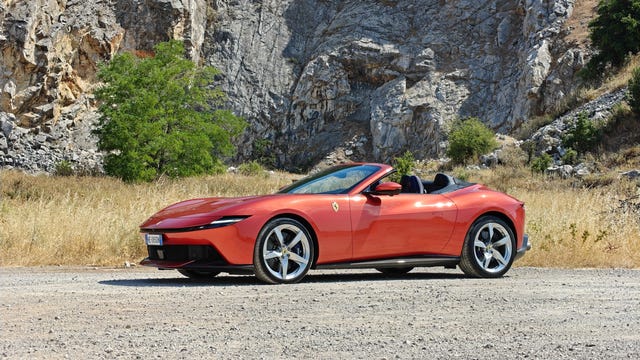
If I have to choose between a coupe and a convertible, I will take the one that lets the wind rush through my hair and fills the cabin with unrestricted exhaust sound every single time. The usual trade-offs in weight and rigidity that come with modern convertibles rarely matter enough on the road for me to worry about them. And that brings me to the Ferrari Amalfi Spider.
I drove the Amalfi coupe last year, and it felt like a superb evolution of the Roma. Yes, there used to be a certain stigma around driving Ferrari’s entry-level model during the awkward California era, especially since that car had originally been conceived as a Maserati. But that baggage has now disappeared, and on paper the Amalfi Spider is exactly the version of this front-engined V-8 two-door Ferrari that I would normally prefer most.
From a styling point of view, the Amalfi Spider makes an excellent first impression with its roof folded away. To my eye, it is even more attractive than the already handsome coupe, and my test car in Greece looked especially inviting in the sunset-inspired Rosso Tramonto paint paired with its shimmering Tecnico Ottanio woven soft-top. Ferrari’s designers told me they began the Amalfi refresh of the Roma using a “speedform” design model, with the aim of creating a shape inspired by speed itself. Make of that what you will, but I find this restrained approach more appealing than the more dramatic styling seen on some other recent Ferraris.
On the rough beachside roads of southern Greece, I tried hard to detect any sign that the soft-top body lacked stiffness, but it quickly became clear that there was no such issue. The retractable fabric roof is the same setup first seen on the Roma Spider, a five-layer construction made with sound-deadening material. It genuinely works. With the roof up, there were moments during my drive when I completely forgot I was in a convertible, and that is about the highest praise you can give a soft-top roadster.
With temperatures touching 105-degree Fahrenheit on Greece’s canyon roads, I kept my open-air bursts fairly brief. The roof takes 13.5 seconds to lower electrically, and using the wind deflector is just as simple from the driver’s seat thanks to a switch that raises the unusual partition between the two rear seats. With the deflector in place and the windows up, buffeting in the cabin was so well controlled that I was almost disappointed by how isolated I felt from the outside world. Drop the windows, though, and the Amalfi Spider’s savage pace on a technical road will make sure your hair is in complete disarray by the next stop.
The Amalfi Spider uses exactly the same powertrain as the coupe, and it brings worthwhile improvements over the 2024 Roma Spider. The 3.9-litre twin-turbo V-8, mounted far back in the engine bay, produces 631 hp at 7500 rpm and 561 lb-ft of torque at 3000 rpm. All of that goes through an eight-speed transaxle and an electronically controlled limited-slip differential before reaching the rear axle. Ferrari has extracted the extra performance over the Roma through a more advanced turbo management system first developed for other models such as the 296 GTB, allowing greater independent control of each turbo.
What disappointed me was the sound, because my test car breathed through mufflers engineered to meet Europe’s noise-emission regulations. Sadly, it was so subdued with the roof down that very little of the classic Ferrari howl reached the cabin. Most of what I heard was rushing air, and even when I happened to be near a rock wall that could reflect the exhaust note back at me, all I got was a faint, metallic hint of the noise the car was trying to make rather than the full open-top Ferrari soundtrack I had hoped for.
Then I raised the roof and realised the car actually sounds much better that way. The trumpet-like intake roar comes through richly inside the cabin. It even seems as though there is more exhaust sound when driving with the roof up and the windows down, which may well be the best way to enjoy the Amalfi Spider unless you plan to fit an aftermarket exhaust. For the first time in a very long while, I find myself leaning towards the coupe instead of the convertible.
Thankfully, there is absolutely nothing to criticise in the way the Amalfi Spider drives compared with the coupe, despite the convertible carrying a 190-pound weight penalty. Ferrari has added an extensive collection of reinforcement measures throughout the car to ensure that removing the roof does not compromise rigidity, and out on the road I could detect very little difference between the coupe and the convertible. The comprehensive suite of active dynamic systems also helped the Amalfi Spider tear through the road with real authority.
My confidence rose quickly on Greece’s switchbacks. In Comfort mode, the rear end stays planted and the chassis remains forgiving. Sport allows a healthy amount of slip angle if my right foot asks for it, while Race mode, even with ESC on, makes it feel as if it is simply me and 631 horses to manage. Ferrari gives a capable driver far more freedom to push the car into more dramatic territory with the electronic systems still technically active than almost any other carmaker. And with all that power going to the rear wheels, it became clear very quickly that driving the Amalfi Spider fast demands a skilled and delicate touch. Simply flooring the throttle and leaving the car to sort itself out is overrated anyway. The Ferrari kept encouraging me to experiment with throttle inputs as I fed in steering lock, unlocking more pace as I climbed and descended the mountain roads. Every new corner became an addictive learning experience, one that left me wishing the road ahead would never straighten out.
These canyons, with a distinctly California-like character, gave me plenty of chances to work up and down through the eight-speed dual-clutch transmission, and I enjoyed every pull of the carbon-fibre paddles. The brakes felt even better than I remembered from the Amalfi coupe, with the slight sponginess at the top of the pedal travel seemingly eliminated. It uses the same ABS Evo system Ferrari introduced on the 296 GTB to manage heavy braking. As brake-by-wire systems go, this is one of the finest.
Another underrated improvement for the Amalfi Spider over the Roma Spider that came before it is the new placement of the infotainment touchscreen. In the Roma Spider, the upward-angled display could be awkward to read when the sun was high overhead, but in the new car I never had any trouble with the lower, shrouded, landscape-oriented screen. The interior itself is a major step forward in all the lovely, tactile ways the Roma should always have been. A proper aluminium red start/stop switch sits on the steering wheel, and there are plenty of physical toggles on the wheel to make navigating complex menus and settings straightforward. Even so, I would still welcome more physical controls to make adjusting the ventilated seats and climate settings more intuitive.
If the Amalfi Spider is being used as a grand tourer, both driver and passenger are likely to adore it. With the roof up, long motorway journeys feel almost hardtop-like in their refinement, and in Comfort mode the Ferrari delivers a perfectly controlled ride through its semi-active dampers. It would be a tight fit, but you could technically get two small carry-ons into the boot for a long weekend away. Any extra bags or items would mean giving up the two rear seats, but that seems a perfectly acceptable compromise because I cannot imagine any adult-sized person wanting to sit back there anyway.
Even so, I cannot shake the feeling that I would rather have the Amalfi coupe than the Spider. The lack of sound with the roof down is a disappointing flaw in a car like this, even if Ferrari cannot be blamed directly given the stricter noise regulations it must meet. You will also pay around 10 percent more for the Spider than for the coupe, which puts the estimated starting price at around $300,000. At that figure, it sits squarely alongside other ultra-luxury convertibles such as the Bentley Continental GTC and the Aston Martin DB12 Volante. Among that group, the Ferrari is the one for the keen driver, offering a level of involvement that feels more sports car than plush grand tourer, and demanding real precision to get the best from it. And that is exactly the sort of car I want to be driving.
-
Independence Day: 6 unique ways to celebrate freedom in Hyderabad

-
Lorry hits parked bus on highway in Nizamabad, two killed

-
Taliban accused of detaining six women’s rights workers

-
Kochi: Man dies jumping into river after posting Instagram reel

-
Did you order removal of mosque loudspeakers?: HC to Bengal govt