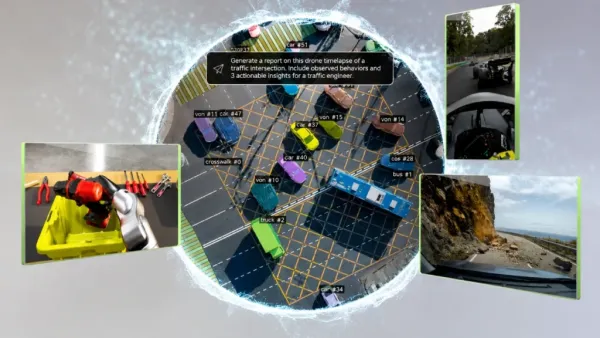
AI systems are being built to understand and interact with the real world. NVIDIA is working on Open-world models like NVIDIA Cosmos 3, a new family of open-world models designed to help developers train Physical AI systems for robots, autonomous vehicles, and advanced vision-based applications.
A few months ago, the Open Weights and American AI Leadership open letter was signed by NVIDIA and other AI companies and organizations. This open letter calls for AI leadership to be measured not by any single frontier model but by how open ecosystems reach every sector.
To meet this need, world models are trained to learn and understand the behavior of physical environments. This training enables them to generate physically grounded world and action data, simulate future events, and provide a foundation specialized for use in Physical AI present in robots, autonomous vehicles, or vision AI systems.
The training data used here is generated by open-world models. NVIDIA’s Cosmos 3 combines the abilities of world models and open models for adoption across various sectors.
How NVIDIA Cosmos 3 And NVIDIA Omniverse Are Helping Build Physical AI
The NVIDIA Omniverse provides prebuilt capabilities that are essential for building simulation-ready worlds for training physical AI. NVIDIA OpenUSD is designed to provide an open framework necessary for composing, reusing, and exchanging complex 3D data across various workflows.
By integrating Omniverse with OpenUSD, NVIDIA can prevent duplicate work from piling up in the process of training physical AI. With this system, NVIDIA is changing the direction of training physical AI for use in the real world.
With NVIDIA Cosmos 3, developers can rely on one model family to train and build their physical AI system. The use cases for Cosmos 3 are vast; it can be used as a vision-language model, a physically grounded world simulator, or the backbone for world action models.
This means that developers will no longer need to assemble and maintain a separate model to handle the needs mentioned above. Through this, NVIDIA is not only simplifying the workflow for developers; it is also improving efficiency in training physical AI.
Here Is the NVIDIA Cosmos 3 Family
There are three members of the NVIDIA Cosmos 3 family, each tasked with handling various roles in training physical AI. The first member of the family is the Cosmos 3 Super (64B), which is used for high-fidelity world modeling.

Next is the Cosmos 3 Nano (16B), which is used for efficient reasoning and post-training of physical AI. Lastly, we have the Cosmos 3 Edge (4B), which is used for on-device vision reasoning and robot policy deployment.
Together, these are lightweight, enabling them to run on edge GPUs and be deployed across NVIDIA RTX GPUs, NVIDIA D6X systems, and NVIDIA Jetson platforms like the Jetson Thor. The system has been benchmarked across Artificial Analysis for open-weight text-to-image and image-to-video generation, PAI-Bench for world generation, and Physics-IQ for image-to-video abilities.
It has also been tested for robot policy on the RoboLab and vision understanding on the VANTAGE-Bench. Across all five benchmark testing platforms, the NVIDIA Cosmos 3 ranked number 1.
NVIDIA Cosmos 3 Is Already Being Put To Use Across The Industry
The NVIDIA Cosmos 3 is already being used across various industries by top firms to train their physical AI systems. In the robotics industry, firms like Doosan Robotics, LG Electronics, Samsung Electronics, and Skild AI are already using NVIDIA Cosmos 3 to train their individual physical AI systems.

In the autonomous vehicles industry, firms like Xiaomi and Afari are using Cosmos 3 to train their physical AI systems for autonomous driving. The vision AI agent industry isn’t left out, as Centific, Fogsphere, Linker Vision, Milestone Systems, and Yuan all use Cosmos 3 for industrial AI and smart space applications.
Why NVIDIA Cosmos 3 Matters for Physical AI
Clearly, the NVIDIA Cosmos 3 is pushing the frontier of physical AI, helping firms train their AI models to meet their individual needs. More details on this system, as well as its industry-wide adoption, will be made available over the coming months.
-
Independence Day: 6 unique ways to celebrate freedom in Hyderabad

-
Lorry hits parked bus on highway in Nizamabad, two killed

-
Taliban accused of detaining six women’s rights workers

-
Kochi: Man dies jumping into river after posting Instagram reel

-
Did you order removal of mosque loudspeakers?: HC to Bengal govt