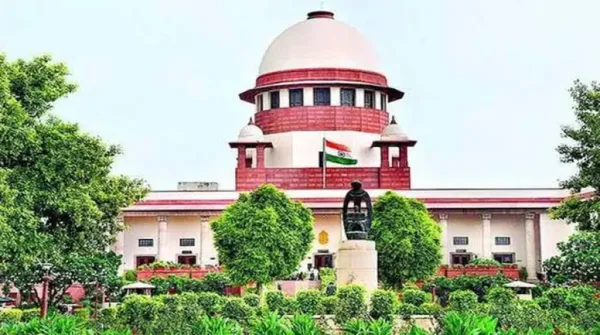
The Supreme Court on Thursday (August 13) raised serious questions over the hesitation of the Food Safety and Standards Authority of India (FSSAI) to put front-of-pack warning labels on packets of packaged food products containing excessive sugar, salt and saturated fat.
The court expressed strong displeasure over this lax attitude of the Central Government and FSSAI and directly asked whether the officials are working under the pressure of big corporate companies? After this, the Supreme Court took a strict stand and said bluntly – “If you can't do it, we will.”
A bench of Justices JB Pardiwala and K Vinod Chandran came down heavily on FSSAI while hearing a PIL. The top court said that this matter is to the health of the citizens of the country, especially the rapidly growing children. Therefore, decisions to this should not be influenced by the pressure of any corporate house. The petitioner drew the court's attention to the fact that the food safety watchdog itself seems to be against the idea of imposing such warning labels, whereas the court had earlier directed FSSAI to consider imposing such labels in the interest of public health.
Why is FSSAI hesitating in implementing warning labels?
During the hearing, when the court referred to the minutes of the FSSAI meeting, it took very seriously the fact that the organization was avoiding implementing such a strict rule. Presenting the minutes of the FSSAI meeting held on March 7, the petitioner's lawyer said that the decisions taken in it were completely contrary to the old instructions of the Supreme Court.
There is continuous opposition from the food industry to putting warning labels on food packets. Citing this protest, FSSAI has suggested giving information about daily requirement of sugar, saturated fat and salt in just one table instead of giving warning on the front of the packet.
Is the government succumbing to the pressure of the corporate lobby?
The fact was also placed before the court that FSSAI's affidavit only mentioned the opposition of the food industry, but completely ignored the concrete evidence submitted by civil society representatives which proved that the imposition of warning labels could reduce the consumption of foods high in fat, sugar and salt.
On this, the bench asked a sharp question to FSSAI whether it is bowing before the big corporate companies involved in food manufacturing?
'Are you fooling the court?'- Sharp comment from the Supreme Court
The bench asked in a very harsh tone, “Are you fooling the court? There is a lot of pressure on you from all these corporate houses and you are succumbing to that pressure! We are doing all this in public interest, mind you. We are not doing this for ourselves. Why are you not following our order? What concrete steps have you taken so far? We understand very well the pressure on you. Will you implement it yourself or will we have to pass a strict order?”
The court was also not impressed by FSSAI's argument that if such warning labels were made mandatory, then many food items like traditional namkeens of India would also be labeled as being high in fat, sugar or salt. On this the judges directly asked, “Don’t you want the people of this country, especially the growing children, to be healthy?”
Is the government ready to take necessary action?
The bench asked direct questions to Additional Solicitor General (ASG) Brijendra Chahar, appearing for the central government. The court asked him whether the government is not ready to take necessary action in this direction? Along with this, the judges reiterated that the court order is absolutely clear.
During the hearing, ASG Brijendra Chahar requested the Supreme Court to allow him to explain in detail about the government's action plan. However, the court made it clear that the government will have to take only those steps as directed by the court. The bench gave a warning and reiterated in the end – “If you cannot do this, we will issue orders.”
-
BRS performed black magic to defame Congress: CM Revanth

-
‘Time For Manan Mishra To Resign?’: Abhijeet Dipke Targets BCI Chief Over NALSAR Row

-
Galatasaray turn down huge €130m Al-Hilal offer for Victor Osimhen and make it clear striker will not be sold this summer

-
Enzo Maresca picks Premier League star as ‘dream’ replacement for Rodri as Manchester City plan for life after the Spanish midfielder

-
The Legend of Maula Jatt’ bags two honours in China